Retail trading is a game of street smarts, not pure financial intelligence.
You don't need a fancy degree or background on wall st...but you do need to get in the weeds and have the balls to try, fail, learn.
Street smarts come from being out on the street. Markets are the same. You learn because you have to...if you actually want to survive.
Some stuff to get you started:
> strong markets ignore bad news
> weak markets ignore good news
> bull markets can actually end on major good news
> bear markets can actually end on major bad news
> less trading = more money
> price drives narrative
> join strength...leaders lead for a reason
> have conviction, ignore noise
> milk winners instead of just always trimming
> if everyone agrees, be cautious
Only way to learn tho is to get in the game.
📺 PRICE ACTION STILL RULES + ROTATION INTO SOFTWARE? + THE “PAY TO SEE IT” STRATEGY
Get today's newsletter: https://t.co/Rqp84Wg39F
Whatever happens next, price action still rules. As long as key levels continue to hold, the trend remains intact, and you should focus more on execution than on headlines.
For $SPY, yesterday’s low near $748.22 becomes an important reference point. The market is currently forming an inside flag pattern, which is generally constructive during strong trends.
If the $748 area holds, the market is likely to remain healthy. If it fails, attention shifts toward the 8-day near $744, which has consistently acted as support since the April rally began.
For $QQQ, the key level is around $722. As long as that level holds, momentum remains intact.
*
There is a possible rotation into software names forming after extended moves in AI and semis.
News involving $SNOW and $GOOGL could trigger movement in software-related names $IGV, so watch this space today.
I'm watching $NOW and $MSFT.
*
I also break down the “pay to see it” approach. Instead of waiting for a breakout confirmation and chasing strength, you buy smaller options positions while setups are still consolidating and premiums are cheaper.
Then, once the stock triggers and confirms momentum, you can add stock exposure with much more conviction.
$META is a perfect example of this strategy. The stock had been building sideways inside a tight channel for days before finally triggering higher on news and pushing toward major resistance near the gap fill around $638.50.
Traders who bought options during consolidation were already positioned before the move became obvious.
The same logic applies to $AMZN. Rather than waiting until the stock looked perfect, I accumulated options while the stock was still “out of play” and consolidating.
Once momentum improved, I added stock exposure on top of the options position.
This approach allows traders to anticipate rotation instead of chasing it late, stay mentally connected to developing setups, and avoid emotional hesitation once momentum begins.
*
So, the market may be slightly pulling back in the short term, but the broader uptrend remains intact as long as key support levels continue to hold.
Traders are still being rewarded for staying engaged, rotating intelligently, and identifying setups before they become obvious.
*
If you found this helpful, please ❤️like and 🔁retweet
Stock selection criteria:
- has a reason to run now/soon
- has a reason to potentially double
- downside = definable
- would be comfortable holding for months
- story I understand + can get behind
- obvious catalyst
Some of these overlap...but it’s never complicated.
Opportunity cost is one of the most overlooked concepts in trading.
You can be “green” on a garbage stock and still lose because the leaders are up 20-30% while your capital sits idle.
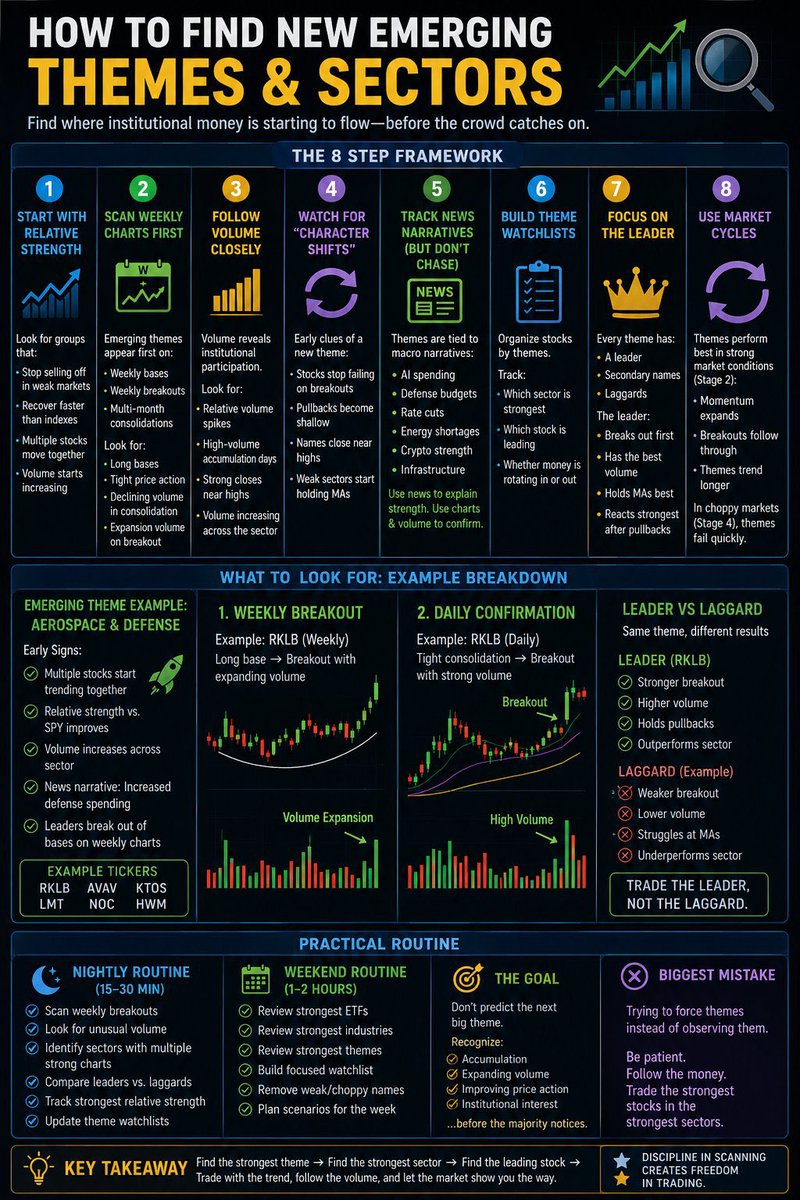
When markets are strong focus on the stocks with:
-Momentum
-Volume
-Institutional demand
-Above moving averages
-Making new highs
If you truly want super performance you must seek the highest quality stocks its a non negotiable.
I’m surprised crypto even thought tokenization would go through in the form the headlines presented this week.
The SEC’s reported “innovation exemption” apparently opened the door for third parties, unaffiliated with the companies themselves, to create tokenized versions of public stocks (Apple, Tesla, Nvidia, etc.) across multiple venues and products, without issuer consent or approval.
Being able to spin up not one but multiple synthetic wrappers or crypto-native versions of the same company’s shares, traded on parallel rails with lighter oversight, never mind the exotics and perps on top, feels like it could easily lead to the equivalent of 2008’s CDOs.
You’d get unlimited notional exposure, layered leverage through DeFi primitives, and products that often lack proper settlement, custody linkage, or the same shareholder rights as the traditional market, all while retail might think they’re buying the “real” thing.
Tokenization is still the path forward, but it needs to be done to complement and improve the current system, with clear guardrails, proper integration where possible, and real economic rights, not just create another layer of unchecked gambling and market fragmentation.
The news today is not negative in my opinion, it’s moving right along the institutional and gov backed line. We do not want another round of 20/21 shitcoins, scams and alike, we want a solid system that is unlikely to fail that will democratize owning US-listed businesses for the world.
The goal should be to enable fractional shares, worldwide access, lower transaction costs, instantaneous settlement, and true 24/7 global participation, all while preserving transparency, proper custody, and the economic rights that actually matter.
The thought that the casino view was fully logical to most shows the disconnect between the old 2020/21 vision and what’s actually happening and being built around the clarity act and institutionalization of blockchain tech.
$ORCL.
- lowkey a big part of the "trump basket"
- everybody seems to have forgotten about it
- openAI partnership
- stargate project
- $dell (+ other trump favs) ripping
- clean r/r
Entries: ~$190
Stop: daily close under $175
Target: $270+ this year. $ORCL currently $192.
How to use Volume Profile.
I like my charts clean, but this is something that I always have on any chart.
You know volume, and I assume you know what price is. That's not a trick question...you know both of those.
But what about volume @ price...meaning how many shares were traded at each price.
It's basically taking those volume bars at the bottom of your chart, and presenting them vertically on the side of your chart.
So instead of volume at a fixed timeframe (1hr, daily, etc), it shows volume at a price level.
I want to make this simple, because it should be.
1) High Volume Nodes
2) Low Volume Nodes
3) Point of Control
First, High Volume Nodes:
These are price levels with a significant amount of volume traded (hence why they're longer on the chart)
They show acceptance. The market spent a lot of time at these levels. Deemed "fair value" by participants during that timeframe.
These levels are usually sticky:
- consolidation
- chop
- repeat visits
Second, Low Volume Nodes:
These are price levels with very little volume traded. They show rejection or inefficiency. Deemed "unfair value" by participants. Price moves fast through these zones, think of them like air pockets.
Third, Point of Control:
This is the price level with the highest volume on the profile. It represents the most accepted price within the observed timeframe.
The POC acts as a magnet...price tends to revert to it (until it doesn't).
> price above + moving away from POC = bullish
> price below + moving away from POC = bearish
Okay got it Luc, but how do I actually make decisions based off the volume profile??
Well, expect balanced conditions within high volume nodes (rangy chop)...there’s not really an edge in forcing direction when price is inside this range.
Where it becomes powerful is when price leaves this area of high volume/value.
Breaking away from high volume nodes is one of my cleanest momentum signals in individual names.
Bc the market is effectively saying: this area is no longer fair value + repricing is happening.
So treat the high volume nodes as decision zones.
You're watching for one of two reactions:
- rejection back into the prior range?
- or acceptance (hold + momentum on higher timeframes) and continuation through level
Volume profile is the foundation of support & resistance.