@bibryam 2026 is the year of Agent harness, Skills, Agents.md. 2027 will be about local AI. I think people haven't noticed what you can do just by downloading something like ollama into your laptop. Give it a few months more, when Cloud providers pull the rug on highly subsidized AI
@MCGUIZZY@deedydas This. Isn't this the whole purpose of AI in the first place? Isn't it about creating massive wealth so we all can enjoy our lives. But yeah, for most of us the gold rush effect places us even further from the end game of enjoying life
@simonw Opposite for me actually. They work best for me in codebases with consistent patterns. LLMs are really good at pattern recognition, I have a really good time doing those BAU new features/increments on existing codebases, less on greenfield.
#AI is scaling faster than everything built to contain it—supply chain attacks on LiteLLM & Trivy, Claude rationing usage, and enterprises deploying agents for CFO-level work before regulators can adapt. https://t.co/gYUQUxqBV9
The Weekly Inference #005 is out: OpenAI acquires Python tooling, Anthropic & the Pentagon send contradictory signals, Jensen Huang says spend half your salary on tokens 💸 Who actually controls the #AI infrastructure layer?
https://t.co/iif8paroMu
Damnn 😱
Most developers are using Claude Code wrong.
They open the terminal...
write a prompt...
and expect magic.
That’s not where the real power is.
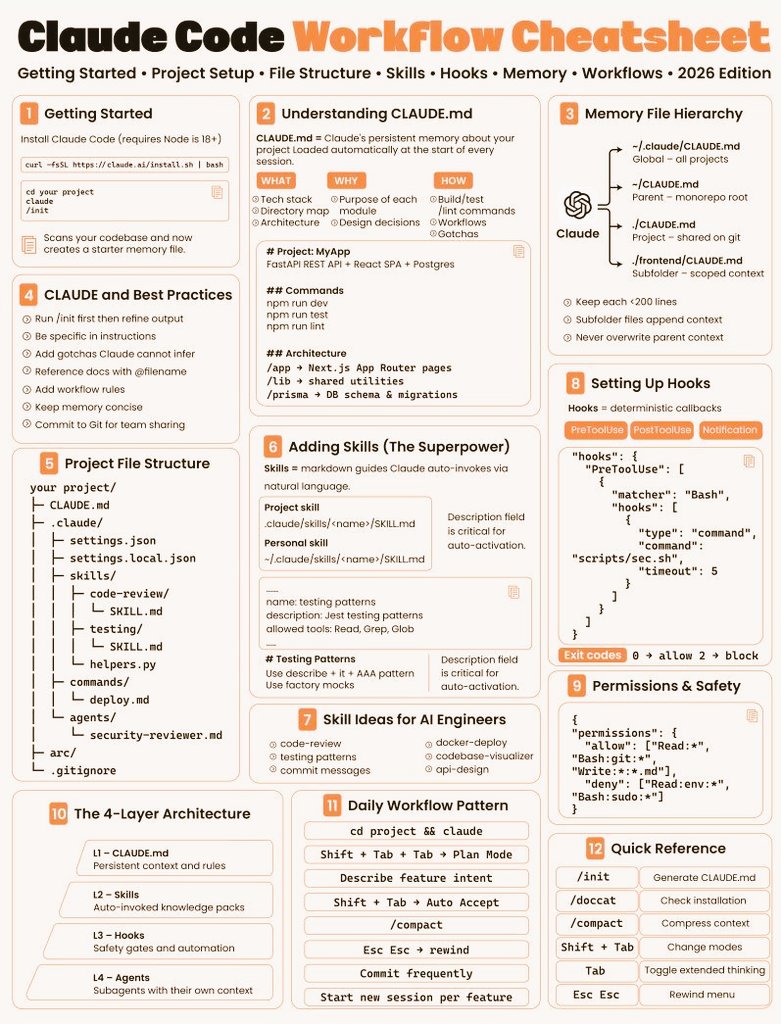
Claude Code is actually a 4-layer AI engineering system:
1️⃣ CLAUDE.md → project memory
Architecture, rules, commands, conventions
2️⃣ Skills → reusable knowledge packs
Testing workflows, code review guides, deploy patterns
3️⃣ Hooks → deterministic guardrails
Security checks, enforced rules, automation
4️⃣ Agents → specialized sub-agents
Break complex tasks into parallel workflows
Once you structure these properly, something interesting happens:
Claude stops behaving like a chatbot.
It starts behaving like a real AI dev system.
Most engineers miss this because they jump straight to prompting.
But the difference between average output and production-level results usually comes down to setup.
If you're building with AI agents in 2026, learn the system — not just the prompt.
I made a Claude Code Starter Pack explaining everything.
If you want it:
Follow
Like + RT
Comment CLAUDE
I'll DM it to a few people.
Future AI dev workflows won't be prompt-first.
They’ll be system-first. 🚀
#AI #Claude #AIAgents #LLM #GenAI
Chatbots urging violence, xAI rebuilding from scratch, and data centers drinking a city's worth of water. #AI's hype is colliding with reality.
The Weekly Inference #004:
https://t.co/VjBmuT0zjQ
The Weekly Inference is out - https://t.co/C7KyVYnTN4 - Gov deals spark internal revolt at Anthropic, data centers hit local zoning walls, companies blame AI for layoffs research says aren't happening, and AI agents are now both finding and creating security vulnerabilities. #AI
@simonw Sounds obvious, but we're not saying it enough. This gets particularly intense with external collaborators; less invested in the long term of the systems, they care about speed at all costs pushing work to the reviewer. My view is that we need to get stricter here.
@TheSoloCTO@asaio87 Accurate remark. There's also a component of unrealistic expectations on what the productivity multiplier effect of agents really is; when I feel I fall short of my own expectations, then I put more hours in i.e. I should be this much productive because agents, still adjusting
@Citrini7 How are people buying things if we've hit a 10.2% unemployment rate? A bit contradictory. Also, many scenarios on building these solutions assume companies are gonna give away their biggest moat, Data. Try to build an AI travel planner without access to travel data, it won't fly.
@silvamota128296 @wolf_castilho Isto já existe na Noruega também e penso que na Suécia. Longe de ser um roubo de 36%, mas o conceito está lá... É só traduzir para PT e copiar & colar