The data science revolution is getting closer. TabPFN v2 is published in Nature: https://t.co/Ybb15pnZ5P On tabular classification with up to 10k data points & 500 features, in 2.8s TabPFN on average outperforms all other methods, even when tuning them for up to 4 hours🧵1/19
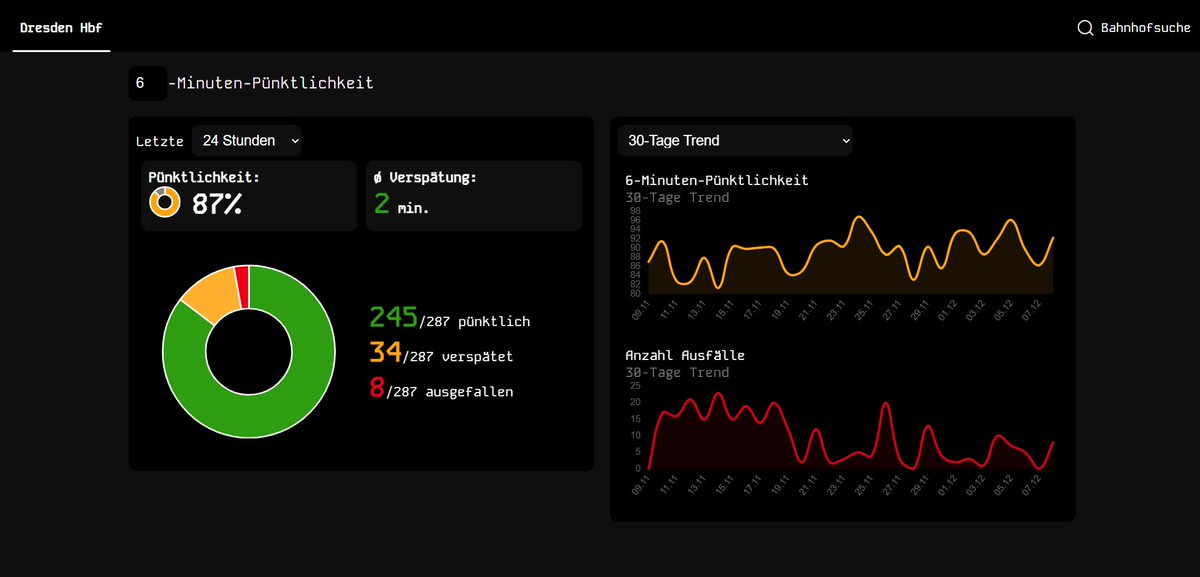
Wie pünktlich ist die Bahn wirklich?
Das wollen @martiinhier und ich herausfinden, und deshalb haben wir vor einigen Wochen begonnen riesige 📈Datensätze für unsere eigene Statistik zu füllen.
Das erste 🚀 Feature steht bereits:
Ihr könnt nun jeden beliebigen Bahnhof tracken 👇
An unforgettable night at the #ACII2024 banquet! 🎉 Delicious food, lively ceilidh dancing, and great company—everyone was having an amazing time celebrating together. 🍽️💃 The energy in the room was electric! #ACII2024Banquet
@Grady_Booch Normally I’m on board with you. But I don’t get your take here. A generative film is not the same as a film made with Generative AI. They specifically mention they are not using generative AI approaches in the recent sense of the term.
It's amazing to me that the year is 2024 and some people still equate task-specific skill and intelligence. There is *no* specific task that cannot be solved *without* intelligence -- all you need a sufficiently complete description of the task (removing all test-time novelty and uncertainty), and you can achieve arbitrary levels of skills while entirely by-passing the problem of intelligence. In the limit, even a simple hashtable can be superhuman at anything.
OpenAI goal is to build a world simulator - that learns the dynamics of the 3D real world - from videos & language descriptions.
They claim the work indicates that training on ever larger datasets is a promising direction for learning such world models.
But they are wrong:
Have you ever done a dense grid search over neural network hyperparameters? Like a *really dense* grid search? It looks like this (!!). Blueish colors correspond to hyperparameters for which training converges, redish colors to hyperparameters for which training diverges.
Excited to announce that my new research group, Human-Centered & Explainable AI, is starting in the new year at @CITEC_Bielefeld. This means I have a fully funded #PhD position to study the effect of #xai in AI-assisted decision-making. If interested 👉 https://t.co/NBxCafbVGz
The #OpenAI soap-opera hijacked the attention of millions of productive people and nonsensually crammed the fine details of the debate between #EffectiveAltruism and #EffectiveAccelerationism into them, a genuinely absurd debate that was allegedly at the center of the drama.
1/
📣 Postdocs and advanced researchers: come to Bayreuth with a Junior or Senior #Fellowship or Short Term Grant from the @unibt Centre of International Excellence “Alexander von Humboldt”! 📅 Apply here until 27 October or 4 November 👉🏼 https://t.co/jm32s9fb5Y #FundingFriday
Licht ins Dunkel bringen mit Social-Online-Daten.💡
@HDrimalla und Team @tf_unibielefeld forschen an digitalen Methoden, um den Zusammenhang zwischen sozialen Interaktionen und mentaler Gesundheit besser zu verstehen. ☝️Hier geht es zur Studienteilnahme: https://t.co/aVzrATNWaX
We not only find that participants (N=271) using SHAP and BertSum were *significantly worse* than the control setting, where users are shown no additional info, but we also found that participants were overconfident in estimating the helpfulness of the assistive information!
My most highly cited research is a paper that uses causal models to give a mathematically precise definition for non-discrimination of computer algorithms
For years, I've given talks about it using the US Supreme Court as an example... 🧵
Despite strong calls for Explainable AI in the area of #affectivecomputing, its use is still in its infancy. In our new review @HDrimalla, Olya Hakobyan and I point to a limited variety of #xai methods and lack of evaluation. Check out our recommendations👉https://t.co/yKj9xfZbsG