Today we're announcing that Modal has crossed $1B in annualized run rate, as well as raised a $750M Series D at a $15.75B valuation, led by @Accel.
Since our Series C, usage has tripled and we’ve grown more than 15x year-over-year.
We are deeply grateful to the developers and companies building on Modal. There's still so much more to build, and we can't think of a better time to be building software.
Training large models with RL typically runs on a fixed homogeneous cluster of the latest accelerators for numerical stability and faster throughput. This throws away inference optimization work done for other vendors and generations, limits the capacity you can utilize, and is unnecessarily expensive.
So we trained a model on agentic coding tasks using fully asynchronous RL and mixed-precision, mixed-accelerator samplers. With off-policy correction, training stayed stable through convergence, on par with homogeneous samplers, at a lower cost.
DFlash: Keep Drafting Parallel
My talk at @modal Runtime in SF on Oct 1. The drafter was the serial bottleneck, so DFlash made it parallel. That moved the bottleneck to selection, so DFlash 2 fixed that.
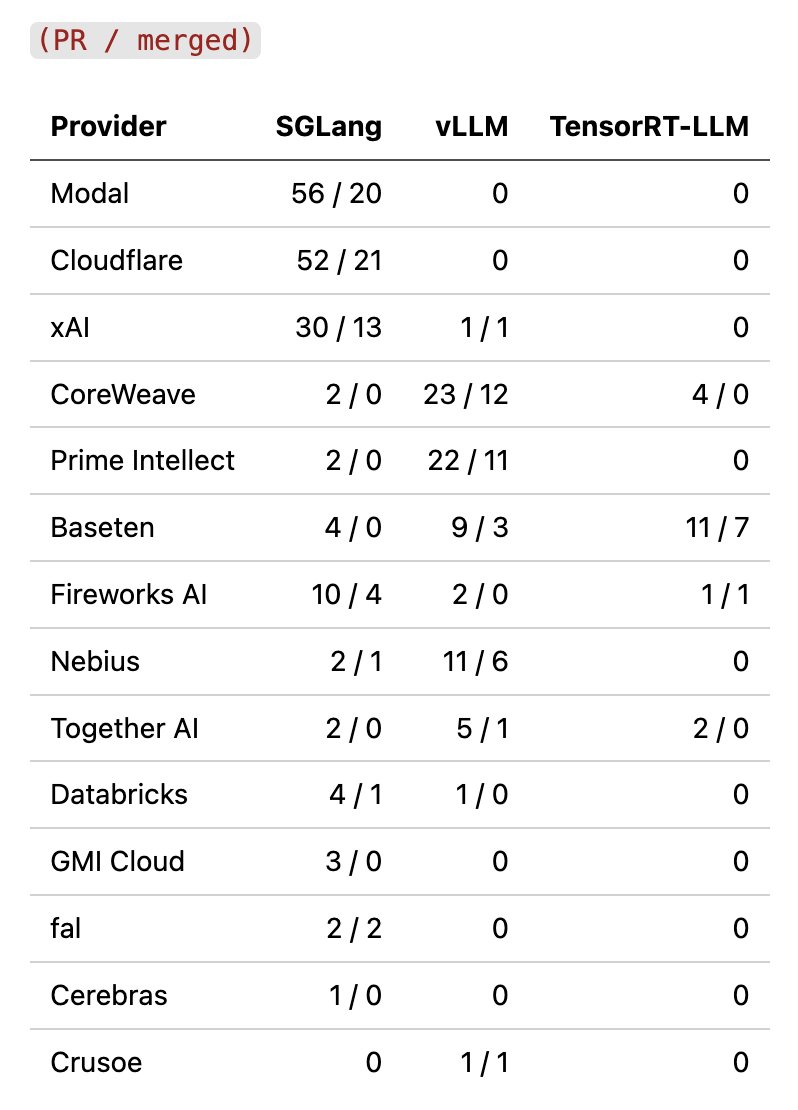
which of your favorite token brokers are contributing back to open source ai? shall we count the ways?
a slice of data: number of PRs upstreamed and merged into the most popular oss inference engines, by PR contributor org
DFlash 2 is here! Qwen3.8-27B at 70 tok/s on an M5 Max MacBook Pro.
⚡ Up to 4.6× the speed of autoregressive decoding, with the same output.
This is the next generation of DFlash, seeded at Z Lab and upgraded at Inco AI. Get one more accepted token on every pass, for free!
https://t.co/We0lwYPSBl