Indian Army on Friday announced the raising of a dedicated battalion for drone operations along the western front with Pakistan.
Link 👇
https://t.co/1kBqzW3lnH
New Delhi
> Vinay Gupta got married to Rekha Gupta 3 years ago.
> They had twin boy and girl.
> He was 31 and worked at Adobe with a 60 lakh package.
> They had an argument about giving medicine to their child.
> Rekha left the house and returned with her family members.
> They assaulted Vinay.
> Vinay's mother was outside to fetch water.
> When she returned, she begged them to stop beating her son.
> After the assault, his neighbour carried him to the hospital.
> Doctors declared him dead.
> Police have arrested Rekha, her two brothers, and sister-in-law.
A young man's life was taken by his wife and her family.
Will she and her family face any punishment?
Was honoured to speak at the @business_today India@100 Conclave earlier today.
'Can India 5X Its Space Economy? Deep Tech Founders On The Road To 2047'
https://t.co/1M9q9BDkM7
Air power baby!
Who killed the Kaveri?
Truth about the Tejas Mk1A mess.
Where is the LCA Mk2 really at?
@zone5aviation is our guest on a banger of a #CtrlAltDefence 🎙️ episode that drops this evening.
While you wait, our pod playlist: https://t.co/TlD5J5i3FZ
Pakistan’s National Assembly and Senate have passed the Defence Forces Act 2026 and amended the National Command Authority Act 2010, formalising sweeping powers for Chief of Defence Forces Asim Munir.
CDF now holds statutory authority over personnel matters (hire/retire/discharge), commands the Army directly, exercises operational command over Navy and Air Force, and sits as senior military adviser on nuclear command.
Defence Forces HQ becomes the apex command centre. Laws apply retrospectively from Nov 13 (Defence Forces Act) and Nov 27, 2025 (NCA amendment). Opposition walked out in protest over limited scrutiny time.
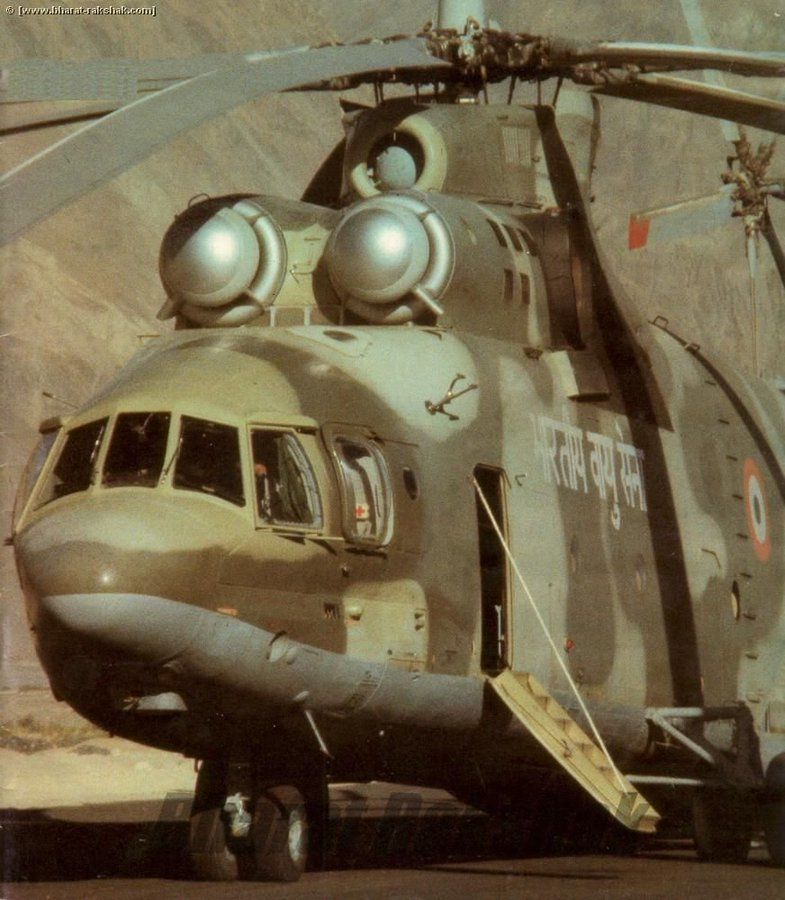
My rants on Kargil would be incomplete without the Mi-26, and particularly without one extraordinary sortie flown on the night of 26 May 1999. The air campaign was only hours old.
By that evening, Srinagar faced a shortage of the 57 mm rockets required by its armed Mi-17s. Replacement stocks were available at Adampur and Pathankot, but they had to be moved into the Kashmir Valley without delay.
The task fell to No. 126 Helicopter Flight at Chandigarh, then operating the IAF’s only heavy-lift helicopter. On paper, the Flight had four Mi-26s. In practice, it had only one aircraft available.
Two Mi-26s were aircraft on ground. A third had gone to Russia for a major overhaul, with three members of the crew also away. The available flying establishment was equally thin.
Squadron Leader Jang Veer Singh Guron was qualified for operations on the Mi-26 by day, but was not current for night flying. Another pilot was new to the unit and had completed only his day conversion. The incoming Commanding Officer was not current on type. The available flight engineer had only recently completed his initial training, while the electronic operator had limited experience on the aircraft.
Guron himself had been on leave in Lucknow when Group Captain H.P.S. Natt, then at Western Air Command, called and instructed him to return immediately. He reported at Chandigarh barely two or three days before Operation Safed Sagar began.
Nor was the Flight’s sole available Mi-26 fully healthy. The helicopter had separate transducers for indicating the main-rotor RPM and the high-pressure compressor RPM. Two were required. Only one was serviceable.
This meant that, during a sortie, the crew could monitor one of the two parameters, but not both. It was a deficiency they had agreed to operate with. The transport fleet was already heavily committed, and there were loads for which no lighter helicopter was an adequate substitute.
On 26 May, Guron returned to Chandigarh and then routed through Adampur and Pathankot to collect the rockets. He reached Pathankot at approximately 1400 hours.
Loading ammunition into the cavernous hold of the Mi-26 was a slow process. By the time the load had been secured and the helicopter was ready to depart, daylight had gone. The aircraft was also loaded beyond its rated capacity.
The situation confronting Guron was therefore stark. He was to fly an overloaded Mi-26 into the Kashmir Valley at night, without being current for night operations, in an aircraft in which one of the two vital RPM indications could not be monitored.
Group Captain Natt gave him the clearance to proceed. The normal helicopter route towards Srinagar wound through the valleys. It was also considerably longer. With the aircraft carrying an excessive load, fuel had become the governing consideration.
The alternative was a direct route across the mountains and over the Banihal Pass. It saved distance and fuel, but exchanged the relative security of the valley route for a high crossing of Banihal in darkness.
The expression “dark night” has a specific meaning in military aviation. A night with less than a quarter moon is classified as a dark night. The weather on 26 May was clear, but there was little natural illumination.
Guron chose the direct route.
The heavily laden Mi-26 climbed towards Banihal and crossed the pass in the darkness. On the outward flight, the high-pressure compressor RPM indication was unavailable. The crew continued across the mountains and brought the aircraft into Srinagar late that night. The 57 mm rockets had arrived. During the return flight, the main-rotor RPM gauge also failed.
Later, the Mi-26 carried a 14-tonne BEML tractor whose dimensions almost matched the helicopter’s loading ramp. With the aircraft overheating and responding poorly in the valleys, Guron executed a roller landing at Udhampur to bring it down without striking the tail rotor.
It transported a P-18/19 surveillance radar underslung into Kargil, despite the unit having little experience of such an operation at those altitudes.
On another mission, two Army trucks filled with communications equipment were driven directly into the Mi-26 at Palam and flown north. A delay on the ground consumed precious fuel, and the warning came on fifteen minutes short of Chandigarh. The aircraft landed, refuelled and continued to Srinagar that evening.
After approximately thirty hours of intense flying, the Mi-26 itself became unserviceable.
The sortie over Banihal remained exceptional even within that remarkable sequence. Guron received an AOC-in-C Commendation.
The fighters and armed helicopters naturally dominate accounts of Operation Safed Sagar. But their effort rested upon a much larger machinery of ammunition, fuel, radars, communications equipment and engineer plant being moved forward, often at the edge of what the available aircraft and crews could manage.
Late on 26 May 1999, the IAF’s only available Mi-26 crossed Banihal in darkness carrying an overloaded consignment of 57 mm rockets.
It fired none of them. Its task was to ensure that the helicopters at Srinagar still could. That is why the Mi-26 belongs in the Kargil story.
#IAFHistory @IAF_MCC
@max_matrix1@airtelindia Make a complaint here:
https://t.co/rN1wj87N7p
I am facing problems with airtel postpaid connections, family plan and their service is pretty much unusable!
Reupping the quote I keep saying: “The life of security forces is like that of goalkeepers, only the misses are counted.”
Let’s change the trend.
Let’s remember, acknowledge and celebrate the saves too. 🇮🇳
NO WONDER WHY THE WORLD MOCKS US
I MEAN JUST TO PROVE A POINT YE GADHE ITNA GIR JAYENGE AB!!
AT LEAST THINK OF THE BRAVEHEART THAT SACRIFICED HIS LIFE,YOU MORON!