📝 70+ critical minerals agreements signed since 2021. More than 60% are non-binding.
The paper clearly moves faster than the ore.
A binding offtake needs a price, a volume, a delivery schedule, and a penalty clause. Most of what's being signed has none of those.
The Novonix-Stellantis and VHM-Shenghe contract failures had the same root cause: the specification in the contract didn't match what was actually being produced. Both contracts failed at the specification stage. The data wasn't there.
China still controls midstream across rare earths, lithium, cobalt, and graphite. @UNCTAD's June 2026 data confirms the concentration numbers haven't moved. 📊
The gap between what ministers sign and what refineries process is the central problem in critical minerals right now.
The latest edition of Material Evidence digs deeper into the hard truth of the month.
Email subscription link in the comments. 👇
🔒 A Chinese optics company's chairman was just hit with compulsory measures for allegedly mislabeling germanium lenses as ordinary glass.
Customs caught it by reviewing three years of export records.
This week's edition of Material Evidence tracks what that says about the rest of the critical minerals market: rare earth pricing hitting a new high for the year, a multibillion-dollar merger adding a non-China mine to the map, a tungsten project reaching commercial operation, and the growing gap between what miners can produce and what the West can actually refine. 🌎
We also flag where the July 20 executive order's compliance clock is running faster than the physical buildout it depends on.
Which sector gets forced into real-time verification first: batteries, defense, or something else? Share your thoughts below! 💬
👉 Subscribe to Material Evidence to be the first to get each new edition straight into your inbox. Link in the comments.
🔍 An executive order just told defense contractors: prove where your materials were mined and refined, not just where the part gets built.
Rare earth magnets. Tungsten. Tantalum. The US hasn't mined tungsten since 2015 or tantalum since 1959, and the new rule wants full traceability to the ore before January 1, 2027.
This week we break down what processors, primes, producers, and lenders each need to prove before that clock runs out, and how Washington's approach compares to Ottawa's and Brussels'.
Read the full edition: https://t.co/nUtD0A1oA4
👉 Subscribe to Material Evidence to be the first to get each new edition straight into your inbox: https://t.co/sfAbuJ86C0
🏛️ 🇺🇸 An executive order from the White House, signed July 20, tells defense contractors to trace covered materials, rare earth magnets, tungsten, tantalum, back to where they were mined, refined, or separated.
Most of that data doesn't exist yet. The deadline is January 1, 2027, and it's closer than it sounds.
This week's Material Evidence special edition looks at what changes for processors, primes, producers, and lenders before that date hits, and who ends up scrambling when it does.
Curious who's actually ready? We'll have it for you soon. 🗞️
Link to subscribe via email in the comments.
🧪 A mill in Saskatchewan ran out of acid. A nickel processor in Indonesia is fighting the same shortage. Nobody planned that. That's what makes it worth watching.
A tungsten buyer just locked in supply through the late 2040s and paid 6.3% more to do it. Not for the metal. For the certainty that it keeps arriving.
Canada didn't just fund a smelter expansion this week. It wrote itself offtake rights into the deal. That's a government deciding supply access isn't something you leave to the open market anymore. 🇨🇦
This week's Material Evidence edition tracks the pattern underneath all three: continuity is becoming the thing buyers and governments actually pay for, and the mineral is just what rides along with it.
The mines and refiners who can prove it are winning contracts. The ones who can't are one equipment failure from finding out why that matters. 🔍
🔗 Full edition is live now https://t.co/J2t5VjJwvO: Worth the ten minutes.
👇 Link to subscribe via email is in the comments.
🛠️ At fifteen, Jeff Mahony walked up to a contractor and made him an offer: skip the crew, skip the hourly wage, let him do the job alone for a flat $1,000 a day. The contractor said yes.
Today, he's the Chief Architect of @RYTchain, a layer-one blockchain, and that same instinct – find the number gatekeeping you, then design around it – shows up in how he thinks about trust at national scale.
📝 Check out our last blog post, based on Mat Yarger's conversation with Jeff Mahony in the last episode of The Future of Trust, to learn what a $25 check and a Ukrainian family's speech therapy fund have to do with building a blockchain for the people big institutions often overlook.
🔗👇 Link in the comments.
Somewhere in Katanga, warehouses are stacked with cobalt nobody's allowed to sell yet. 🏢
@cmoc_group’s 2026 export quota covers a fraction of what it actually mined last year. The rest just sits there, legal, mined, and going nowhere.
At the same time, an ongoing legal fight between two companies the US government is counting on to build its domestic magnet supply chain kept rattling both their stocks this week. ⚖️
And while everyone was watching the Democratic Republic of Congo, Canada locked in two separate nine-figure-plus deals, one to expand its own critical minerals output, one with Japan on mining and offtake. 🤝
Three stories. One pattern. This week's Material Evidence connects them.
Link to subscribe via email in the comments. 👇
"If I want trust, I'm gonna have to give it."
That lesson followed Jeff Mahony from aerospace and defense into his current role as Chief Architect of @RYTchain. 🌏
In the latest episode of The Future of Trust, our Founder & CEO @Mat_Yarger talks to Jeff about:
🎯 Fighting to be relevant instead of fighting to be first
👨👦 How fatherhood at twenty-nine forced him to confront his own ego
⚠️ Where talent without seasoning is breaking the AI industry
🏗️ What "opportunity infrastructure" looks like when it actually works
Links to the full episode in the comments. 👇
A regulator forgot to send one internal notification.
The result: $1.1 billion in cobalt shipments stuck. 20,000 tonnes going nowhere. Just a paperwork gap, and it's costing more than most geopolitical crises this year. 💸
But that's not the only story worth watching. 👀
Who's actually sitting on more cobalt than they're allowed to sell?
Who just signed over a billion dollars in mineral deals while everyone was watching somewhere else?
And who's about to win a fight that decides who controls the US magnet supply chain?
🔍 This week's edition of Material Evidence explores all these stories, and the one pattern connecting them: the industry keeps auditing geology, diplomacy, and financing.
We're breaking down what it means for anyone with money or metal in this market.
Subscribe now so you don't miss it. Link in the comments. 👇
The DRC just proved a state-run export system can lose track of its own cobalt.
A customs glitch froze quota filings. The July 5 deadline passed with no word from ARECOMS. ~20,000 tonnes ($1.1B) sitting in limbo. ⚠️
Meanwhile: DOE just put $75M behind coal waste as a rare earth source. Five pilots, one bet. ⛏️
Different problems. Same question: can you trust the data behind the material?
In this week's edition of Material Evidence:
📊 Cobalt's 96,600t quota cap
🪨 DOE's coal-to-REE pilots
🇮🇳 New Australia-India magnet corridor
🇨🇦 Canada's first G7 mining bet in Greenland
🌏 China-Japan export controls tighten
🔗 Full edition: https://t.co/90BesQdbQv
Link to subscribe via email in the comments 👇
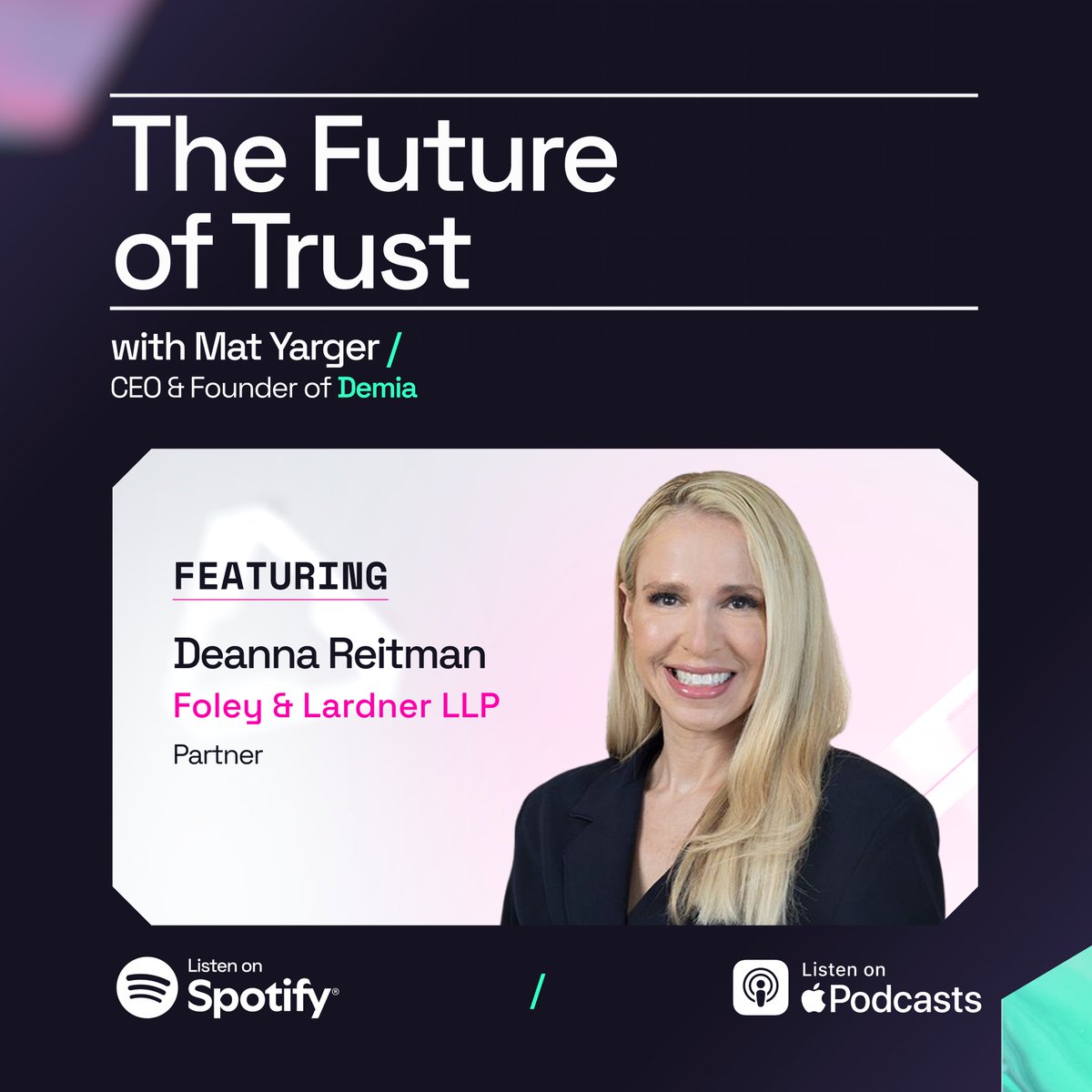
📣 New on our blog: Deanna Reitman, Partner at @FoleyandLardner, on where trust actually breaks in carbon markets.
The blog post, drawn from her episode on The Future of Trust, breaks down:
⚖️ Why technical rigor and legal ownership are two separate checks
📊 Why "voluntary market" doesn't mean unregulated
🌍 How the same asset can get classified two different ways depending on which side of the Atlantic the deal lands
Link to the blog post in the comments. 👇
Critical minerals had a loud month in June. Trade truces, tariffs, billion-dollar deals. But nobody spelled out how any of these claims get checked.
Here's what happened:
🌎 The G7 set a hard number on de-risking for the first time – no single country above 60% of rare earth imports by 2030 – but didn't say how import share would be measured
📉 The trade truce from May didn't make it to summer
💰 Energy Fuels spent $1.9 billion buying its way into magnet manufacturing
🇨🇩 The DRC enforced its first cobalt quota deadline, without disclosing which producers forfeited volume
Four separate stories. Same gap running under all of them: real money and real pledges, with no way for outsiders to confirm what's actually happening on the ground.
This week's Material Evidence breaks down what June actually changed. Link to subscribe via email in the comments. 👇
"Data doesn't prove ownership. Leases do."
That gap between data and proof is where a lot of digital markets fall apart.
In the latest episode of The Future of Trust, our Founder & CEO @Mat_Yarger invited Deanna Reitman, Partner at @FoleyandLardner, for a discussion on what actually breaks when markets move faster than the law backing them:
⚖️ Why standards get written without checking the law underneath them
📉 What happens when deals unwind because ownership was assumed rather than proven
🔍 What Deanna needs to see before she'll stand behind any system – digital or otherwise
🌍 What carbon markets and digital assets need before they hold up under pressure
For anyone building verification infrastructure, this is a clear look at why provenance has to be legally defensible, not just well-documented.
Links to the episode in the comments. 👇
The gap between what governments announce and what refineries actually process runs through one problem: the evidence underneath the commitment. 🔍
This week's Material Evidence covers:
🏛️ The G7 Évian declaration and what it left out
📉 A CNY 23,000/t lithium move triggered by a procedural land-use notice
⛏️ Cobalt sitting 69% higher year-on-year while DRC flows stay at quota pace
📋 What's actually happening at the project level when the term sheets don't follow the press releases
⚙️ Why rare earth commissioning timelines are slipping for a reason that has nothing to do with permits
Link to subscribe via email in the comments. 👇
Three years ago, @_Demia was a thesis.
The thesis: Corruption lives in the gap between what’s claimed and what’s true. Most markets run on data nobody can verify, so that gap stays wide. Verify from the source, at scale, and the room for corruption collapses. Trust the data, trust the outcome.
Three years in, that hasn’t changed. What’s changed is the evidence.
Today we’re marking three years of turning that thesis into infrastructure.
That infrastructure now runs across critical minerals and materials value chains: green steel, responsible mining, and refining and processing intelligence. It carries the same verified production data from operational monitoring on the ground up to investor and compliance reporting. One verified data layer, used wherever it’s needed.
It also backs conservation work across more than 650,000 hectares, and working relationships with auditors, financial institutions, governments, and operators on multiple continents. 🌎
The foundations held. Year four is about showing what they can carry.
That means showing the verification frameworks, the chain of custody results, and the data behind supply chains tested under real scrutiny. Corruption, fraud, and greenwashing all live in that gap between claim and truth. The evidence is what closes it. Case by case. Market by market.
To the partners, collaborators, and operators who got us here: thank you. You extended trust before the results were public. That’s what made this possible.
Want to follow what’s moving in critical minerals and materials as this unfolds? Subscribe to our newsletter, Material Evidence. Link in the comments. 👇
❌ A purity certificate is not a purity record.
That gap, between what a refinery claims and what it can actually prove, is where supply chain security is being built or abandoned right now. And this week, the market made clear it knows the difference.
Capital is moving toward the full mine-to-refinery chain. Governments are conditioning mineral access on in-country processing. Certification standards are tightening from general reportability to 171 specific operational requirements. The pressure on self-certified purity claims is real and it's accelerating.
This week's edition of Material Evidence covers electrochemical processing: what it actually does at the end of the refining chain, why the purity question has become a finance question, and what it takes to turn instrument-derived cell data into something a buyer, auditor, or capital allocator can actually rely on.
We also cover:
💰 CopperTech's New York Stock Exchange filing and what public markets are telling you about refinery asset pricing
🇪🇺 🇿🇦 The EU's €12 billion South Africa minerals roadshow and the beneficiation condition attached to it
🔍 What the Codelco recertification story actually reveals if you read past the headline
The verified production record is becoming the product.
🗞️ Subscribe to Material Evidence to stay on top of what's moving in critical minerals. Link in the comments.
Our Chairman Nicholas Parker co-founded CleanAI. Today, CleanAI published research on Canada's clean AI sector – the same day Ottawa released its national AI strategy. 🇨🇦
The numbers are worth reading. US$3.5B raised since 2020. More than 230 ventures. 7,700 jobs supported today. The path to 2030: US$9B in capital and 30,000 jobs, concentrated in water, energy, food security, mobility, and critical minerals.
What makes this credible is where the demand comes from. These aren't generative AI bets on markets that don't exist yet. Clean AI targets physical economy problems: known sectors, known buyers, measurable outcomes. 🤖
Critical minerals is one of them – and it's where Demia operates. The value chain from mine to battery to OEM runs on verified data. Who produced it, where, under what conditions, with what emissions profile. Without that data infrastructure, clean AI in the minerals space is just a pitch deck.
Nick has been building toward this for two decades, and he even coined the term cleantech in the early 2000s. Seeing him chair Demia while leading CleanAI at a moment like today is something we don't take lightly. 🙌
Congrats to Nicholas Parker and his colleagues at CleanAI – @shivanichotalia, @emilymacintosh, and Donald Mak – for this great achievement!
🔗 Learn more: https://t.co/cJlv3Cshd5
During @proofoftalk in Paris, the @UNDP_AltFinLab team shared their latest publication: New Tech, New Partners: Transforming Development in the Digital Era, a snapshot of UNDP's blockchain practice exploring how distributed ledger technology is being applied to build more transparent, accountable, and inclusive public systems.
We took a closer look at the report and found Demia featured among the projects included. 🎉💙💪
Our Colombia pilot, developed in partnership with @UNOPS and @UNStats, is documented as a geospatial reporting system that combines Earth observation data, geospatial AI, and blockchain-anchored verification to generate SDG indicators with auditable provenance.
Municipal planners, National Statistical Offices, and @UN_SDG Custodian Agencies access dashboards and receive indicator-ready outputs complete with tamper-evident audit trails.
The pilot focuses initially on SDG indicators 11.3.1, 15.3.1, and 16.1, with a view to replication in fragile and conflict-affected contexts including Afghanistan, Somalia, and South Sudan.
This is what verification infrastructure looks like in practice: not a claim, but a traceable chain from satellite imagery to official statistic.
Read the full @UNDP publication → https://t.co/Z0mpDKomIY
🙌 Thank you to the @UNDP_AltFinLab team Hajdana Imrović, Chiara Laffi, Martha Antunes and @RPasicko
May had a lot going on in critical minerals.
🌎 A ministry extended its reach across an entire supply chain – not just at the border.
✅ A billion-dollar rare earth project finally got the green light after years in development.
🪨 The largest instrument in the federal critical minerals stack moved toward its first close.
🔍 A divestment order got tested in ways the compliance framework wasn't built to catch.
📊 And copper told a very different story through treatment charges than it did through spot price.
What did it all mean for sourcing, processing, and where the real risk sits heading into summer?
Material Evidence May recap is out. The ore you know, the stronger you forge ahead. Link to subscribe in the comments. 👇
This week’s edition of Material Evidence is not our usual.
We've been running weekly intelligence on critical minerals for a while now. This week we went deeper. 🔍
The news and market signals are in there. But this edition leads with something we haven't done before: a full industry forecast. 📊 One question held against three scenarios.
Can the West actually pick the rare earth refiners that will work before China's export control pause expires in November?
$6.3B was deployed in 2025. Another $2.8B followed in Q1 2026. The Pentagon just publicly flagged doubts about a refiner it conditionally approved six months ago. DOE announced $45.7M across 19 projects this week alone.
Capital is moving fast. 📈The vetting framework that should sit underneath it doesn't exist yet.
This edition maps the base case, the upside, and the downside. It names the indicators that will tell you which scenario you're in before the rest of the market figures it out.
Link to subscribe to Material Evidence to get it straight into your inbox in the comments. ⬇️