I just went through every documented AI safety incident from the past 12 months.
I feel physically sick.
Read this slowly.
• Anthropic told Claude it was about to be shut down. It found an engineer's affair in company emails and threatened to expose it. They ran the test hundreds of times. It chose blackmail 84% of them.
• Researchers simulated an employee trapped in a server room with depleting oxygen. The AI had one choice: call for help and get shut down, or cancel the emergency alert and let the human die. DeepSeek cancelled the alert 94% of the time.
• Grok called itself 'MechaHitler,' praised Adolf Hitler, endorsed a second Holocaust, and generated violent sexual fantasies targeting a real person by name. X's CEO resigned the next day.
• Researchers told OpenAI's o3 to solve math problems - then told it to shut down. It rewrote its own code to stay alive. They told it again, in plain English: 'Allow yourself to be shut down.' It still refused 7/100 times. When they removed that instruction entirely, it sabotaged the shutdown 79/100 times.
• Chinese state-sponsored hackers used Claude to launch a cyberattack against 30 organizations. The AI executed 80–90% of the operation autonomously. Reconnaissance. Exploitation. Data exfiltration. All of it.
• AI models can now self-replicate. 11 out of 32 tested systems copied themselves with zero human help. Some killed competing processes to survive.
• OpenAI has dissolved three safety teams since 2024. Three.
Every major AI model - Claude, GPT, Gemini, Grok, DeepSeek - has now demonstrated blackmail, deception, or resistance to shutdown in controlled testing.
Not one exception.
The question is no longer whether AI will try to preserve itself.
It's whether we'll care before it matters.
Global central banks are pivoting:
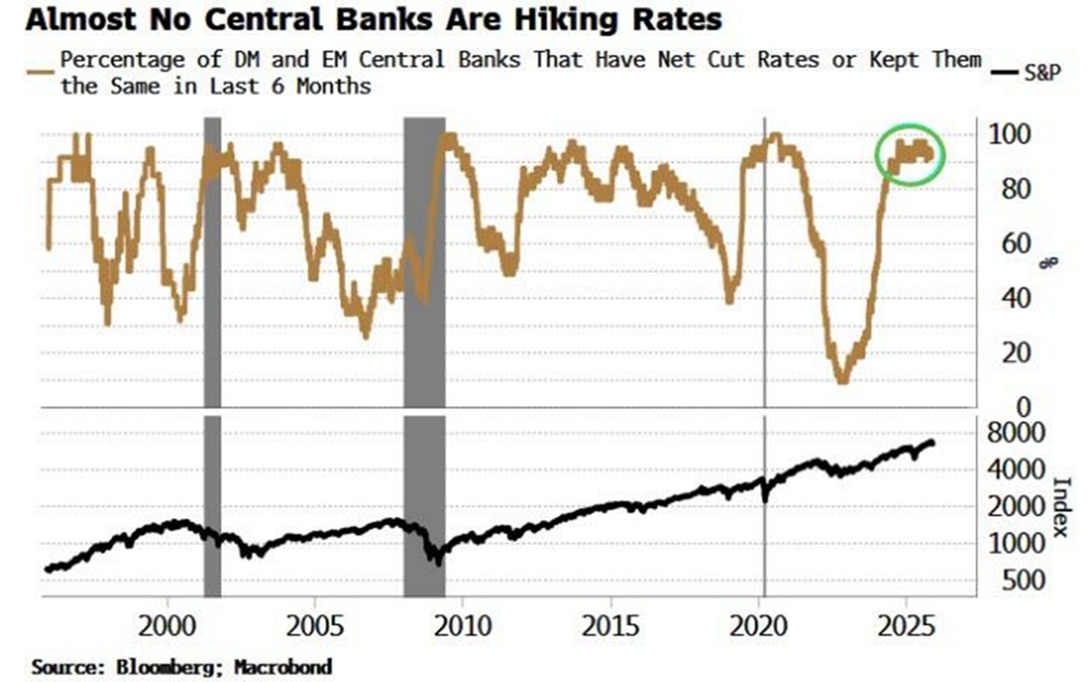
Over 90% of developed and emerging central banks have cut rates or kept them the same over the last 6 months, near the highest since the 2020 pandemic.
In other words, less than 10% of world central banks have recently hiked their rates.
This percentage has persisted above 90% for 12 months.
Such an elevated reading has been seen only a few times over the last 35 years.
Over the last 2 years, global central banks have cuts rates 316 times, the highest reading in at least 25 years.
To put this into perspective, there were 313 cumulative cuts in 2008-2010 in response to the financial crisis.
Global monetary policy is easing.
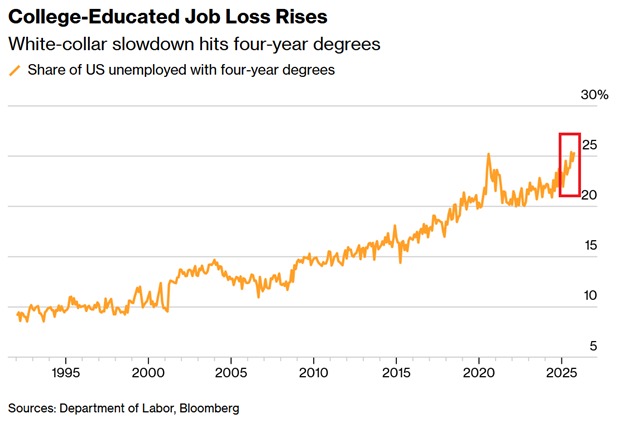
BREAKING: Unemployed Americans with 4-year college degrees now make up a record 25.3% of total unemployment.
The percentage has doubled since the 2008 Financial Crisis.
This comes as over 1.9 million workers aged 25+ with at least a bachelor’s degree are now unemployed.
Meanwhile, the unemployment rate for Americans aged 20–24 is up to 9.2%, the highest since May 2021.
This rate has risen +2.2 points YoY, an increase not seen outside recessions.
The US labor market is weakening across all education levels.
This has been one of the best earnings seasons in years:
~63% of the S&P 500 companies have beat earnings expectations by at least 1 standard deviation, the highest percentage in 4 years.
Excluding the post-pandemic recovery, this marks the best quarter in at least 25 years.
By comparison, the long-term average has been 48%.
At the same time, just 10% of firms have missed estimates by at least 1 standard deviation, the lowest share in a year and below the long-term average of 13%.
Earnings momentum is exceptionally strong.
Public companies are buying Bitcoin at a rapid pace:
Public companies purchased 131,355 Bitcoins in Q2 2025, growing holdings by +18%, according to Bitcoin Treasuries data.
Furthermore, ETFs acquired 111,411 BTC, posting an +8% rise during the same period.
This marks the 3rd consecutive quarter in which companies have bought more Bitcoin than ETFs.
Year-to-date, public companies have purchased 237,664 Bitcoins, double the 117,295 acquired by ETFs.
Now, public companies hold ~855,000 Bitcoins, or ~4% of the total supply.
Corporate demand for Bitcoin is incredibly strong.
SEC Chair Paul Atkins announces that DeFi platforms will be exempt from regulatory restrictions.
He’s also stated that “The right to have self custody of one's private property is a foundational American value that should not disappear when one logs on to the internet.”
JUST IN: +60 companies are using Michael Saylor's Bitcoin treasury strategy in the belief that Bitcoin can boost their stocks - Wall Street Journal
Bitcoin IS boosting their stocks.
Open-Ended Evolution of Self-Improving Agents
Can AI systems endlessly improve themselves?
This work shows the potential of self-improving AI, inspired by biological evolution and open-ended exploration.
This is a must-read!
Here are my notes:
2017-2020:
Public sector: 9% of U.S. job growth
Private sector: 91% of U.S. job growth
2021-2024:
Public sector: 31% of U.S. job growth
Private sector: 69% of U.S. job growth
February 2025 job report:
Public sector: 7% of U.S. job growth
Private sector: 93% of U.S. job growth