Great news! 🎉
ReviewsJet has officially joined the Webflow Marketplace! 🚀
No need to overspend for a review management tool that works perfectly with Webflow.
Read here 👇🏼
https://t.co/n2jH3X9MlV
🚀 Big News!
ReviewsJet is now on WordPress! 💪
Say goodbye to overpriced review plugins and hello to affordable, powerful review management.
Read here 👇🏼
https://t.co/CNZ3PvB8Mo
#WordPress#Reviews#SaaS
Boost sales with Amazon reviews on your e-commerce site! ⭐️
With ReviewsJet, you can:
✅ Import real reviews
✅ Showcase them beautifully
✅ Build trust & increase conversions
Learn how 👇🏽
https://t.co/ic40jHhlF3
#ecommerce #AmazonReviews #ecommerce #FridayVibes #Friday #FridayMotivation
Debugging Distroless Containers Like a Pro 🧵
When a containerized app starts acting up, "docker exec" is the most obvious choice for troubleshooting.
But what if there is no shell in the container image:
- Google's distroless
- Slim(med)
- Chainguard
- FROM scratch
- etc?
Give Away Alert!!
1. Artificial Intelligence
2. Machine Learning
3. Cloud Computing
4. Ethical Hacking
5. Data Analytics
6. AWS Certified
7. Data Science
8. BIG DATA
9. Python
10 MBA
For 24 Hours only!!
To get it: 1. Follow @Parul_Gautam7 (so I can DM)
2. Like & retweet
3. Reply "Send"
I'm trying to figure out a good encryption scheme for Playbit's workspace (virtual computer) state.
Conceptually each peer (a participant) communicates changes to a workspace directly with other peers that participate in the same workspace.
However in practice there is a limited centralized server which can perform tasks that are practically inconvenient to do completely decentralized, like user authentication (think: you lost your password/key; how can you get your stuff back?)
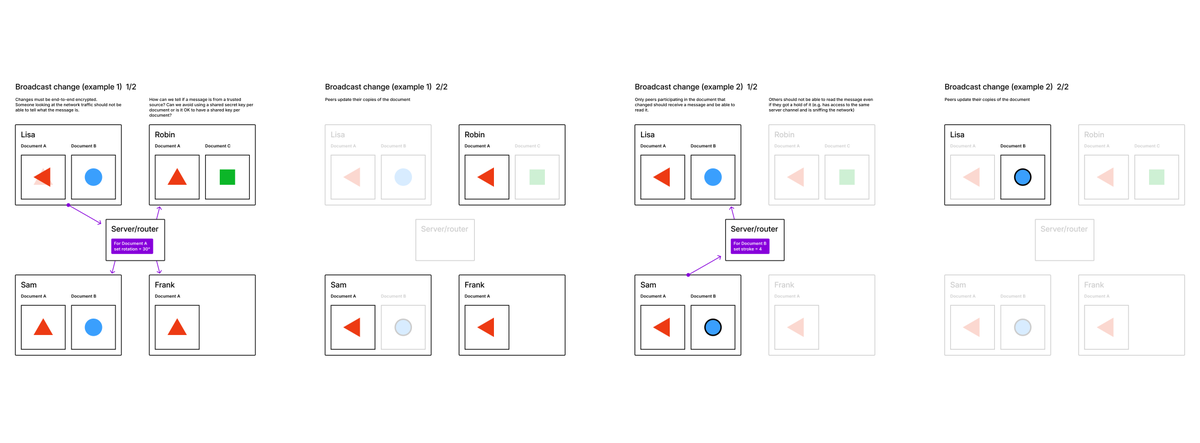
The challenge lies in how to encrypt "workspace change messages" so that only the peers who are participants of a workspace can read the message while also not being massively inefficient.
A naïve approach we're currently taking—which is both inefficient and insecure—is for every peer to have a copy of the server's public encryption key which every outgoing message is encrypted with along with the peer's secret key. The peer shares its public key with the server. When the server receives a message to be broadcast to other peers, it decrypts the message and then makes a copy for every other peer and encrypts each copy of the message for each peer. The peer receives a message encrypted specifically for that peer (it uses its secret key + the server's public key to decrypt the message.)
This works but it has two problems:
1. It is not truly end-to-end encrypted; the server can view the messages.
2. It is inefficient; copying the _same_ message for every peer wastes both memory and compute (for encryption.)
Now, it is of course impossible to make the server completely invulnerable. Even if it can't see messages, a compromised server could still authenticate invalid logins but the damage would be pretty small compared to the previously-mentioned scenario where a compromised server can do anything to any workspace.
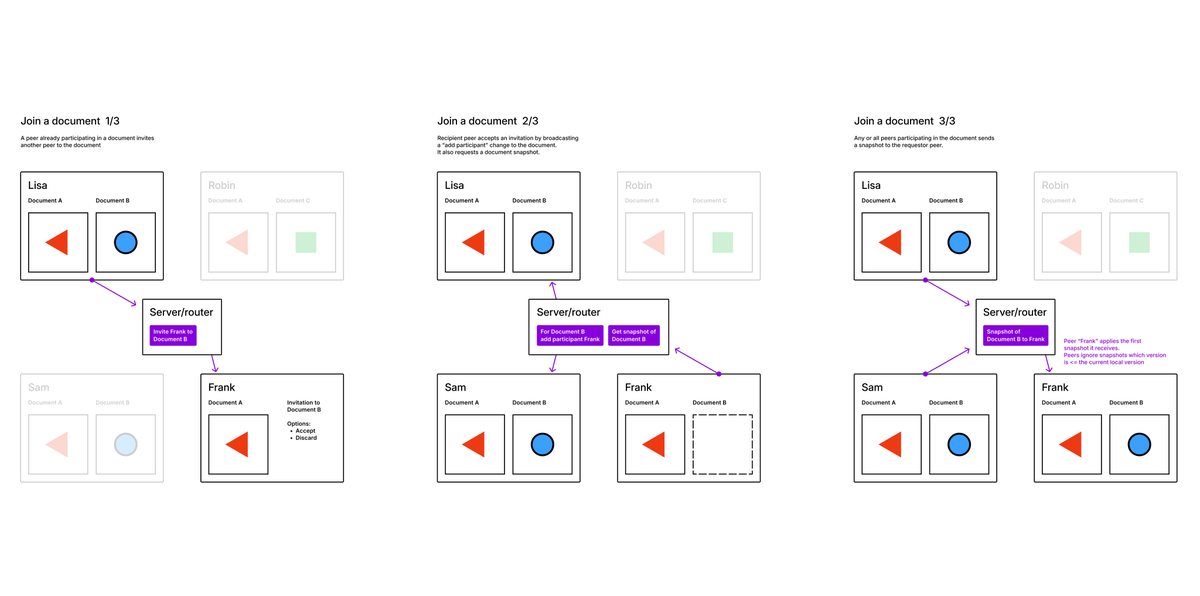
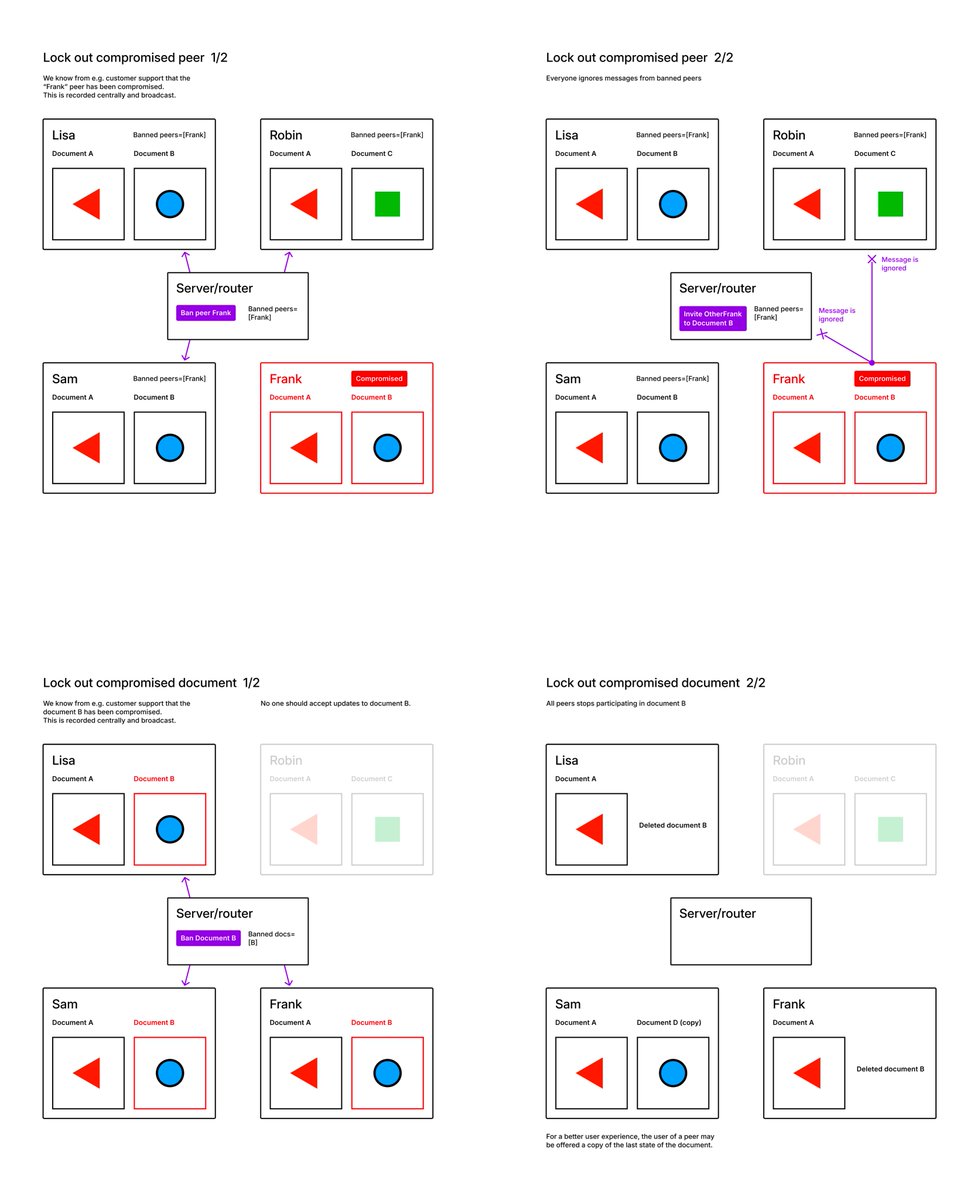
I've put together a few illustrations of various scenarios, simplified for the sake of conversation:
https://t.co/o6XhzoWfv2
What is a good architecture here?
🎁 Giving Away 100 Digital System Design, ML System Design, & Newsletter Subscriptions 🎁
𝐇𝐨𝐰 𝐭𝐨 𝐩𝐚𝐫𝐭𝐢𝐜𝐢𝐩𝐚𝐭𝐞:
✅ Like & retweet
✅ Subscribe to our free weekly newsletter: https://t.co/5teyU77Kjr
✅ Winners get all 3
Happy Thanksgiving ❤️
⏰ The giveaway ends in 72 hours.
Winners will receive an email on how to redeem the rewards on Nov 26.
I am an optimistic , goal oriented lady and a team player with great time management skills. I have special interests in female empowerment and contributing to tech community. As part of my long term goals, I want to own multiple tech based companies.
Hi everyone, we're excited to announce our next conversation: SSH Internals with Moses Koledoye (@MoVonLagos) on Sun, April 16th, 2023, at 6pm GMT.
Moses is a Senior SRE at Google that has worked extensively on distributed systems, particularly with SSH.
Fun experiment: started 100 Firecracker microVMs on a single bare metal server, and the 101st took less than 5 seconds to warm up 🚀
...and at least 15 of those VMs were running K3s
...while the resource utilization stayed < 30%
via iximiuz Labs ❤️🔥
According to a #StackOverflow Survey, these are the top 5 programming ⌨️ languages developers wan to use! 💻
1. #RustLang 🥇 - 17.6%
2.#Python 🐍 - 17.59%
3. #TypeScript ⌨️ - 17.03%
4. #GoLang 🏎️ - 16.41%
5. #JavaScript 💩 - 12.98%
Here's my take on why!
(A thread🧵)