Colleen Honigsberg, Edwin Hu & Robert J. Jackson, Jr. identify thousands of financial advisors who have committed serious misconduct and exited the federal regulatory regime—yet continue to advise investors. @StanfordLaw, @nyulaw (2/4) https://t.co/XGBNYvdarO
Prof. @_edwinhu_’s co-authored paper analyzing how shareholders use customized proxy advice won the @NFA_CA Best Paper Award in Corporate Finance. https://t.co/PkwO7cStVG
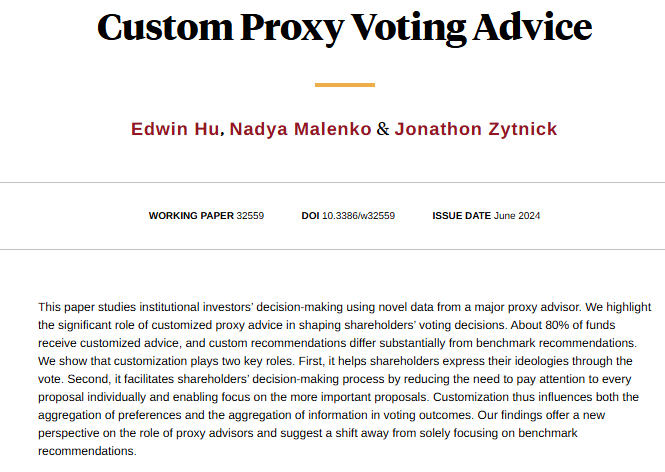
Institutional investors rely heavily on customized recommendations from proxy advisors. Customization helps funds express their ideologies and allocate attention effectively, from @_edwinhu_, @nmalenko, and Jonathon Zytnick https://t.co/7qbUzY46AC
Empirical law and finance expert Edwin “Eddy” Hu, a former economic adviser to an SEC Commissioner who has already shaped the field, will join the #UVALaw faculty on July 1. @_edwinhu_ https://t.co/hiuIJ8RHKo
@AnthonyLeeZhang And of course secondary trades on an exchange are normally not public offerings because they don’t involve the “issuer” or their “underwriter.” By contrast a direct listing is a programmatic sale that involves an issuer.
@AnthonyLeeZhang Yes, once you have answered the threshold question of is it (ever) a security, you look at whether the offering was illegal. It should have come out the opposite. Institutional sales likely exempt (not a “public offering”), but programmatic sales definitely a “public offering.”
@AnthonyLeeZhang@theshah39 A DAO that can—through tokenomics, pricing, or vote weights—allocate value would potentially be a viable for-profit member-investor hybrid entity. I suspect most DAOs will degenerate into investor-owned entities unless they are basically run as nonprofits.
@AnthonyLeeZhang@theshah39 Voting weights maybe a second or third-best option, but not clear that "loyalty shares" model of Curve approximates that either.
US regulators are expanding their crackdown on misleading labels of investment products with a probe focused on whether managers of funds marketed as sustainable are trading away their right to vote on ESG issues https://t.co/ET28YnEvKm via @business
To be sure, there may be reasons to prefer engagement over proxy voting as there is at least correlative evidence that the former is effective (in Europe).
https://t.co/hmcmAmcJZJ
@SMTuffy Yup. Levered/inverse was the main thing our office was concerned about. I was under the impression that this would be addressed by other rules. The surprise (to me) is that the industry got these through before the SEC/FINRA added those safeguards.
https://t.co/ogQMF8Nfys
@SMTuffy In trying to streamline the ETF registration process (and derivatives rules) the SEC (inadvertently) opened the door to these products. Funds no longer have to seek individual exemptive relief or "approval" as long as they meet certain reqs.
@matt_levine@IvanTheK perhaps still trying to get firms like Coinbase to register or seek exemptions (but seems especially unlikely with today's Coinbase rulemaking petition).
https://t.co/Jts1gObHKc