There’s a big debate about whether everyone should train fasted, and especially whether the answer is different for men and women.
My view is pretty simple: start with how you feel. If you feel terrible exercising fasted, that matters. Listening to your body is important. There are absolutely times when I need to eat before a workout.
The other big variable is the type and duration of the workout. A 30-minute run or lift is very different from a 2-hour run or lift. If you’re doing a long session, you might need fuel.
From my recent appearance on DOAC with @StevenBartlett.
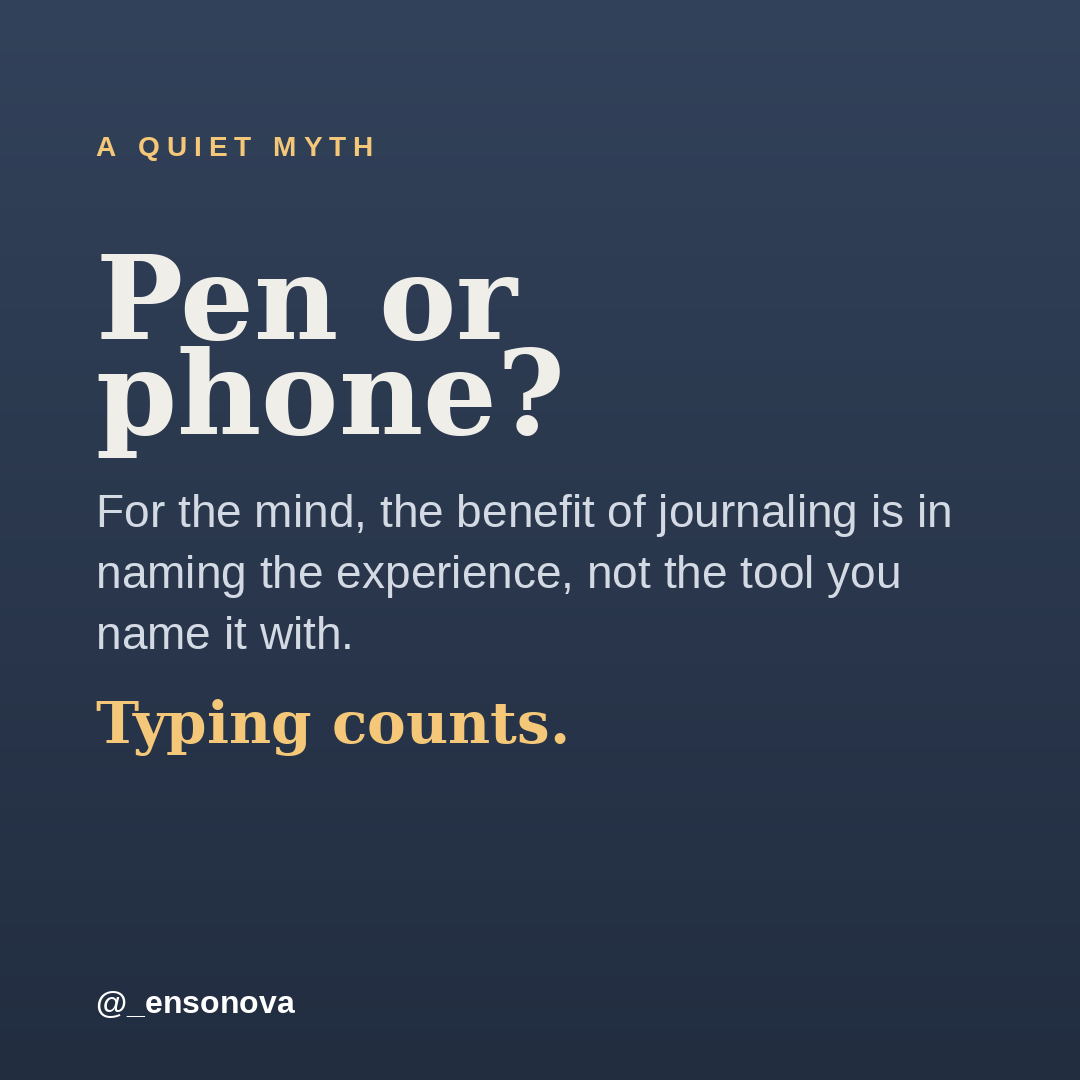
Pen or phone?
People romanticize the leather notebook, but the part of journaling that changes you is not the paper. It is the act of turning a vague feeling into specific words. Naming what is going on quiets the alarm and hands the moment back to the thinking part of your brain. That works whether you write longhand or thumb it into a notes app on the train.
So if buying the perfect journal is the thing stopping you, skip it. Open whatever is already in your hand and name one true thing.
The tool was never the point.
Two engineers get laid off the same week with nearly identical experience. One does a small writing exercise for five days. Eight months later that person is more than twice as likely to be employed again.
That is a real finding, not a pep talk. In a 1994 study in the Academy of Management Journal, Spera, Buhrfeind and Pennebaker had recently unemployed professionals write about their deepest thoughts and feelings about the layoff for 20 minutes a day across five straight days. Within eight months about 53 percent of the writers had found new full time work, versus roughly 24 percent of those who wrote about neutral topics and 14 percent who did not write at all.
No one handed the writers a better network or fresh credentials. The likely mechanism is quieter. Carrying an unprocessed loss costs attention. You sit in the interview still half arguing with the job that let you go, and it leaks into how you come across. Putting the resentment and fear on the page seems to let you stop relitigating it, so the person who walks in is more present and less braced for a fight.
Reinvention is the whole mood this year. The strongest cheat code for it is not a new layout or a fresh pen. It is the quiet habit a group of experienced engineers used to write their way back to work. Twenty minutes a day. The notes app in your pocket counts.
Your working memory is small, and an unresolved worry quietly rents out a chunk of it.
Psychologists Kitty Klein and Adriel Boals tested this directly (Journal of Experimental Psychology General, 2001). Across two semester long studies, students who wrote expressively about a stressful experience showed measurable gains in working memory about seven weeks later. Students who wrote about a trivial topic did not. The writers also reported fewer intrusive thoughts, and the size of the gain tracked with how many cause and insight words they used, not how much they vented.
That is the part most journaling advice skips. The benefit was not the venting. It was naming what happened clearly enough that the mind could close the loop instead of holding it open in the background.
Think of it as clearing cache. The worry stops running as a quiet process, and the bandwidth it was eating comes back for whatever is in front of you.
You do not need a special notebook. The notes app already in your hand, a few honest minutes, the cause and the meaning written plainly. That is the cheat code.
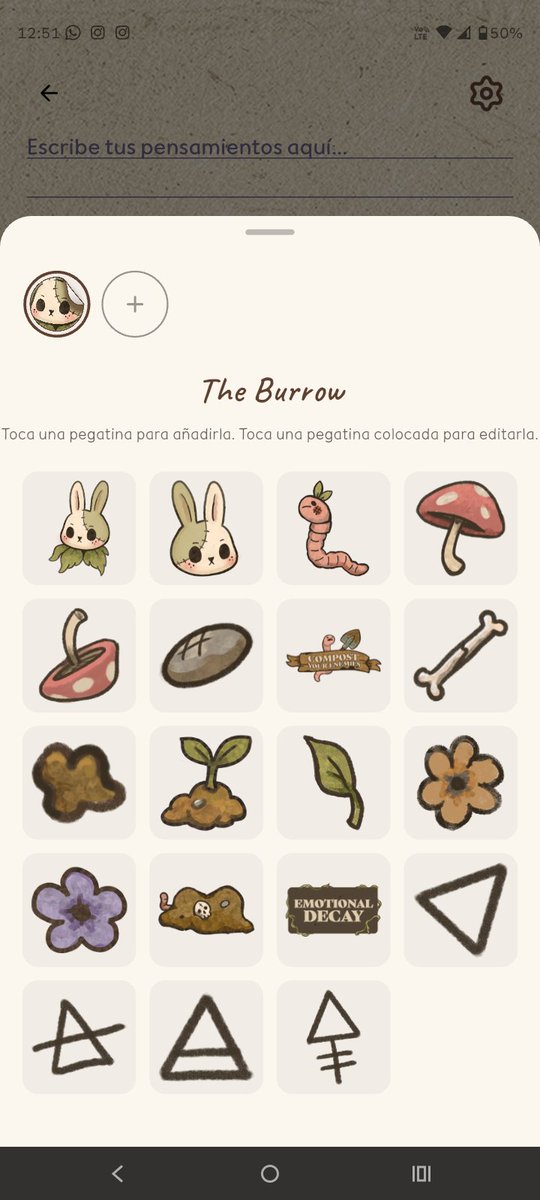
What an adorable concept! 😍 Chose the bun I actually sleep with, and that comforts me the most through the hard days. 💙 Hoping they'll add a way to make our own custom stickers to use our journals. ✍️🏻
Ahhhhh if you like journaling and like lovely bunbuns this is for you! It brings physical journaling like the stickers or the color pens but in all the places and in a secret way, I'm so freaking happy! Go go go!🫵🏻🩵
Journaling reads like a mood thing, but one of the strangest findings in the research showed up in skin.
In a 2013 randomized trial in Psychosomatic Medicine, Koschwanez and colleagues had healthy adults aged 64 to 97 write for 20 minutes a day across three days. Half wrote about an upsetting experience, half about ordinary daily plans. Two weeks later everyone received the same small skin biopsy on the arm. By day 11, significantly more of the expressive writing group had fully healed.
Same wound, same aftercare, different closing speed. The main thing that differed was what they had written about two weeks earlier.
The active ingredient is not venting. It tracks with putting a hard experience into actual words, naming it and giving it order, so the mind spends less effort holding it open. Writing that only vents, with no sense made of it, does not show the same lift.
So the cheat code is smaller than the aesthetic suggests. Not a prettier notebook, not a gratitude list. A few honest minutes turning an experience into language. The surface barely matters. A notes app on the phone in your hand counts. The words are what do the work.
@americanmcgee What a lovely app! 🖤 You can really see the care put into the details and aesthetic. Thank you for finally letting us into the Burrow. I can't wait to keep exploring it. 🦇✨
do i own a @PlushieDreadful yet? no
did i just journal for the first time in years?? yes!!
thank you for such a cute app @americanmcgee ! hoping i’ll finally get my first bunny this year 🥹🩵
A mantra is not a wish you whisper. It is a rep that quiets your brain's alarm system.
The point of repeating one sound or phrase is not the meaning of the words. It is what the looping does to a busy brain.
In a small fMRI pilot (Kalyani et al., International Journal of Yoga, 2011), volunteers chanting 'om' showed reduced activity across limbic regions, including the right amygdala, compared with making a matched vocal sound. The emotion and threat centers got quieter while one simple sound repeated.
That is the cheat code. You are not arguing yourself into calm. You are handing attention one small thing to hold so it stops sprinting. A word, a count, a tone. The mind grabs it, and the noise settles behind it.
No cushion or silent room required. Headphones in, a guided loop on your phone, sixty seconds at a red light or before a hard conversation. Same rep, anywhere.
Calm is not a mood you wait for. It is a button you learn to press.
Hypnosis sounds like a stage trick. The pain research treats it like a skill.
A 2019 review in Neuroscience and Biobehavioral Reviews pooled 85 controlled experiments on hypnosis for pain, more than 3,600 people in total. When the session used direct suggestion, people who scored high on suggestibility reported about a 42 percent drop in pain and medium scorers about 29 percent. The effect was not magic. It tracked how trainable a person's attention already was, and suggestibility itself climbs with practice.
That is the cheat code. Hypnosis is mostly guided attention plus an expectation you rehearse, the same machinery a focus or meditation rep runs on, aimed at one target. No swinging watch required. You need a quiet voice, a clear instruction, and a few minutes to follow it. Your phone is a fine place to run that rep, headphones in, eyes closed, one session a day.
Start by noticing you can move attention on purpose. The rest is reps.
Most people treat dreams as something that happens to them. A small group treats them as something they can steer. That is lucid dreaming, the moment inside a dream when you realize you are dreaming and can shape what happens next. It sounds like a gift a few lucky people are born with. It is closer to a trainable skill.
The groundwork is simple and mostly happens while you are awake. Notice the strange logic of your day and gently ask whether you are dreaming, so the habit carries into the night.
Keep track of your dreams so your mind starts treating them as worth remembering. Set a clear intention before sleep that tonight you will catch the dream in the act.
@_ensonova
Most people think fasting works because you eat less. The timing is doing its own job.
In a 2018 Cell Metabolism trial, Sutton and colleagues fed prediabetic men all their food inside a six hour window that ended in the early afternoon, then matched the same meals across a normal twelve hour window. Calories were identical. Nobody lost weight. The early window still improved insulin sensitivity, blood pressure, and oxidative stress. The clock was the active ingredient, not the deficit.
Your body runs a metabolic schedule. Insulin sensitivity is higher earlier in the day, so the same plate lands differently at 1pm than at 9pm. Eating in tune with that rhythm is less about willpower and more about playing the level the way it was designed.
You do not need the strictest version to feel it. Pull your eating window a little earlier and a little tighter, let the evening go quiet, and let your morning metabolism do work it is already good at.
Same food, better timing, different result.
Affirmations do not work by hyping you up. They work by reminding you what you already care about.
In a 2015 study in PNAS, Falk and colleagues slid sedentary adults into a brain scanner and showed them messages about moving more. Before the messages, one group spent a few minutes ranking and affirming their core values. That single step changed activity in the ventromedial prefrontal cortex, the region that tags incoming information as relevant to you rather than as noise to skip. The people whose VMPFC responded most then became measurably less sedentary over the following month, tracked by sensors, not by what they claimed.
So the cheat code is not positive self talk on a loop. It is pointing your attention at what genuinely matters to you first, so the next useful thing actually lands instead of bouncing off. That is the whole game behind a good mantra. You are not lying to yourself. You are widening the door before you try to walk through it.
A phone is a strangely good place to run that rep. Thirty seconds, eyes on one line that names something you value, then on with your day.