I'm excited to share a career update! After a year as a Neyman Visiting Assistant Professor @UCBStatistics I'll be joining @ChicagoBooth in July 2025 as an Assistant Professor of Econometrics and Statistics.
I'm very excited to be organizing an invited session at IMS 2022 in London on Inference Methods for Adaptively Collected Data!! The speakers are @nathankallus, Koulik Khamaru, @_evan_munro, and myself, and @SusanMurphylab1 will chair the session!! Happening on June 29, 1:30-3:30
We provide estimators for the average direct and indirect treatment effects based on an augmented unit-level randomized experiment. We provide methods for asymptotically exact inference, and describe how
equilibrium interference impacts the variance of the estimators. (3/3)
Excited to share a new working paper with S. Wager and @xu_kuang on estimating treatment effects in a market equilibrium! The paper applies a mix of game theory, asymptotic theory, and experiment design to tackle a problem in causal inference.
https://t.co/NHKAKGiQri
(1/3).
Programs are often evaluated within a market economy, where individuals buy and sell at the prevailing market price. Equilibrium prices introduce interference, so usual estimators of the ATE do not correctly estimate the average total effect of a treatment. (2/3)
@SFPDSgtMike @SFPD When was this photo captured ? A friend and I had a shark scare while surfing at 6:15 pm at Taraval st on Sunday but perhaps it was this guy !
@wmdecon Thanks! Blei + Ng classes will be a great combo. Stefano Ermon teaches a graphical models class at Stanford that I really enjoyed (and was helpful for the paper).
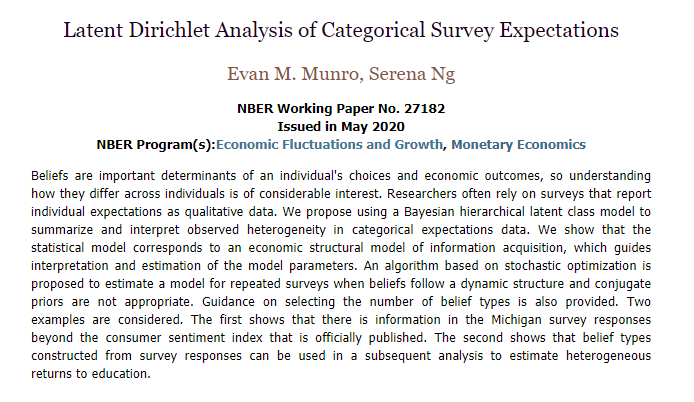
My paper "Latent Dirichlet Analysis of Categorical Survey Responses", with Serena Ng, is now forthcoming at JBES!
https://t.co/KI1zbQWMlV
The main contribution is providing a methodology for summarizing and interpreting heterogeneity in qualitative survey data. (1/4)
The paper also includes some applications of the methodology to analyzing survey data on consumer expectations and returns to education. An R package dhlvm (hosted on my Github) is available for the models in the paper. (4/4)
A key insight in the paper is that an economic model of belief formation leads to a version of LDA for survey data. The structural model underpinning the statistical model guides interpretation, identification and estimation. (3/4)
New version of our paper, which includes a theoretical model of information acquisition that motivates using LDA for analyzing categorical survey data.
@TrueHoop This slide is from my work on draft lottery design with @BanchioMartino, which won the best paper this year at MIT Sloan. Would be interested in getting your thoughts! Link to the full paper, which includes our contact info here: https://t.co/A7boF7MuI8
Research Paper Competition Presented by @MLB
Grand Prize: Evan Munro and Martino Bianchio, “Designing a No-Tanking Draft Lottery”
Audience-choice: Samuel Kalman and Jonathan Bosch, “NBA Lineup Analysis on Clustered Player Tendencies”
How generative adversarial networks can be used to make Monte Carlo studies more credible by tying simulation designs to real data sets, from @Susan_Athey, Guido W. Imbens, Jonas Metzger, and Evan M. Munro https://t.co/BE37EEa2TN
@Susan_Athey For modeling, Pyro (built on top of PyTorch) is a good option for estimating scalable hierarchical Bayesian models, which could be used to decompose a state space in an interpretable way. https://t.co/VM7cW5TVgI
GRF version 0.10.3 is now available on CRAN! This release includes support for sample weighting, merging forests, and boosted regression forests, as well as improvements to memory usage. Full list of changes: https://t.co/CIihDy1BUs