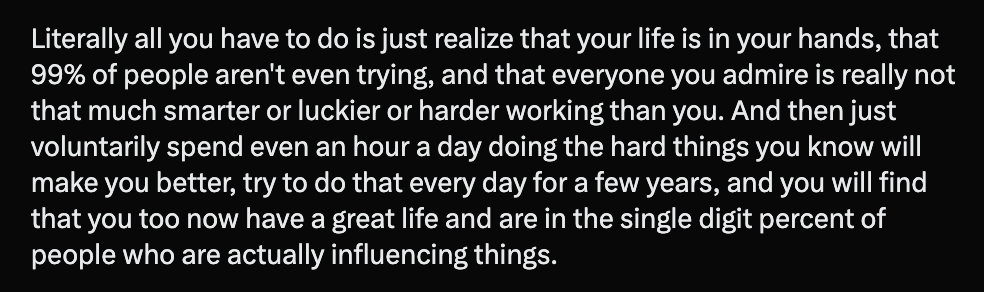
Lock in for 90 days. Don’t post about it, don’t explain it to anyone. Wake up, do the work, eat clean, sleep early, repeat. Some days you’ll hate it. Do it anyway. After three months people will ask what changed, and you’ll just smile, because you know it was nothing magical. Just you, showing up every day.
Fear Who no Fear me !! lol
$50K to $800K +
All done under PROPER risk management and EVERY SINGLE TRADE taken LIVE 🔴
EVERY SINGLE TRADE YOU SEE HERE WAS TAKEN LIVE 🔴 !!!
I’ll always say this to y’all: There is a big difference between " i have been in the trading space for 5 years" and " I have been trading for 5 years"
It doesn't matter how long you’ve been trading if you still can’t trade profitably.
If you’re still repeating the same mistakes, still scared to execute, and still struggling to show up consistently, then time alone hasn’t made you better..... Fix up🥂
There’s no prize in trading for years with nothing to show for it.
Ask yourself this question: What have I really been doing all these years? Am I deceiving others, or am I deceiving myself?
Not too late to Reflect, Restart and Refocus
GM Billionaires
Wish y'all a profitable week ahead🥂
Elon Musk was right when he said:
"Go and get your damn confidence back. Without it, you'll fail miserably, no matter how skilled or intelligent you are."
After I posted this, I got asked a lot of questions about improving marathon performance.
I think there are two things that matter for running a faster marathon:
1. Preparation
2. Execution
Here's how I think about each one:
(stream of consciousness, so pardon any errors)
1. Preparation
This is just how well you prepared for the race.
What did your training look like? Were you prepared for the distance? Did you have enough confidence built up from your training block to go into the race feeling good about your ability to execute?
There are plenty of smart coaches on here that can give you better advice than me, but my staples here would be:
- 1 weekly long run
- 1 weekly track workout
- 3-4 easy runs
Long run has progression work or intervals to prepare your body (and mind) for the faster paces you'll have to run on race day on tired legs.
Track workouts generally focus on middle distance intervals (800m, 1200m, 1600m) on medium rest intervals (90-120s). For me, I view this work as acclimating my body and nervous system to paces significantly faster than what I'll have to run on race day.
Nutrition matters during preparation, too. Consuming enough calories, particularly in the form of carbs, to fuel yourself to perform. Under-eating during training is a great way to get hurt (or experience massive muscle loss). The nutrition part extends into executing your pre-race carb load during the 2-3 days leading up to the race as well.
2. Execution
I break this into 4 components:
1. Pacing
2. Nutrition
3. Hydration
4. Mindset
Pacing is just about how well you execute your pacing plan for the race. If it's mostly flat, ideally an easy negative split, where you start out below marathon pace target and slowly get faster. If it's a hilly course, planning and executing around those climbs.
Having completely screwed this up in my first three marathons (and then nailed it in my recent one), I know how impactful it is on how you feel later in the race.
Avoiding the adrenaline-driven surge early is the whole game for a novice. You pay for it later. Trust me.
Nutrition is about the carbs you consume during the race. The biggest mistake I've made in the past was under-consuming carbs during my long runs and races.
You have to train the way you're going to play on race day. Practice your nutrition. Test the gels and find what your body tolerates and responds to best.
Then, don't do anything new on race day.
My strategy for this was one gel every 30 minutes, each with 50g carbs (I used Carbs Fuel because I liked it and it didn't destroy my stomach).
Practicing on your training runs also avoids making dumb rookie mistakes (like I made) around dropping gels or realizing your cold fingers can't tear them.
Hydration is about the fluids you consume during the race. This is what I screwed up during my DNF in September.
You need to tailor your fluid consumption to the race day conditions. Higher temperature / dew point means more fluid needs. There are precise ways to figure this out, but the best way is to just experiment during your long runs and make sure you match your race day approach to what has worked.
Personally, I've found that fluids are extremely overrated on cold days but have an exponentially increasing importance as temperatures tick up.
I consumed just two 14oz bottles with electrolytes during my marathon last weekend. But if it had been 20 degrees warmer, I would have cramped and blown up only consuming that amount.
Mindset is about how you approach the race and distance itself. How you break it up in your mind. How you navigate the inevitable random dark thoughts during a race. How you respond to the little pains and cramps that strike.
To be honest, I think this one is deeply intertwined with the first three execution components.
It's very easy to have a good mindset when you're feeling great because you're executing on pacing, nutrition, and hydration. You start passing people. That feels good. You feel stronger than you ever have at Mile 20. The race gets shorter. You feel better.
Momentum is a hell of a drug.
Anyway, that's my stream of consciousness on running a faster marathon. I'll probably do a more detailed post on my actual training that I followed to run the sub-2:50 marathon while maintaining muscle (I'm 6'2" 180).
If you're interested in that, just let me know and I'll pull it together.
By the way, all of this insight is derived from reading/watching a lot of stuff from people much smarter (and faster) than me. But it's all been put through my critical filter of what actually worked in my own battle-testing.
Take it with a grain of salt, but I think you could do much worse than following the above.
Major life hack: act fast and stop overthinking. Got a new idea? Figure out how to test and validate it quickly. Unhappy with your current routine? Change something today and see what works better. Speed is a virtue. You learn faster, you get more done, and you have more fun along the way. You don't need a perfect plan, and not every step has to be checked a thousand times. Perfectionism often just hides fear of starting. Put yourself under healthy pressure, build an obsession with progress instead of perfection, and iterate relentlessly. Move fast, learn, adjust, repeat. Make this mindset your own and you'll be ahead of almost everyone around you.
thank me later
a new opportunity to train Ai and get paid at least $50 per hour
https://t.co/O6Gotgy7f6
jobs are already there, you just pick a job and start immediately
goodluck 🫶🏼
1. Play the long game.
Most people start with enthusiasm and quit midway. The people who keep going past that point look irrationally optimistic. In the end, delusional optimists win simply because everyone else stopped.
2. Frontrun an industry.
You don't have to be the smartest person in the room. You just have to be early. Some people aren't exceptional at the craft, but they're good at noticing a trend before it becomes obvious. They position themselves early, and when the wave arrives, they already look like experts.
3. Optimize your geography.
Not just physical geography. Your zone of genius needs the right environment, the right people, and the right audience.
That's why some people thrive on LinkedIn and are invisible on X, and others live on TikTok and would die on LinkedIn. You're not supposed to be everywhere. You're supposed to play your game in front of the people most likely to care about it.
4. Take more shots.
Luck is mostly a numbers game. The more things you try, ship, and share, the more chances you give the world to notice you. Most people take one big bet and wait. It's better to take a lot of small bets and let one of them compound.
There is no cute way to chase your dreams.
This is one of those things everyone knows in theory but forgets in practice. We picture the people who made it as if they were always cool. We imagine they had a plan, and that the plan worked, and that they looked confident while it was working.
It is almost never like that.
If you actually watch someone trying to do something ambitious, it looks embarrassing. They are sending cold emails that don't get answered. They are building a version of the thing that barely works. They are explaining the idea to people who don't get it, or who get it and don't care. They are working on it in their spare time, after work, when they are tired, when it would be easier to do nothing.
The reason it looks uncool is that coolness is mostly about not trying too hard. And chasing a dream is, by definition, trying too hard. You care more than is reasonable. You keep going after the point where a sensible person would stop.
Founders understand this. The first version of almost every successful startup was embarrassing. Not just imperfect, but actually embarrassing to show to people. The founders knew it was bad, and showed it anyway, because the alternative was to show nothing.
The same is true for writers, artists, researchers, anyone. The early work is ugly because you don't yet know what you're doing. You only learn what you're doing by doing the ugly version first.
People wait for a cool way to start because they think embarrassment is a signal that they're doing it wrong. In fact it's usually a signal that they're doing it at all. If you're not embarrassed by your first attempt, you probably started too late.
There is a temptation to hide until you are ready. To work in secret, polish in private, and then appear, fully formed, as if you never struggled. But that is just a way of protecting your reputation at the cost of your progress. The people who make it tend to be the ones who were willing to look foolish in public for longer than everyone else.
It doesn't get cool later, either. It just gets less visible. Once someone succeeds, we edit out the embarrassing part. We tell the story backwards, from the success to the start, and it sounds inevitable. We forget the years when it looked like nothing was going to work.
So if what you are doing feels ugly and difficult and embarrassing, that does not mean you are on the wrong track. It is what the right track feels like at the beginning.
Stop trying to look successful.
Learn how to:
•Generate income.
•Build useful skills.
•Maintain good health.
•Manage responsibilities.
•Create opportunities.
•Enjoy your own company.
Real confidence comes from capability
4 X $25K FUNDEDNEXT STELLAR GIVEAWAY
Instructions:
▪︎ Follow @lex_consults | @FundedNext
▪︎ Also follow @Techriztm x @Onlyonecurrency
▪︎ Join my telegram: https://t.co/EP7VmpKbTf
▪︎ Like and repost
Winners will be announced in 48 hours