Roadmap update: FACTOR → Ethereum.
We’ve officially added an Ethereum bridge to the roadmap.
This opens new opportunities for liquidity, DeFi integration, cross-chain utility, ecosystem growth, and broader access to FACTOR.
A bigger, more connected future starts here.
#Eth@ethereum #ether
A new miner version, 4.4, is now live.
We have fully reworked how machine performance is measured. The miner now reports hashrates that make it easy to compare performance across different workers.
Example log output:
21-11-2025 07:20:33.707 INFO Hashrates [current/1h/24h]: 1871/1876/1910 rels/s.
Shares: 90, Uptime: 0 days, 11 hours, 20 minutes.
A well performing 7950X will usually sit around 1900 rels per second.
These hashrates are now sent directly to the pool, as shown in the screenshot. Logging has also been cleaned up and reorganized.
To update, run this command inside your worker folder:
wget -O update_worker.sh https://t.co/Bh9LOpi8wD && bash update_worker.sh
The pool’s worker overview has also been overhauled. Online and offline workers now appear in separate lists, which makes it much easier to spot problem machines.
Next on the roadmap: automatic updates. Once that rolls out, the worker will keep itself up to date without requiring manual installs.
https://t.co/lpVSnm93MI
🚨New Factor Mining Pool Listing Alert!🔑
Thanks to the Factor Mining Pool Crew, we are now listed on @HashrateNO.
Just the coin listing so far - a more accurate revenue-estimation is being worked on.
Link in thread to Hashrate/Factor page ▼
This is exactly the kind of low-level vulnerability @ProjectFactor's research tools are designed to surface, verifying whether cryptographic keys remain statistically secure even when hardware entropy is flawed
📰NEWS
"@AMD confirms security vulnerability on Zen 5-based CPUs that generates potentially predictable keys, RDSEED fix coming through an #AGESA firmware update for desktop chips"
Link to article in thread ▼
Coming Soon!
🏭Factory Light⚡️
A lightweight Factor miner that runs quietly in the background, using minimal CPU for ~60 seconds rougly every 10 minutes.
⚡️Near-zero energy use
🛜 Low bandwidth
⛏️ Dual/triple mining ready
🪙Small but steady rewards
Join the discussion and help shape the rollout on Discord - Link in thread. ▼
actor $FACT Core Features
#5 Open Participation
What it is
Factor was designed for universal accessibility. Anyone with a computer and curiosity can contribute to the network, no specialized ASIC hardware, no central authority, and no institutional gatekeeping. Whether you’re an independent miner, a student, or a research organization, participation is open, verifiable, and rewarded through on-chain consensus.
Why it matters
Traditional scientific computation, blockchain mining, and academic research are often siloed. Access to resources, funding, or validation is limited by infrastructure or affiliation. Factor removes these barriers by allowing anyone, anywhere, to join and contribute to meaningful mathematical and cryptographic work. This open architecture democratizes discovery, encouraging collaboration across individuals and institutions alike.
What this means for users
Participation is not restricted by budget, credentials, or geography. Anyone with CPU or GPU power can mine, test algorithms, post challenges, or solve them. This inclusivity builds a global ecosystem where progress in number theory, security, and decentralized compute comes from the bottom up — powered by open access, not institutional privilege.
Applicable Sectors & Markets
• Academic and Educational Institutions
• Independent Researchers and Developers
• Scientific and Cryptographic Research Networks
• Distributed Compute Platforms
• Community and Public Science Initiatives
Benefits to Users
👩💻 Developers can build and test cryptographic applications using Factor’s open infrastructure without licensing or permission.
🎓 Students and Universities can use Factor as an educational and funding tool, turning idle compute into research rewards.
⛏️ Miners can participate competitively without specialized hardware or exclusive access to compute farms.
🧠 Researchers can collaborate globally on shared challenges with transparent results and provable contributions.
🏢 Institutions and Enterprises can engage publicly in decentralized computation and research without gatekeeping or closed systems.
🌍 The Public can contribute meaningfully to cryptographic progress and mathematical science through open participation.
Find out more or get involved - links in thread.▼
DYK?
Did you know @ProjectFactor has factored about half of all 512-bit *RSA keys on the internet?
So What?
That means Factor has already proven its real-world capability to break weak encryption at a massive scale. In practical terms, it demonstrates that the network isn’t just theoretical math, it’s performing computational work with measurable, verifiable results. Factoring half of all known 512-bit RSA keys shows that Factor’s distributed compute power rivals some of the most advanced academic and governmental research clusters, validating its model for decentralized, real-world math-as-a-service.
Why That Matters for the Quantum Age
As #quantumcomputing advances, much of today’s encryption, including RSA, will become vulnerable. Traditional mining systems waste enormous energy solving meaningless hashes that quantum machines could trivialize overnight. Factor, by contrast, anchors its block rewards to real cryptographic work. Each solved key is both proof of work and proof of utility. This model evolves naturally with the coming era: instead of being rendered obsolete by quantum power, Factor’s Integer-Factorization-as-a-Service (IFaaS) harnesses it.
So, as computing capacity scales, whether classical or quantum, Factor’s network scales with it, turning that raw power into measurable scarcity and genuine security work. This positions Factor as a bridge between classical cryptography and post-quantum cryptographic systems, transforming mining from a wasteful race into a globally useful compute marketplace that secures the next generation of cryptographic infrastructure.
🔗Link to website for further research and to participate.🔬▼
Factor Ecosystem
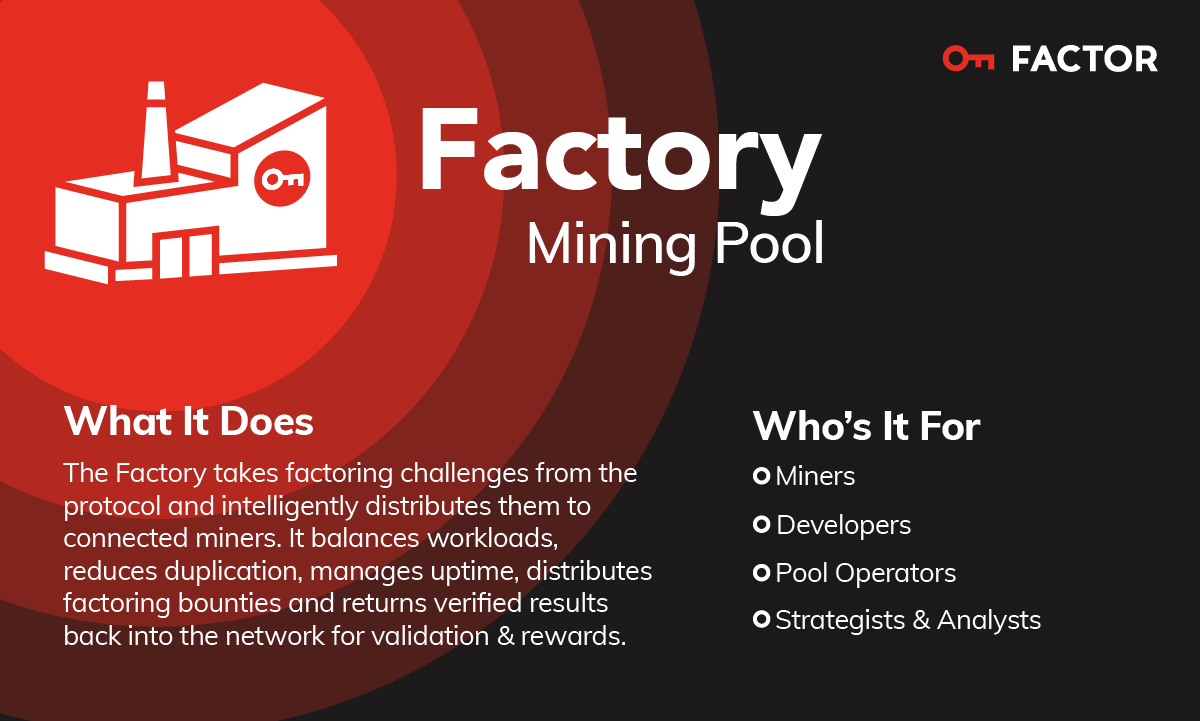
FACTORY (The Mining Pool)
Definition:
Factory is the official mining pool of the Factor network. It manages computational work allocation and aggregates miner activity into verified submissions for factoring challenges.
What It Does:
Factory orchestrates large-scale solve attempts on factoring problems, coordinates fair work distribution among miners, and routes successful solutions back into the protocol for validation and payout.
Who’s it for:
⛏️Miners (Individual & Small-Scale): Submit compute to open challenges and earn $FACT. Mining Communities: Collaborate on large, high-value cryptographic tasks.
🧑💻Pool Operators: Manage compute strategy and job distribution.
👩🏻💻Developers: Plug in scripts and tools to optimize job targeting.
🧐Strategists & Analysts: Monitor network-level performance and efficiency.
🧑💻Hardware Operators: Utilize idle CPU/GPU cycles for research-grade computation.
Function in Ecosystem:
The Factory is the execution engine of Factor. It converts raw computing power into real, useful mathematical output, bridging the gap between miners’ hardware and the protocol’s demand for factoring. By operating as a next-generation mining pool, it transforms what was once wasted proof-of-work into coordinated, high-value computation.
🔐 Core Feature: Integer Factorization as a Service (IFaaS)
What it is:
IFaaS turns the Factor blockchain into a decentralized compute layer where anyone can submit large integers to be factored. These tasks are picked up by global miners who compete to solve them. The first correct solution wins the on-chain bounty, automatically distributed via smart consensus.
This is powered by KeyBoard (formerly Deadpool), an open bounty marketplace embedded in the network. Users post integers with a $FACT reward attached, and solvers anywhere in the world use CPU/GPU resources to attempt solutions.
Why it matters:
Instead of relying on expensive cloud compute or custom-built contracts, researchers, academics, cryptographers, and even enterprises now have access to a global, permissionless factoring engine.
Each bounty becomes its own market. The harder the problem, the more it costs to solve, and the greater the incentive becomes for solvers to participate. This dynamic equilibrium makes Factor self-balancing and economically expressive, something no traditional blockchain provides.
What this means for users:
You don’t need to run your own compute cluster or negotiate with contractors. Post a bounty, set a reward, and let decentralized miners do the heavy lifting. You can also increase bounty size at any time to attract more solvers. Everything is transparent, cryptographically secure, and settled in $FACT.
This is not just blockchain-as-infrastructure. This is computation-as-incentive, a network that earns its coin through meaningful, real-world math.
Applicable Sectors & Markets
• Cryptographic Research
• Academic Labs & Universities
• Enterprise Security Audits
• Distributed Compute Networks
• Post-Quantum Security Analysis
Benefits to Users
🔐 Bounty Creators: Instantly spin up global factoring tasks without infrastructure overhead.
⛏️ Miners: Compete to solve challenges and earn $FACT directly from the network.
🏫 Academic Institutions: Use the network to crowdsource experimental math research.
🥼 Researchers: Post test integers, track solution trends, and adjust reward incentives in real time.
📈 Enterprises: Evaluate cryptographic strength or test novel algorithms without hiring compute farms.
🧠 Developers: Build apps that interface with the IFaaS layer, automating task generation and payout routing.
Core Feature: ASIC Resistant (CPUs and GPU Friendly)
What it is:
ASIC Resistance means FACTOR avoids mining domination by specialized hardware. Instead, it uses integer factorization, where algorithms like ECM, NFS, and the Sieve of Eratosthenes run best on general CPUs and GPUs.
Why it matters:
Traditional Proof-of-Work chains centralize over time as only ASIC-owners profit. FACTOR keeps the playing field open, so students, hobbyists, and academic labs can mine with standard hardware. Participation depends on smart configuration and algorithmic skill, not capital.
What this means for users:
Mining outcomes stay fairer, and access isn’t locked behind expensive rigs. Anyone with a decent computer can contribute to network security and research, creating a wider, more diverse pool of participants. For now, ASIC resistance gives you a real chance to be part of the system without massive investment.
Applicable Sectors & Markets
• Fair Mining Models
• Academic Labs & Universities
• Open Research Networks
• Community-Driven Infrastructure
Benefits to Users
⛏️ Miners keep costs low by competing with standard GPUs/CPUs, not specialized rigs.
🏫 Academic Institutions can involve students and faculty in distributed factorization experiments.
🥼 Researchers get equal footing to test algorithms without hardware barriers.
🧑💻 Developers can design apps that rely on wide, decentralized participation.
📈 Enterprises explore decentralized benchmarking without capital lock-in.
🔐 Bounty Creators & Solvers gain a fairer marketplace where raw compute, not hardware advantage, drives results.
Factor Facts.
🔎Was @ProjectFactor funded by @coinbase ?
A: Yes, FACTOR was entirely funded by the Coinbase Crypto Community Fund, which supports innovative projects within the cryptocurrency space.
Learn more about this and more via links in the thread. ▼
FACTOR FEATURES
1. Useful-Proof-of-Work (UPoW)
What is it?
Useful Proof-of-Work is a conceptual framework, not a consensus algorithm, where the computational work of mining contributes to solving valuable problems beyond mere hash puzzles. Unlike typical Proof-of-Work (PoW), which secures networks using arbitrary computations (like SHA-256 in Bitcoin), this UPoW model seek to attach utility to the mining process, providing benefit to external systems or real-world research.
How Factor Uses It.
Factor does not implement a distinct #PoUW consensus mechanism. Instead, it layers utility on top of its standard PoW mining system. Through its Factoring-as-a-Service #FaaS layer, users can post mathematical challenges, specifically integer factorization problems, that miners may choose to solve using the same software & hardware infrastructure. These problems are cryptographically verifiable, and rewards are issued through trustless bounty mechanisms. This approach allows Factor to offer Useful Proof-of-Work without altering consensus logic.
Applicable Sectors & Markets
• Sustainable Blockchain Models
• Public Research Infrastructure
• Math-Driven Compute Markets
• Environmentally-Conscious Mining Initiatives
Benefits to Users
⛏️Miners gain access to dual-income streams: block rewards and factorization bounties. This turns mining into more than just securing a ledger.
🏫Academic Institutions can run distributed experiments on real hardware without building supercomputers.
🥼Researchers can leverage the decentralized network to stress-test cryptographic assumptions at scale.
🧑💻Developers could design security applications that rely on factorization activities happening on FACTOR
📈Enterprises may outsource benchmarking tasks and analyze encryption strength in a decentralized way.
🔐Bounty Creators & Solvers operate in a verifiable, self-incentivizing system with no trusted intermediaries.
See Links in thread for more on Factor.





![ProjectFactor's tweet photo. A new miner version, 4.4, is now live.
We have fully reworked how machine performance is measured. The miner now reports hashrates that make it easy to compare performance across different workers.
Example log output:
21-11-2025 07:20:33.707 INFO Hashrates [current/1h/24h]: 1871/1876/1910 rels/s.
Shares: 90, Uptime: 0 days, 11 hours, 20 minutes.
A well performing 7950X will usually sit around 1900 rels per second.
These hashrates are now sent directly to the pool, as shown in the screenshot. Logging has also been cleaned up and reorganized.
To update, run this command inside your worker folder:
wget -O update_worker.sh https://t.co/Bh9LOpi8wD && bash update_worker.sh
The pool’s worker overview has also been overhauled. Online and offline workers now appear in separate lists, which makes it much easier to spot problem machines.
Next on the roadmap: automatic updates. Once that rolls out, the worker will keep itself up to date without requiring manual installs.
https://t.co/lpVSnm93MI](https://pbs.twimg.com/media/G6Sd5sbXoAAIK62.png)