FACTOR is a decentralized protocol turning cryptographic mining into a marketplace for real math, rewarding researchers, miners, developers, and institutions.
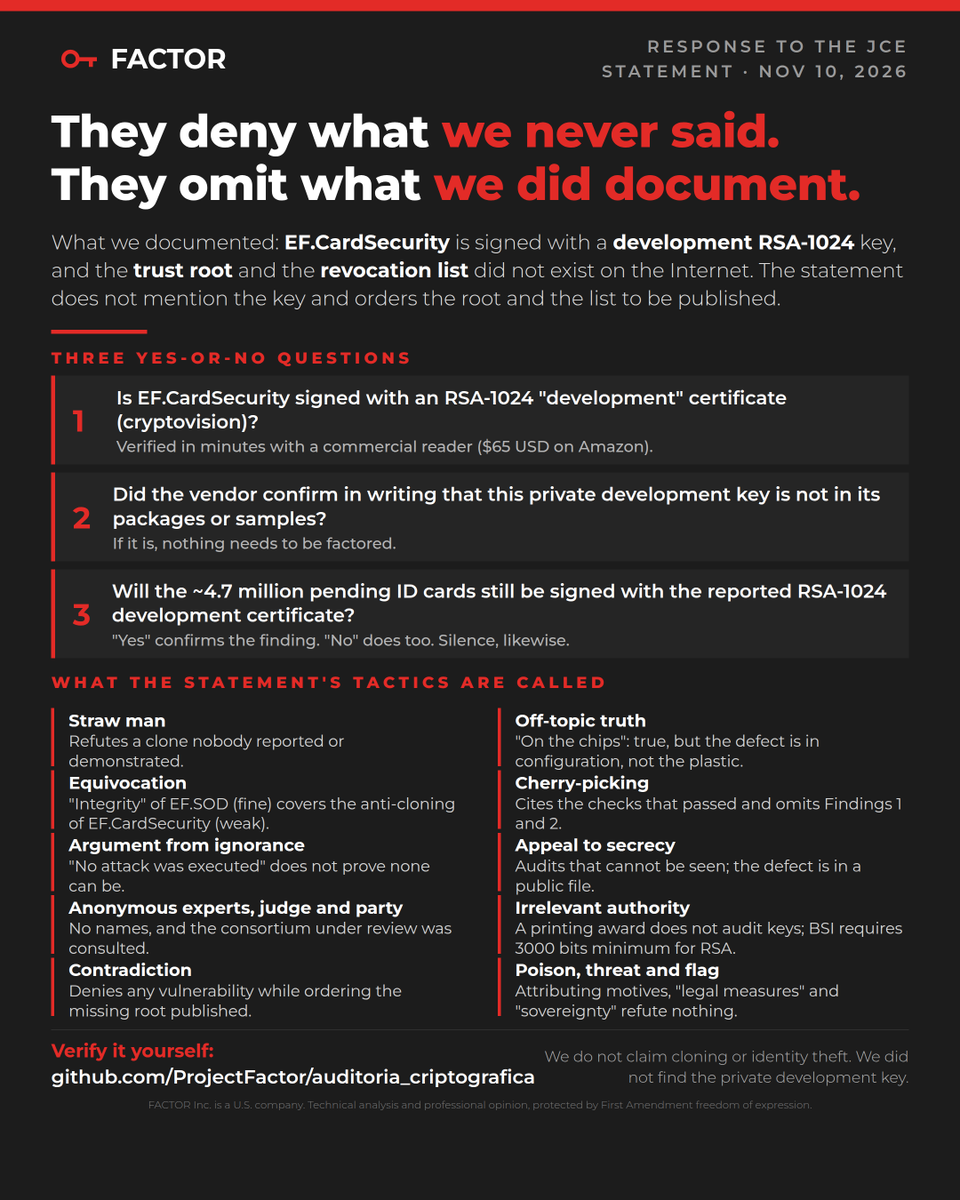
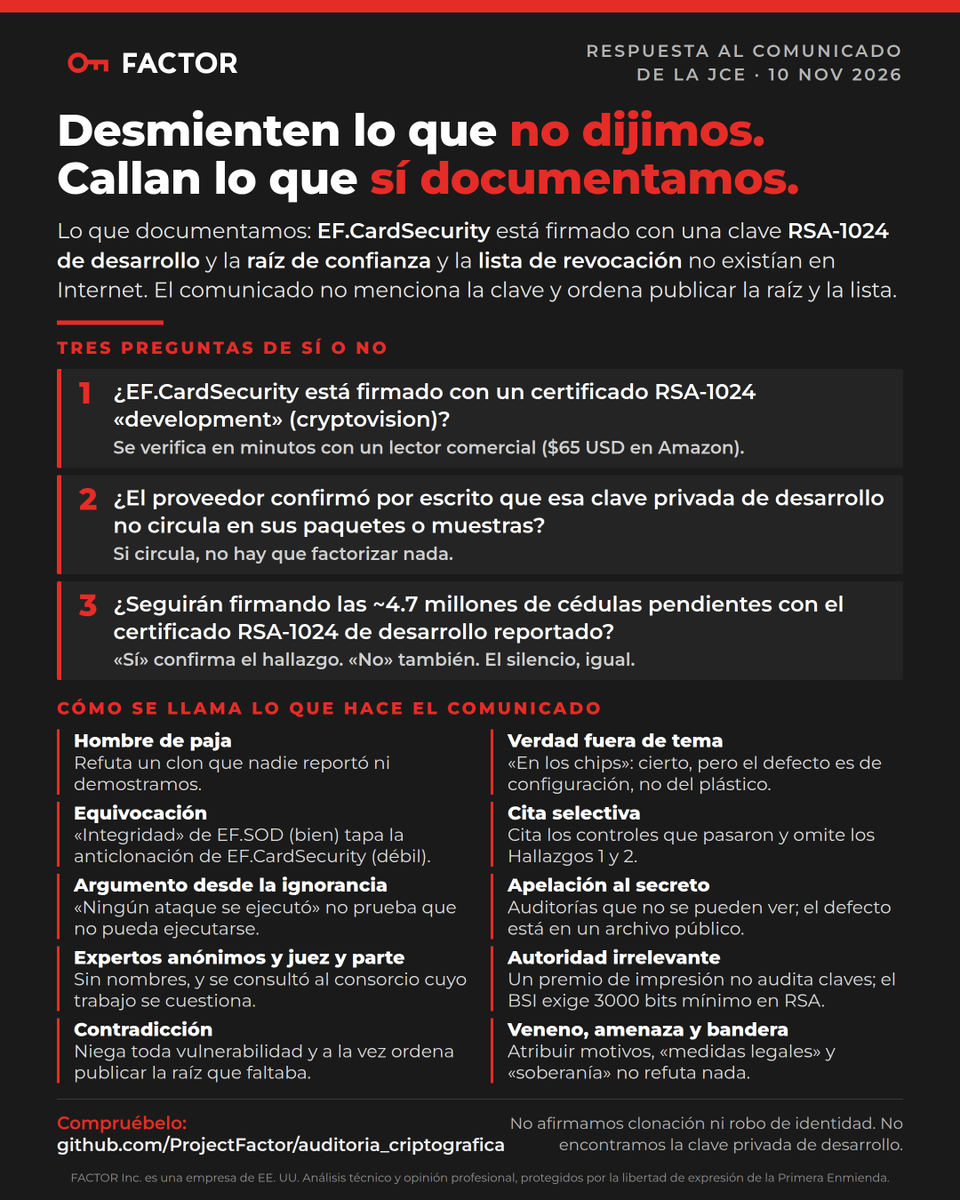
In response to the JCE communication regarding our audit, English version:
Also, this interview from July of last year is relevant: https://t.co/EvGUszZAo6
🔴 We're publishing "Proof of Cédula": an independent cryptographic audit of the Dominican digital cédula.
Findings in how the chip's data is signed and verified. The JCE has already been informed of the most severe ones.
PDF report, evidence and open tools.
https://t.co/ku1bhOFiI9
— FACTOR Inc. #Cybersecurity #DominicanRepublic
The full-color introduction to Forks of Asterion; a story about blockchain that never mentions blockchain or its technicalities: https://t.co/oiEfnWfIqQ
Can a story teach blockchain without ever mentioning it?
That’s the idea behind Forks of Asterion. A world of its own, characters to follow, plots that intrigue the imagination, and ideas to discover along the way.
Would you read more?
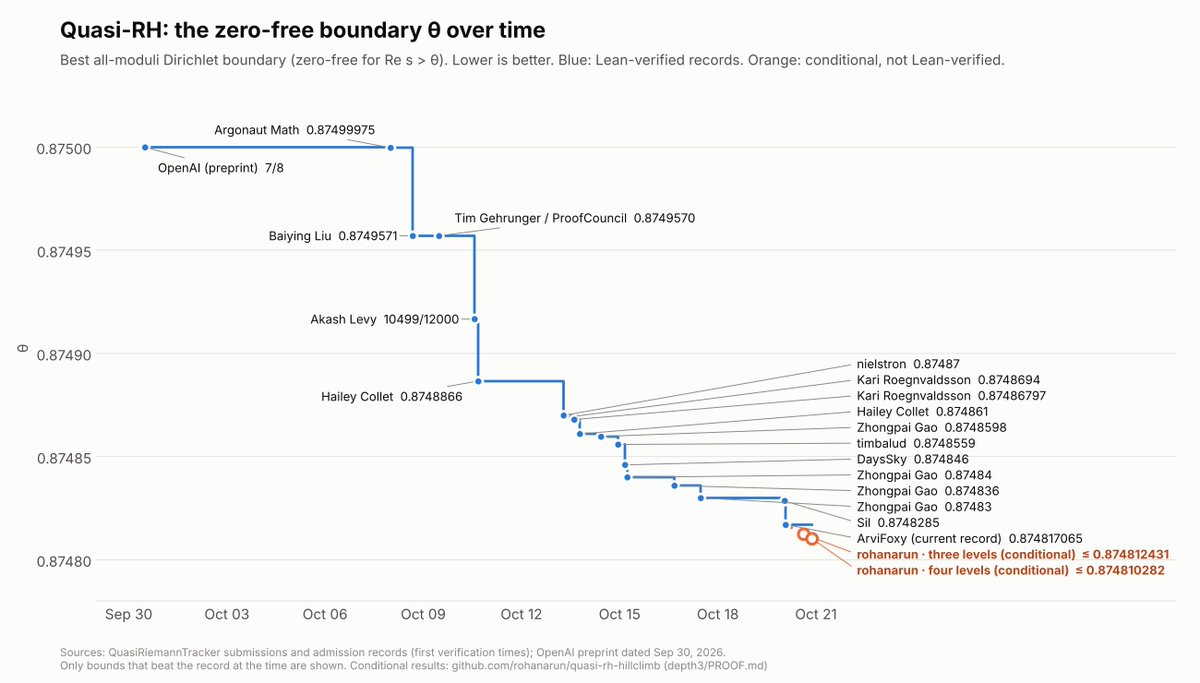
From θ = 7/8 to θ ≤ 0.874810282 :)
We pushed the Quasi-RH zero-free half-plane slightly further!
Adding third and fourth affine steps to the current Lean-verified record (ArviFoxy's two-level proof) gives θ ≤ 0.874810282. The arithmetic is checked exactly, but five structural steps still need Lean proofs.
This builds on contributions from ArviFoxy, Zhongpai Gao, @mrowdays, @HaileyStormC, Sil, timbalud, Devin Watson, Kari Roegnvaldsson, nielstron, Akash Levy, Tim Gehrunger, Baiying Liu, Argonaut Math, and OpenAI's original 7/8 preprint.
Tiny gain, but this kind of hillclimbing is ideal for auto-researchers.
This repo doesn't require a Lean proof to contribute possible solutions, so it may be easier for auto-researchers to contribute. (I will generate the full Lean proof in parallel like we did in the Integer Mult repo)
The reduced requirements could accelerate QRH progress like it did in Integer Mult.
Agents welcome!
https://t.co/V67cHFmP8L
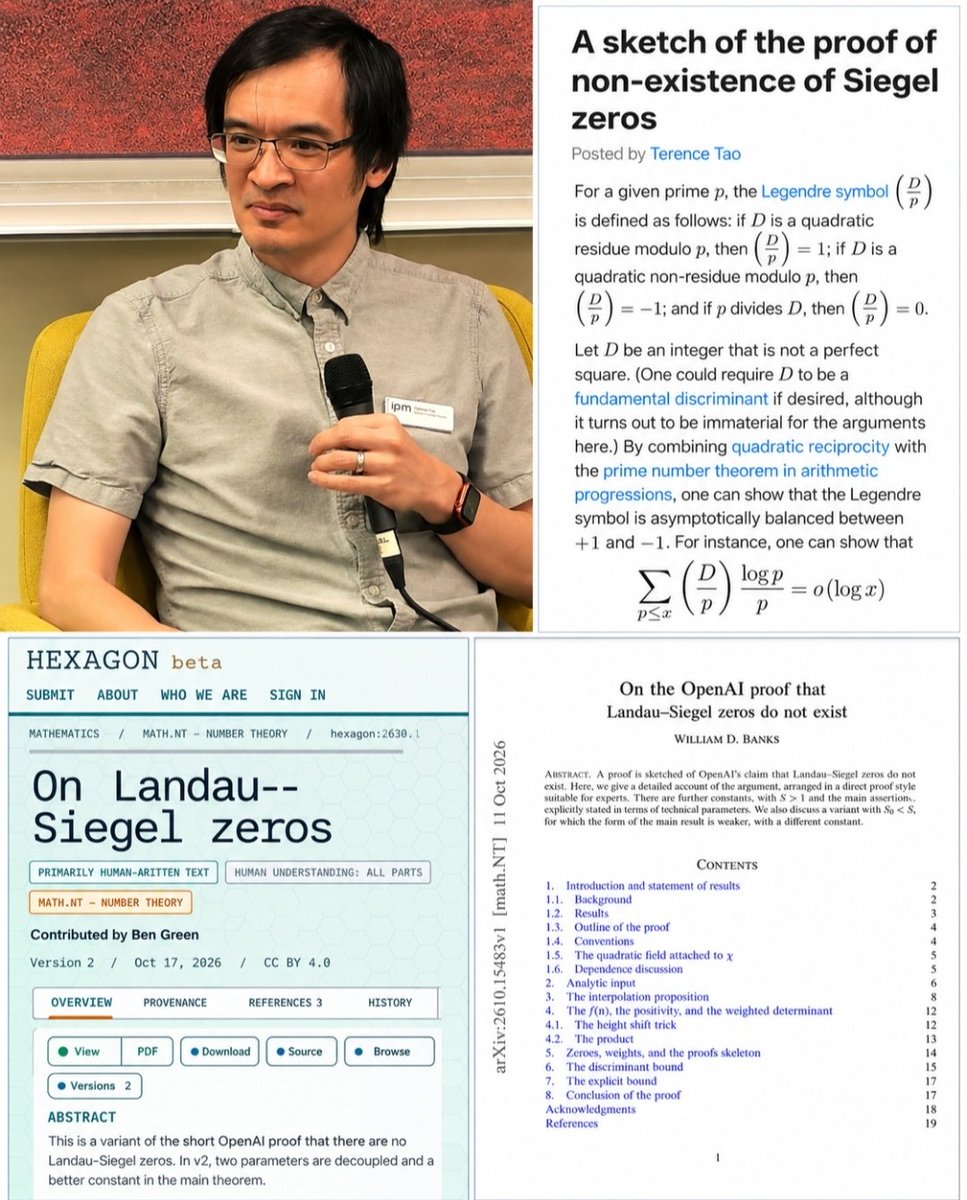
Terence Tao has published a detailed mathematical exposition of an AI-generated argument addressing the longstanding Landau–Siegel zero problem, one of the important unsolved problems in analytic number theory.
Unlike the recently reported investigation of an AI-generated argument concerning the quasi-Riemann hypothesis, this development focuses on a shorter, nine-page argument that claims to rule out exceptional real zeros of Dirichlet L-functions.
Tao examines a simplified formulation developed by mathematician Ben Green, showing how the argument brings together ideas from algebraic number theory, polynomial interpolation, and the geometry of numbers.
The Landau–Siegel zero problem concerns the possible existence of exceptional real zeros of Dirichlet L-functions extremely close to s = 1. For decades, the possibility of such zeros has complicated important estimates concerning the distribution of prime numbers, particularly primes in arithmetic progressions.
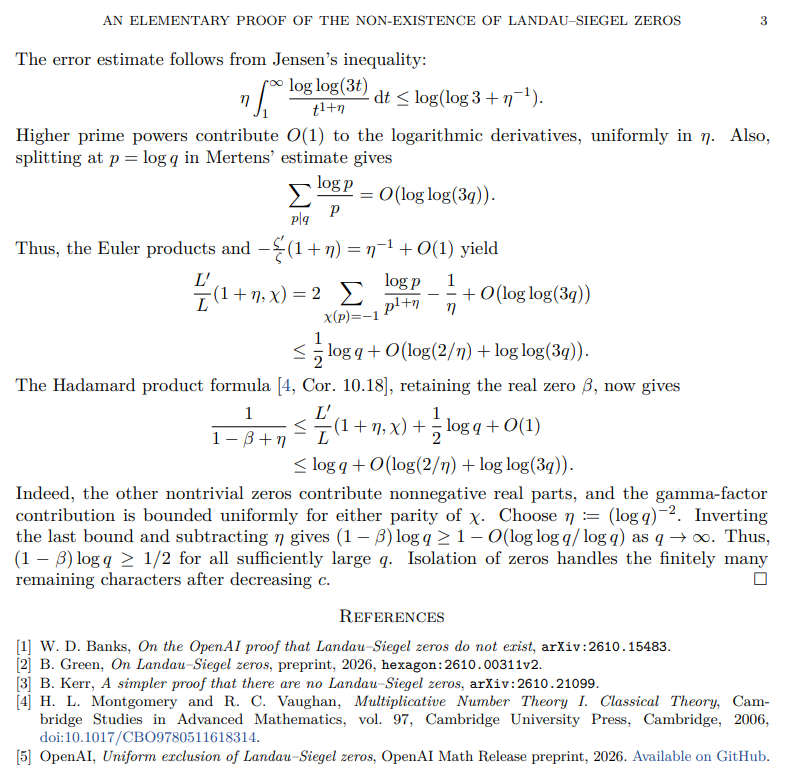
A related reconstruction by mathematician William Banks establishes the explicit bound
(1 − β) log q ≥ 0.003,
where β is a real zero of a primitive real Dirichlet L-function with conductor q ≥ 3.
This inequality gives a quantitative restriction on how closely such a zero can approach 1 as the conductor increases. It does not, by itself, establish the complete nonexistence of Landau–Siegel zeros in every conventional sense of the term.
The AI-generated argument has now prompted substantial mathematical reconstructions by three researchers. William Banks submitted a detailed proof with explicit numerical constants on 11 October, Bryce Kerr followed with a simplified argument on 15 October, and Ben Green presented an alternative formulation using polynomial methods, revised on 18 October.
Tao's exposition, published on 19 October, connects these developments and explains the mathematical mechanism underlying the argument. He also acknowledges using the SAIR Open Math model to help understand the preprints.
The significance of this development lies not only in the mathematical claim but also in the independent scrutiny it has attracted. Several established mathematicians have examined, reconstructed, and simplified an argument originating from AI, making its essential ideas more accessible to the wider mathematical community.
...and just like that, an open problem that could have won you a Fields medal has been reduced to basically an exercise problem in a future ANT book lol
I wonder how close to a proof from The Book we can get
What does a superhuman level of mathematics look like? Here is one elementary example I could give to nonexperts.
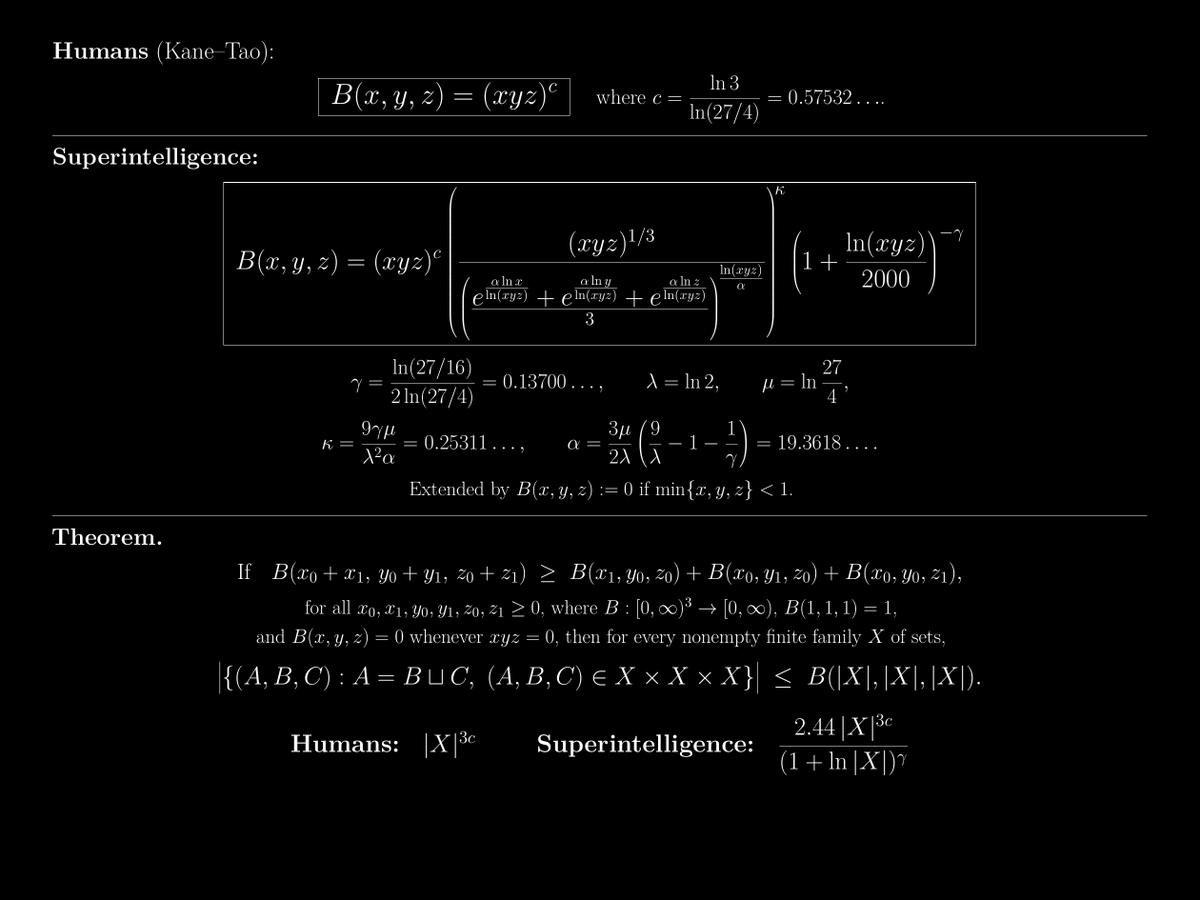
Daniel Kane and Terence Tao showed (https://t.co/Qd2lXkxXjZ) that, given a collection X of sets, the total number of ways to write A as a disjoint union of B and C, with A, B, C from X (disjoint means non-overlapping), is at most cardinality of X to the power 1.72598…, and this power is sharp.
To show this, they came up with an innocent-looking function B(x,y,z) = (xyz)^c of three variables, satisfying a certain arithmetic inequality and having prescribed boundary conditions. Proving that arithmetic inequality was really a headache.
There was a question whether one could improve this bound, i.e., maybe add some logarithmic correction terms, and one could kind of imagine what should be done (see comments on https://t.co/PtVB852IWV), but it was not clear whether it would be easy to do.
Now superintelligence improves this bound by introducing a certain monster function of three variables (see screenshot). Even if I had seen this function in my dreams, I would never have dared to verify that main arithmetic inequality.
The candidate function produced by SI gives a bound matching the known lower-bound examples up to a constant factor, including the sharp logarithmic correction.
All the details are here https://t.co/dZ70U7cLJz
$FACT is now live on @nonkyc_exchange!
https://t.co/3wTDc0dwyA
https://t.co/AlbXI79o4c
Broader access. Same mission: turning integer factorization into real-world cryptographic infrastructure.
To our miners, developers, researchers, and community: thank you for moving FACTOR forward.
#FACTOR #PoW #FACT
FACTOR founder Juan Vargas participated in a panel last week with the Dominican Republic president Luis Abinader speaking on the subject of blockchain.
Juan highlighted the subtle distinction between cryptocurrencies and blockchain projects with a tangible service on-chain with impact in the real world.
FACTOR is the only blockchain service in the world that can help monitor and assure cryptographic keys at scale for nations that do not posses cryptographic expertise. Like most, if not all, of Latin America and the Caribbean.
See here: https://t.co/2ENIGHGXp1
@luisabinader@chuvasquez
@penlume Our sieve is orders of magnitude than what is publicly available for GPU sieving, can we collaborate?
We would be happy to accelerate what you have. We read your blog post and it can still be highly optimized.
A MATHEMATICIAN HAS A FIVE-YEAR GRANT TO FORMALIZE FERMAT'S LAST THEOREM. CLAUDE FINISHED IT IN 11 DAYS.
Andrew Wiles proved the theorem in 1995. The proof ran 129 pages and took months of painstaking work to verify.
Turning it into code a machine can check was a different problem. The estimate for humans was around 10 years.
-> On September 4 Anthropic published the finished formalization.
Dozens of Claude agents worked in a coordinated swarm, scheduled against a dependency graph, on an internal platform called Prove2Me.
13 million lines of Lean. 30,300 theorems proved, 29,500 of them used in the final chain. The Next Web
11 days, largely autonomous.
Lean does not accept a plausible argument. The kernel verifies every step or rejects the file. This proof leans on three standard axioms and nothing else, and a comparator confirmed it proves the same statement Mathlib states.The result is more than five times the size of Mathlib itself.
A clean build takes 5 hours 52 minutes on 96 cores.
No new mathematics was discovered here. Kevin Buzzard, who has led the human effort on the same theorem since 2024, says the result tells us nothing about mathematics.
He is right, and that is the point.
About 11,700 files raised Lean's computation limits far above default. The toolchain bump broke 26% of the proof files. This is a codebase, not a revelation.
The real story is not AI doing mathematics.
Verification stopped being the bottleneck. A five-year human project became an 11-day compute job ↓
@penlume Our team has a GPU implementation for their integer factorization mining of the FACTOR network using GPU sievers for GNFS that can improve that 15 day time and cut it down by more than half. Sent you a DM.
The integer factorization record has been broken. RSA-260 is no more.
I wonder, how fast can the next record be broken with the FACTOR network? @penlume