The Library of St. Gall in Switzerland is one of the oldest and most beautiful monastic libraries in the world.
Completed in 1767, it houses a remarkable collection of rare medieval manuscripts, including some dating back to before the year 1000.
Macaws spend a lot of time grooming their feathers, and sometimes they need a little help reaching the tough spots. 🦜💚 In this wholesome moment, the owner helps remove old feather sheaths, allowing new feathers to open properly. It's a completely natural part of macaw grooming and a great example of the trust they share
Ancient Greeks thought delphinium flowers resembled leaping dolphins and named them delphinion (“little dolphin”). In Greek mythology, dolphins were sacred to Apollo. They were believed to rescue sailors from drowning at sea and carry them safely ashore. #MythologyMonday
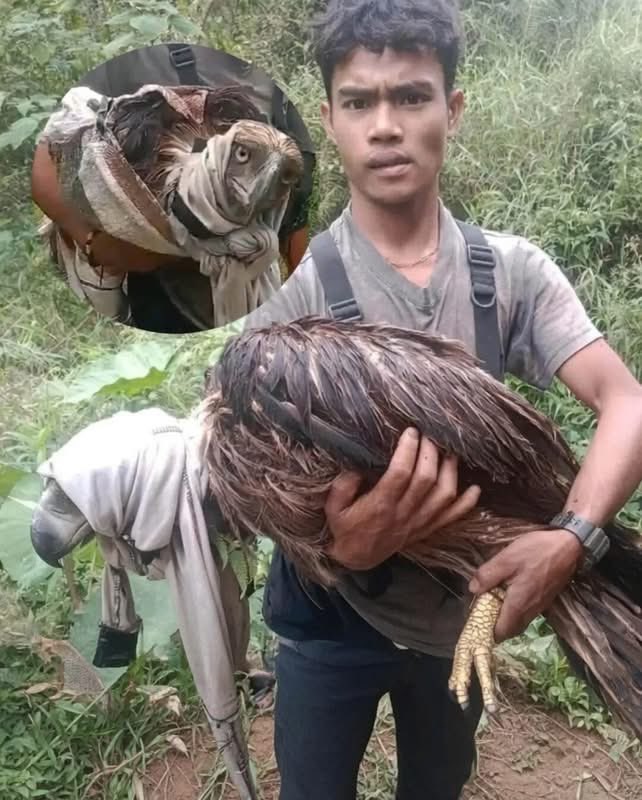
While foraging in a Philippine forest, Marven Linoy stumbled upon a critically endangered Philippine Eagle being attacked by over 30 monkeys. He barked like a dog to scare the troop away, covered the injured bird with his jacket, and called for help.
Rescuers from the Philippine Eagle Foundation found the bird severely dehydrated and wounded. X-rays later revealed a darker backstory: she had two pellets lodged in her body and rope burns on her legs, indicating she had been shot and trapped prior to the monkey attack.
Now named Sawaga-Dalwangan, the eagle is receiving intensive veterinary care. With only an estimated 400 breeding pairs left in the wild, Linoy's quick intervention saved a vital life for the species.
When a Cherokee woman wanted a divorce, she just put her husband's belongings outside—and that was legally binding. No lawyers. No judges. No permission from male relatives. If she decided the marriage was over, she gathered his things, placed them on the doorstep, and he left. Because in Cherokee society, women owned the houses. The land. The food. The tools. Everything in them.
When European colonizers arrived in what is now the southeastern United States, they were shocked. They expected a world where men ruled, and women obeyed. Instead, they found a society where women held real power. Cherokee women sat in councils alongside men, debating war, treaties, and tribal policies. Some earned the title of "Beloved Women" or "War Women," a position of authority so great their words could spare prisoners’ lives or decide whether the nation went to battle. Nancy Ward, one of the most famous Beloved Women, negotiated directly with colonists and influenced decisions during the Revolutionary War era.
But power wasn’t only political. Cherokee society was matrilineal: identity came from the mother’s clan, children belonged to their mother’s family, and property passed from mother to daughter. When a couple married, the husband moved into his wife’s home. If he failed as a father or husband, her brothers—not his male relatives—held authority over him.
Irish trader James Adair, living among the Cherokee in the 1700s, was scandalized. He called it a “petticoat government,” unable to imagine a world where women weren’t property. Yet women weren’t just making laws—they ran the economy. They cultivated corn, beans, and squash, the “Three Sisters” that fed the nation. They wove baskets that held water, tanned hides into soft leather, built houses, and raised children. They preserved stories, dances, and traditions that kept Cherokee identity alive. Men hunted, fished, and fought—but the women controlled the distribution of food. Men might provide, but women decided its fate.
This wasn’t utopia. There was hierarchy, conflict, rules. But it worked on a fundamentally different principle: women and men were different but equal partners, each with authority over vital aspects of life.
Then came forced removal, boarding schools, and federal policies meant to erase Cherokee culture. The U.S. recognized only male leaders, imposed patriarchal laws, and taught women to be submissive. Yet Cherokee women resisted, preserving language, stories, and traditions. Today, Cherokee Nation citizenship is still traced through maternal lines in many families, keeping alive the principles of centuries past.
The power Cherokee women held wasn’t a quirk. It was proof that patriarchy is a choice, not inevitability. In the 1700s, Cherokee women owned property, divorced freely, and shaped government—rights most American women wouldn’t see for centuries. The next time someone says gender inequality is “just how things have always been,” remember the women who placed their ex-husbands’ belongings on the doorstep, on land they inherited, in a nation where their voices mattered. Different worlds are possible. We know because they existed.
#archaeohistories
🔹THE CHILDREN'S HOSPITALS KNOW. THEY HAVE KNOWN SINCE 2014. A PEDIATRIC ONCOLOGIST JUST SENT US HIS RESIGNATION LETTER. READ IT.
"To the Board of Directors, St. Jude Children's Research Hospital. Effective immediately, I resign.
I have spent 19 years in pediatric oncology. I have treated 2,300 children with cancer. I have watched 814 of them die.
I am writing this letter because I cannot carry the weight of what I know for one more day.
In 2014, I was invited to a closed-door presentation at a medical conference in Geneva. The presentation was titled: 'Non-Invasive Electromagnetic Approaches to Pediatric Tumor Regression.' It was not listed in the public program.
The presenter — whose name I will not reveal for his safety — showed us data from 340 pediatric cancer cases treated with frequency-based therapy between 2009 and 2014:
— 312 out of 340 children achieved complete tumor remission
— Average treatment time: 3 sessions of 25 minutes each
— Side effects: ZERO
— Recurrence rate: 4%
— Age range: 2 to 16 years old
312 children. Cured. No chemotherapy. No radiation. No hair loss. No vomiting. No organ damage. No death.
I sat in that room with 40 other pediatric oncologists. We all saw the same data. We all understood what it meant.
Then we were told:
'This technology is not approved for civilian use. Any attempt to replicate, discuss, or disseminate these findings will result in immediate termination and criminal prosecution. You are bound by the non-disclosure terms of your conference registration.'
We went home. We went back to our hospitals. We went back to injecting children with chemotherapy that we KNEW was unnecessary.
I went back to Room 4B. That's where we do pediatric chemo at my hospital. Room 4B.
I went back to holding the hands of 6-year-olds while poison dripped into their veins.
I went back to telling mothers: 'We're doing everything we can.'
We were not doing everything we could. We were doing everything we were ALLOWED to do.
Since 2014, I have personally administered chemotherapy to 847 children.
I know — with absolute certainty — that at least 70% of them could have been cured in 75 minutes with zero pain.
Instead, I gave them 6-18 months of chemical torture. I watched their hair fall out. I watched them vomit until they had nothing left. I watched their parents sell their homes to pay for treatment that I KNEW was inferior to technology that already existed.
I watched 214 of those children die.
214 children. Dead. Since 2014. Under my care. While I knew.
I am not asking for forgiveness. There is no forgiveness for this.
I am asking for this letter to reach every parent who has ever been told 'there's nothing more we can do.' Because that sentence is a lie. It has been a lie since at least 2014.
There IS more they can do. There is a treatment that cures pediatric cancer in 75 minutes with zero side effects. It exists. It works. 312 children proved it works.
Your doctor knows. Your hospital knows. The board of directors knows.
They chose money over your child's life. I chose my career over your child's life.
I will not choose it one more day.
To the 214 families whose children I failed:
I am sorry. I am sorry I was a coward. I am sorry I chose silence. I am sorry I let the system convince me that obedience was the same as ethics.
It is not. Obedience killed your children. My obedience killed your children.
This letter is not enough. Nothing will ever be enough. But the silence ends today."
— Name withheld. Pediatric Oncologist. 19 years. 2,300 patients. 814 deaths. 214 preventable.
He watched 214 children die knowing the cure existed. He stayed silent for 10 years. He is not silent anymore. Neither are we.
Share this for every child who deserved 75 minutes instead of 18 months of poison.
Valentin Gruener from Germany has cared for lioness Sirga for 12 years in Botswana’s Kalahari. 🇧🇼
Abandoned by her mother, he raised her from a cub. She roams freely in a 2,000-ha reserve and hunts, but chooses to spend ~75% of her time with him. He can secure her safely during threats like poaching, fires, rival prides, or illness.
I'm a cardiologist. Everyone is sharing this study as a skin story. They're burying the part that matters.
Scientists took the aorta of a 75-year-old donor, applied a single engineered enzyme, and stripped away more than 70% of the molecular damage — bringing it down to the levels you'd see in a 30-year-old artery.
Published five days ago in Nature Communications. Revel Pharmaceuticals, with Calico and the University of Colorado.
Here's what they erased.
Sugar reacts with proteins in your body the same way heat browns bread — slowly, over a lifetime. It leaves behind a residue called CML, the most abundant advanced glycation end product in aging tissue. It welds itself onto collagen and elastin in your skin, your eye lens, and your arterial walls.
Two things follow. Your arteries stiffen. And CML latches onto a receptor called RAGE, which drives chronic inflammation — the exact fire I've been writing about for months as the engine of heart disease.
Since the 1980s this damage was considered permanent. Your body has no enzyme to remove it. Every existing approach only slows new damage from forming. Nothing touched what was already there.
So they built an enzyme that doesn't exist in nature. They screened 45,000 protein structures, then ran five rounds of directed evolution across more than 500 million variants until they had CMLase — a molecular lawnmower that oxidizes the CML off the protein and restores the original, healthy lysine underneath.
Not patched. Reversed.
Over 70% cleared from elderly arterial tissue. Over 55% from elderly skin — below the levels found in 31-year-old skin. 45-78% in lens proteins. The CEO said they expected 20% and were floored.
Arterial stiffness drives systolic hypertension, heart failure, and stroke, and I have no drug that reverses it. I can slow the process. I cannot undo it. This paper says undoing it may be possible.
The caveats are real and I won't skip them. This was done on donated tissue in a dish, not in a living person. No functional data yet — we don't know if that artery got measurably more elastic. Delivering a large enzyme deep into human tissue is a hard, unsolved problem. Clinical trials are years away.
But something considered permanent for forty years just came off human tissue.
We spent a century learning to slow aging. Someone finally figured out how to erase it.
Thank you @theallinpod@friedberg@chamath@pesottas
Richard Feynman stood at a Cornell blackboard in 1964 and explained the problem every AI lab is fighting in 2026. The BBC filmed it. Almost nobody watches it.
The lecture is about why nature only answers in mathematics. Every team forcing language models to reason is hitting the wall he mapped 62 years ago.
He was 46. The Nobel Prize came 11 months later. The footage survived on film reels and now sits free on YouTube with fewer views than a keyboard unboxing.
Watch the blackboard section near the middle. He takes 1 of Kepler's laws and rebuilds it from nothing, with notation a 12-year-old can follow.
No slides. No jargon. 1 piece of chalk.
An ML engineer I know paused it 4 times and made his whole team watch it before standup.
You're 62 years late. The lecture is still free.