There's been a pattern where we normalized a very inefficient way of living. However, something quietly shifted in how people relate to ownership. Most haven't noticed yet.
Most owned items spend more time sitting idle than being used. People buy them for temporary moments, then leave them untouched for months or even years. That unused gap is bigger than most people realize.
The real issue isn’t access anymore, its trust. Peer-to-peer systems break down quickly when people can’t verify ownership, authenticity, or accountability. Nobody wants uncertainty attached to valuable items.
@ivaultapp saw this as a potential problem and built a blockchain-verified digital twin model that solves the trust bottleneck before it even becomes a problem.
Sharing works differently when it happens within neighborhoods and nearby communities. Less friction, faster coordination, stronger reputation systems. Trust forms quicker when people feel connected to the network around them.
The incentives in the Ivault app change behavior even more. Users get rewarded for listing items, returning them, verifying activity, and participating consistently. Once the system rewards contribution, participation compounds naturally. And slowly, ownership itself starts changing.
People realize they don’t need to buy everything they rarely use. Access becomes more valuable than ownership.
#ivault
common patterns in the way ownership is shifting exist. you see them once you stop looking at assets as static.
• the idle inventory problem
most owned items sit unused. the utilization rate on physical goods is low. that gap is the opportunity.
• the trust bottleneck
peer transactions stall without verification. who owns what. is it real. blockchain-verified digital twins answer this before the question is asked.
• the neighborhood layer
proximity matters. local lending reduces friction, builds reputation, creates community before it creates revenue.
• the token incentive loop
rewards for listing, returning, verifying. behavior compounds when the system pays for participation.
• the ownership redefinition
you don't need to buy what you rarely use. access replaces acquisition. the asset base stays the same. the behavior changes.
these shifts aren't theoretical. they're already happening in the margins.
The day a VC told me peer to peer rental was a solved problem and blockchain added nothing to it, I understood exactly why most people building in this space stop explaining themselves.
Good evening guys👋👋
Gotta share something before going to bed
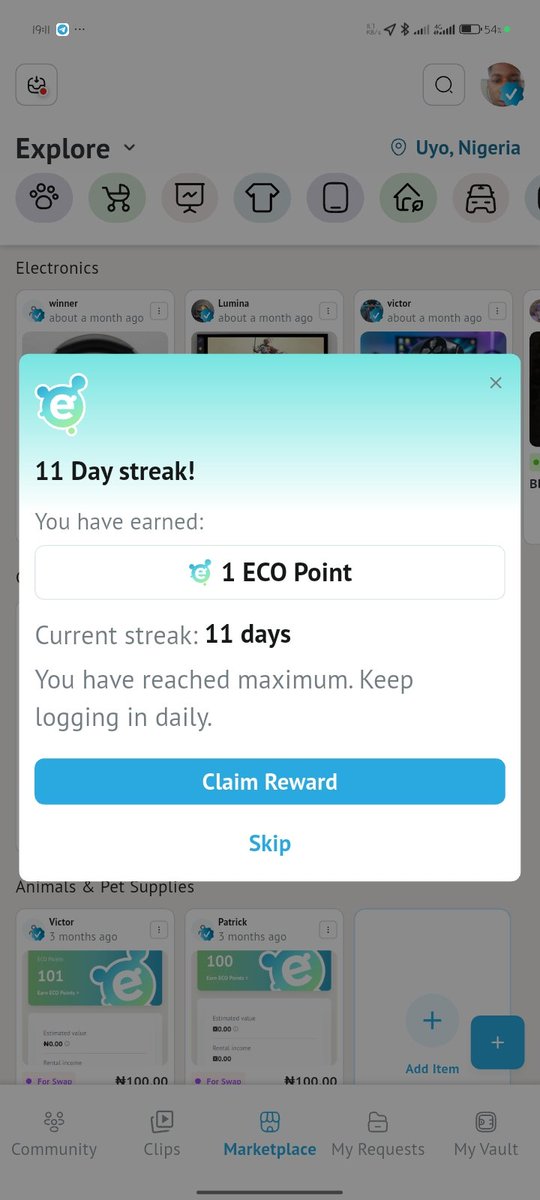
I finally completed my 10-day ECO streak in the ivault app and unlocked the 3 ECO Points daily reward. Watching those points stack up wasn't easy but after so many failed streaks I finally completed it😅.
I actually like the fact that ivault didn’t make earning rewards in the app so complicated. You earn ECO Points by basically using the app. Invite people, list items, answer quizzes, stay active, complete simple tasks, it all adds up over time.
A lot of people still see ECO Points as “just points,” but we already saw the first ECO to $IVT conversion happen. The second wave of eco point conversion to $IVT is coming soon, which means the activity people ignore now will end up mattering later.
If you’ve been meaning to stay active on the app, this is probably the best time to start stacking up those eco point, and utilize the model @ivaultapp has built.
#ivault