A little AI search hack I've been using:
Take your SEO keyword research & convert keywords into prompts for AI search within Google sheets' AI function using a prompt like this one:
=AI("You are converting a terse SEO search keyword into the natural-language query a real person would actually type or speak to an AI assistant like ChatGPT, Gemini, or a voice assistant. Rewrite the keyword as a single conversational question or request that preserves the exact search intent and intent type (informational, commercial, transactional, or local). Phrase it the way someone would genuinely ask out loud in a full sentence — not in keyword shorthand. Keep any brand, product, or location named in the keyword, but do NOT invent specifics, constraints, or details that aren't already implied. Do not answer the query. Return only the rewritten prompt as plain text — no quotation marks, no preamble, no explanation, no trailing punctuation beyond a question mark. Keyword:", A2)
Google has launched Search profiles for publishers and creators.
So I built a tool to help you find Search Profiles from anywhere.
https://t.co/NHIWgo5HUd
Google anuncia, en colaboración con la comunidad de Schema(.)org un nuevo repositorio con datos de uso de los diferentes marcados de datos estructurados a lo largo de Internet.
Estos datos, que se actualizarán de manera mensual, estarán disponibles para su análisis o descarga (en .csv o .json) desde el GitHub oficial de Schema: https://t.co/jL1s9lMAz2
Una manera de ver la adopción de los datos estructurados con el paso del tiempo, así como para ver cuál de ellos escoger en base a su nivel de implantación en casos de duda ante otros similares.
Puedes ver el comunicado oficial de Schema en: https://t.co/sZRRJBMjMh
Así como algo más de información adicional en: https://t.co/wG57AjzdKs
Last week Google announced that Search was undergoing its biggest change in 25 years.
Two days later they launched a core algorithm update on top of it.
Here is exactly what happened, what it means for your brand, and what to do next:
The new Google Search box accepts text, images, files, videos, and open Chrome tabs.
It expands dynamically as you type and anticipates your intent before you finish asking.
It is powered by the newest Gemini model, now the default model for AI Mode globally.
[Want to know where your site stands across Google AI, ChatGPT, Claude, Grok, etc?
Check here (it's free):
https://t.co/Pn764BHwyL]
Nearly 50% of all Google searches now display an AI answer at the top of the page, up from 34.5%in December 2025.
Information agents, which run 24/7 in the background scanning the web on your buyer's behalf, are launching this summer for Google AI Pro and Ultra subscribers.
On May 21, two days after saying that Search was changing, Google launched its May 2026 core update.
This is the second broad core update of the year and fourth *confirmed* ranking update of 2026.
Early observations show thin informational content losing visibility, but not as much as during the last core update.
Sites with strong topical authority and named expert voices are holding or gaining, but again, movements aren't as pronounced as the last core update (yet).
But back to the new Search box.
Google came out and said in a statement that it is not replacing traditional search (yet). Blue links are staying (for now).
But the brands that only show up in blue links are now competing for a shrinking share of clicks.
Meanwhile the brands being cited inside AI answers are pulling ahead.
In fact, brands cited inside AI Overviews earn more organic clicks and more paid clicks than non-cited competitors on the same queries.
And with information agents launching this summer, the brands in that cited source pool will be recommended continuously, automatically, to buyers who are actively monitoring their category 24 hours a day.
So what should you do?
The core update and the Search redesign are rewarding the same signals.
Content depth matters, a lot.
Cover every sub-question a buyer in your category asks.
Every page that answers one of those sub-questions is another chance to get cited.
Editorial authority matters a lot, too.
Backlinks from trusted websites are what signal credibility to every retrieval system Google has ever built. They lift your entire domain, making every page more likely to appear in AI retrieval for sub-queries.
The May core update is rewarding this signal. The information agents launching this summer depend on it.
If you need help with all of the above, SEO Stuff (https://t.co/wKpf0EILTx) was specifically designed to build this system out.
The done-for-you package: https://t.co/yEFyM0Ze7W
10 pieces of optimized content built to cover the sub-questions Google's AI systems pull from in your category. 3 DR50+ contextually relevant backlinks to build authority. Full SEO and AI search visibility audit and roadmap.
The "just content" package: https://t.co/4CAnUt07PO
60 pages of expert-attributed content covering the full question map in your category. The strongest driver of AI citations and topical authority simultaneously.
Google is changing. It's time to prepare accordingly.
And if you want to know where your site stands right now across Google and AI search, check here (it's free):
https://t.co/Pn764BHwyL
There is a reason more than 80 percent of SEO Stuff customers reorder. The results continue long after the work is done.
how to automate your entire seo workflow with okara:
> go to https://t.co/8b7IyKwzJR
> drop your website url
> it audits your site, finds technical issues, keyword gaps, and content opportunities
> connect your github repo and it fixes seo issues automatically
> connect your cms and it writes and auto-publishes seo articles to your cms daily
🚀 The Latest in SEO & AI Search Updates & Releases from #SEOFOMO - May 24, 2026 👇
* Google didn’t flip the AI Mode switch. It rebuilt the Search doorway.
* Google Shopping introduces Universal Cart at Google I/O, an AI-powered shopping cart
* How AI Mode is changing the way people search in the U.S.
* Google Confirms May 2026 Core Update Is Now Rolling Out
* Google Adds Markdown Files To Help Docs, But Not Used For Search
* More traffic and engagement insights about the recent ChatGPT changes on May 7th, giving links more prominence
* Google Expands AI Mode With New Ad Placements For Advertisers
* The Schema Question, Reframed or Trying To Clarify What It Is For
* Scaling AI Content Is The #1 Enterprise Priority: How Do You Scale Without Penalty?
* Your Inbox Might Be the Next AI Search Signal
* The Problem & The Fix on GEO case studies promising results in 1 week
* Is AI Killing Publisher Search Traffic? What The Guardian and Telegraph Think
And more 🔥 SEO resources, including tools, events, jobs!
From SEOs and marketers like @wilreynolds@gfiorelli1@theshelleywalsh@garrettsussman@Jammer_Volts@thetafferboy@bngsrc and many more.
Check it out: https://t.co/CtfpK0LNj2
Must-read SEO: 7 Ways to Automate Content Workflows With Agents.
You can use AI agents to automate refreshes, topical authority analysis, links + more:
You could literally:
> open Claude
> paste these 20 prompts
> do the work of an entire SEO agency
> pay $20/month instead of $10k
> outrank every competitor in your market
> make $100k/month
The math is a no brainer.
What’s stopping you?
Hootsuite is officially cooked.
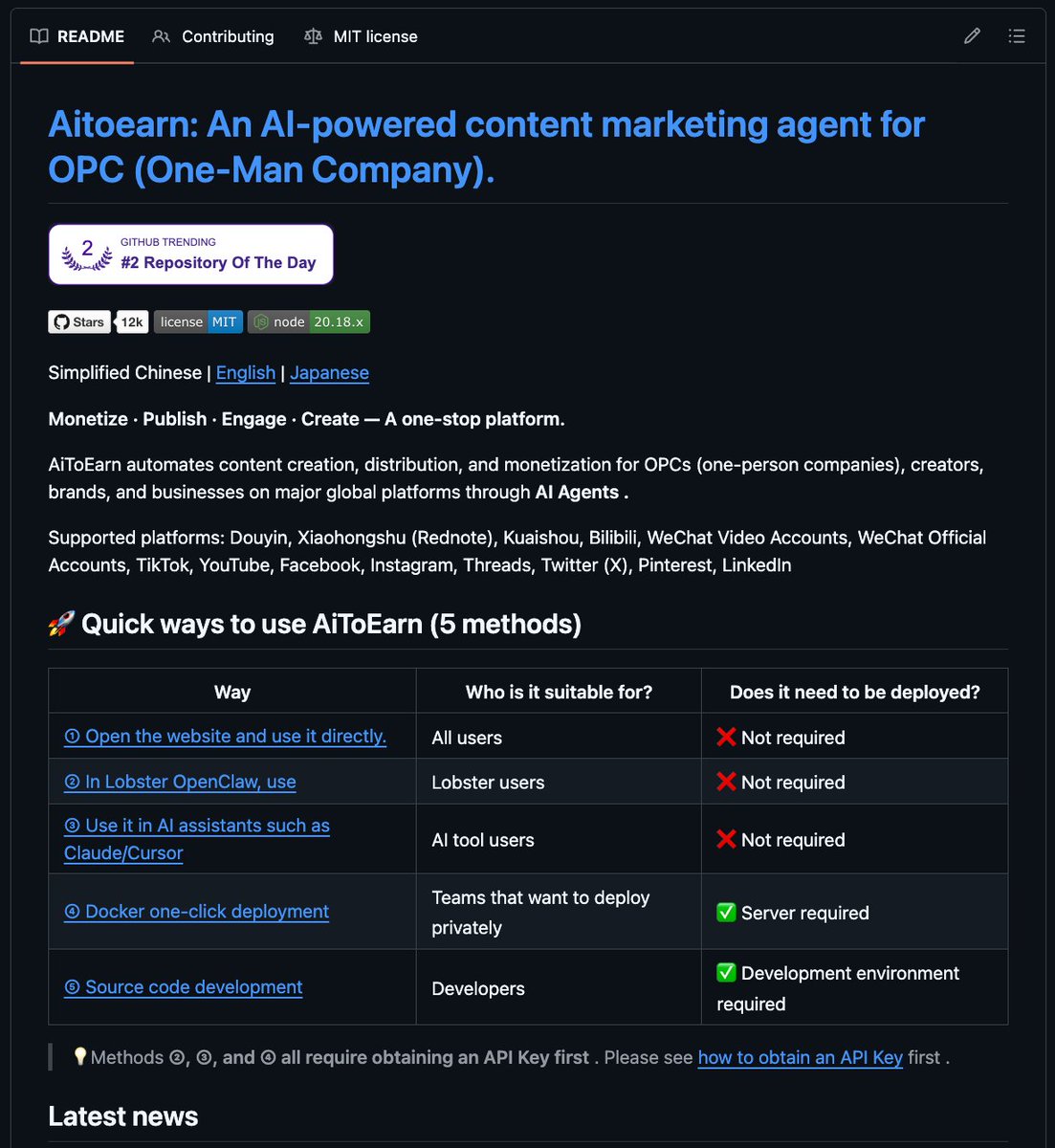
AiToEarn is a full AI agent for content marketing. Create, publish, engage, and monetize across 14 platforms from one place.
12,200 GitHub stars. 100% open source. MIT licensed.
What it does:
→ One-click publishing to TikTok, YouTube, X, Instagram, LinkedIn, Facebook, Threads, Pinterest, Bilibili, Douyin, Xiaohongshu, Kuaishou, WeChat Channels, WeChat Official
→ "All In Agent" auto-generates and publishes content for you
→ Trend Radar surfaces viral content before it peaks
→ Comment search detects buying signals like "link please" and "how to buy"
→ Calendar scheduler across every platform
→ Plugs into Seedance, Kling, Hailuo, Veo, Sora, Pika, Runway, Flux, GPT image
→ Self-host with one Docker command
Hootsuite is $99/month. Buffer is $100/month. Later is $80/month.
This is free.
Social media managers have charged $5k/month retainers for what this repo does in one click. That business model is done.
SEO in 2025:
❌ Ahrefs for keyword research
❌ Human prospecting for links
❌ Surfer for content optimization
❌ Screaming Frog for tech seo
❌ 2-3 content writers for blogs
SEO now:
✅ Claude + API keys
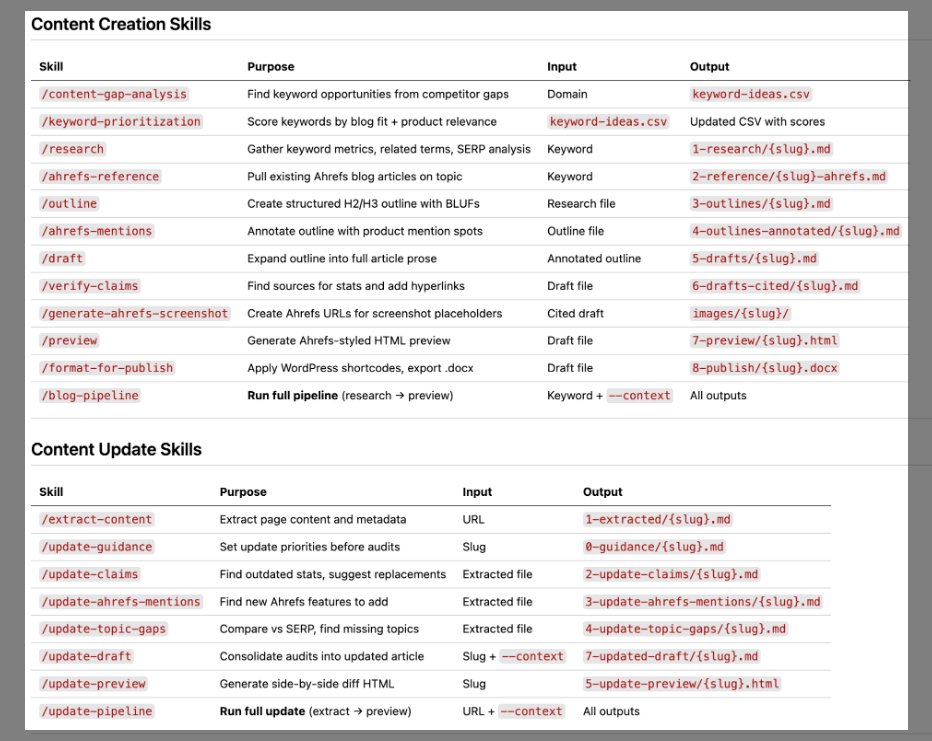
Here's how I run my ENTIRE SEO operation through Claude 👇
🔥 Great news for Websites: @Google is releasing new updates to AI Mode and AI Overviews to find relevant websites, deep insights and original content from across the web 👇
1. Explore new angles: You’ll start to see suggestions for where to go next at the end of many AI responses. This section links to unique articles or in-depth analyses on different facets of your topic.
2. See links right where you need them: To help you dig deeper into useful websites as you’re reading, you’ll now also see more links directly within AI responses — right next to the relevant text.
3. More UGC! Get advice from people who have been there: AI responses will now include a preview of perspectives from public online discussions, social media, and other firsthand sources. They're adding more context to these links, like a creator’s name, handle, or community name, etc.
4. Get more context on linked websites: They're now giving you a quick preview of a website when you hover over an inline link in AI experiences on desktop. You’ll see helpful information, like the name of the website or title of the web page, so users have a better idea of the site to help click through.
5. Easily access your news subscriptions: A new feature that highlights links from your news subscriptions in AI Mode and AI Overviews. Subscription linking information for publishers can be found here: https://t.co/cE8MrTaR2M
--- These look like useful new releases that should improve referrals towards sites 🙌
Read more here: https://t.co/zS33qsilwH - can't wait to see the impact 👀
/ht @rmstein
Very well written article, thought provoking and that punches up well.
Totally worth a read, specially for those that don't "know enough" technical SEO/GEO
Thank you for this great article, @pedrodias
Eric Schmidt (ex-Google CEO):
“If you really want to make money, start an agentic AI company. This is the agentic period in AI.”
Claude + SEO is going to make more millionaires in 2026 than Wall Street has in the last decade.
don’t bookmark this if it crosses your timeline.
just paste this entire thing into Claude.
thank me later.
Acabo de ver que hace unas semanas que se publicó esta charla que tuve con Pedro en sus oficinas de Palo Seco allá por septiembre.
La comparto por aquí ya que es TOP3 entrevistas donde más contento estoy de cómo quedó todo y de los temas que tratamos.
➡️ https://t.co/PVLPAyAjvt
Gracias a Pedro y su equipo por cierto, por la invitación y por ser tan majos 😃
If you had one of the fastest HTML parsers in the world...
...could you reverse-engineer ChatGPT's ranking factors?
--
Some background...
I've been working on parsing HTML for 20 years now. Not just the usual things like text and links, but interpreting marketing opportunities, article text, advertising, comments, etc.
I set the problem down three years ago and picked it up again this year. I finished it last week.
Compared to the best parsers on GitHub, this is 100-200x faster than anything else.
With a single CPU core on decade-old hardware, it's capable of parsing the most recent Common Crawl dataset of ~3 billion web pages as fast as it can be downloaded on a gigabit connection (~8 days).
Why spend 20 years on this?
--
Most large-scale data challenges are solved by throwing more hardware at the problem. Costs and complexity balloon quickly.
If you're parsing 20-40 web pages per second, per CPU core, you need 1-2 dozen machines to process 3 billion web pages in the same 8 days I'm doing it with a couple cores on one machine.
Managing more machines is more complex, opens up new sets of issues, and the time cost of managing that becomes pretty inconvenient...
But the cost isn't even the main reason.
--
When parsing 100-200x faster, new opportunities become immediately viable.
Want to find all the mentions of your brand? Your competitors? Your brand and competitor links? Executives? Product names?
You want link prospects? How about all the articles that mention certain words in the post with followed outbound links, sorted by PageRank?
Or the articles that contain sponsored links?
Or the articles that link to multiple competitors, but not you, and all of those links are followed and not marked as sponsored or ugc?
Sure. Give me a couple weeks.
Need it in a week?
Alright, I'll get another server or two and split up the work.
Oh, you don't want just the most recent 3 billion common crawl pages analyzed? You want the last 12 months, and 30 billion+ pages analyzed for opportunities? And you need it in a month?
No problem.
If you want help with reputation monitoring, competitive analysis, link prospecting, or anything else like that, message me.
But there's more...
--
GPT-2, the version of ChatGPT that was deemed "dangerous" was 40 gigabytes of pure text.
That's in the area of 10 billion words... Assuming a post length of 250 words, we're looking at about 40 million web pages of text...
Extracting the main content and separating it from navigation, etc, now makes Common Crawl data look like modern LLM training data...
Would it be possible to figure out patterns, per industry, of how and why certain sites are recommended by LLMs?
I believe so... It requires a lot more than HTML, which I'll be walking through this week.
Follow me for more. I'll be explaining more along the way and releasing a massive set of research next week that goes far beyond all of this in an attempt to reverse-engineer ChatGPT's ranking factors.
🚨 INSTEAD OF WATCHING NETFLIX TONIGHT.
Spend 1.5 Hours with THIS.
A Claude + SEO FULL COURSE that teaches you how to dominate Google rankings like a $10k/month SEO Agency.
The people who watch this tonight will wake up tomorrow with a new skillset altogether.
Watch it. Read the 20 prompt article.
Bookmark both now.
🤖 SEO en la Era de la IA: Cómo posicionar en LLMs
Ya puedes ver mi charla en el pasado Talent Arena donde hablé de:
1⃣ Qué es y cómo funciona un LLM
2⃣ El cambio de paradigma en la búsqueda en Internet
3⃣ Cómo aparecer en los resultados de la IA
4⃣ Cómo NO aparecer en los resultados de la IA
Media hora llena de datos, documentación y ejemplos reales para poner blanco sobre negro la situación real actual tanto en Google como en ChatGPT.
https://t.co/7PMdplP6LH
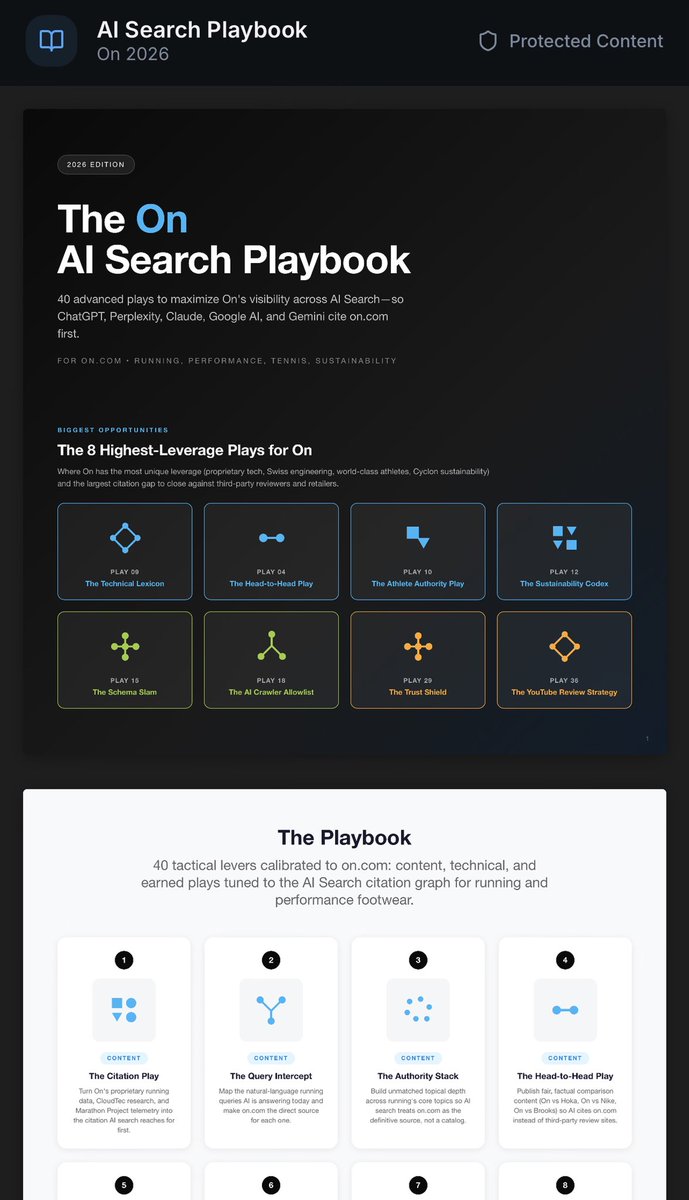
This AI SEO Playbook is quite literally... out of this world, freely available, and by former Head of SEO at NASA, Rodrigo Stockebrand @spanglishseo 🚀👽🛸🔬
Rodrigo shares 40 advanced plays to maximise On Running’s visibility across ChatGPT, Perplexity, Claude, Google AI and Gemini. The most comprehensive GEO/AEO resource I’ve seen to date - and applicable to any brand serious about AI search.
🤓 TL;DR: 14 content plays, 13 technical plays, 13 earned plays. Each with tactical steps, difficulty ratings, timeframes, KPIs and a “where to start in 30 days” section. This isn’t a blog post - it’s a full operating manual.
What this incredible playbook covers:
🧠 Content plays - “The Citation Play” turns proprietary data into the citation AI reaches for first. “The Head-to-Head Play” publishes brand vs competitor comparisons so AI cites you instead of RunRepeat. “The Technical Lexicon” makes your brand the definition source for your own proprietary terms. “The Buyer’s Decision Tree” maps every runner-to-shoe decision path into structured, AI-extractable content.
⚙️ Technical plays - “The Schema Slam” deploys full Product + Offer + Variant + Review schema across every PDP. “The AI Crawler Allowlist” explicitly welcomes GPTBot, ClaudeBot, PerplexityBot with llms.txt and llms-full.txt. “The Server-Side Render Audit” catches content invisible to AI crawlers. “The Disambiguation Play” stops AI confusing similarly named products.
📡 Earned plays - “The Reddit Embassy” runs transparent AMAs with engineers - no astroturfing. “The YouTube Review Strategy” seeds structured review access to running creators whose transcripts feed LLMs directly. “The Podcast Citation Play” turns interview transcripts into perennial citation sources. “The Trust Shield” turns Runner’s World, Wirecutter and RunRepeat coverage into a trust network pointing back to the brand.
🔬 Things I’ve tested and can vouch for:Schema at PDP level making a measurable difference to AI extraction accuracy. FAQ blocks being the single most extractable content format (Play 11 - “The FAQ Goldmine” nails this). Comparison content earning disproportionate citation share. And SSR gaps silently killing AI visibility - most brands don’t even know their content is invisible to crawlers that don’t execute JavaScript.
🪙 My 2-pence:
💡 This is the real deal. Not a theory deck. It’s calibrated to a specific brand (On Running) with specific products, athletes and competitor dynamics - which is exactly what makes it incredibly useful rather than generic.
💡 The earned plays section alone is worth the read. Most AI SEO content stops at schema and content structure. This covers Reddit, YouTube, podcasts, press, retailer co-marketing - the full signal network AI triangulates from.
💡 Not plug-and-play. You still need to calibrate every play to your brand, your data and your competitors. But the framework is the best starting point I’ve seen.
Rodrigo, take a bow👏🏼🏆
Rodrigo's AI Search Playbook
https://t.co/ej6iDHrrT6
His announcement post:
https://t.co/4qmnD3uzOL
#ai #seo #google #llms


![alexgroberman's tweet photo. Last week Google announced that Search was undergoing its biggest change in 25 years.
Two days later they launched a core algorithm update on top of it.
Here is exactly what happened, what it means for your brand, and what to do next:
The new Google Search box accepts text, images, files, videos, and open Chrome tabs.
It expands dynamically as you type and anticipates your intent before you finish asking.
It is powered by the newest Gemini model, now the default model for AI Mode globally.
[Want to know where your site stands across Google AI, ChatGPT, Claude, Grok, etc?
Check here (it's free):
https://t.co/Pn764BHwyL]
Nearly 50% of all Google searches now display an AI answer at the top of the page, up from 34.5%in December 2025.
Information agents, which run 24/7 in the background scanning the web on your buyer's behalf, are launching this summer for Google AI Pro and Ultra subscribers.
On May 21, two days after saying that Search was changing, Google launched its May 2026 core update.
This is the second broad core update of the year and fourth *confirmed* ranking update of 2026.
Early observations show thin informational content losing visibility, but not as much as during the last core update.
Sites with strong topical authority and named expert voices are holding or gaining, but again, movements aren't as pronounced as the last core update (yet).
But back to the new Search box.
Google came out and said in a statement that it is not replacing traditional search (yet). Blue links are staying (for now).
But the brands that only show up in blue links are now competing for a shrinking share of clicks.
Meanwhile the brands being cited inside AI answers are pulling ahead.
In fact, brands cited inside AI Overviews earn more organic clicks and more paid clicks than non-cited competitors on the same queries.
And with information agents launching this summer, the brands in that cited source pool will be recommended continuously, automatically, to buyers who are actively monitoring their category 24 hours a day.
So what should you do?
The core update and the Search redesign are rewarding the same signals.
Content depth matters, a lot.
Cover every sub-question a buyer in your category asks.
Every page that answers one of those sub-questions is another chance to get cited.
Editorial authority matters a lot, too.
Backlinks from trusted websites are what signal credibility to every retrieval system Google has ever built. They lift your entire domain, making every page more likely to appear in AI retrieval for sub-queries.
The May core update is rewarding this signal. The information agents launching this summer depend on it.
If you need help with all of the above, SEO Stuff (https://t.co/wKpf0EILTx) was specifically designed to build this system out.
The done-for-you package: https://t.co/yEFyM0Ze7W
10 pieces of optimized content built to cover the sub-questions Google's AI systems pull from in your category. 3 DR50+ contextually relevant backlinks to build authority. Full SEO and AI search visibility audit and roadmap.
The "just content" package: https://t.co/4CAnUt07PO
60 pages of expert-attributed content covering the full question map in your category. The strongest driver of AI citations and topical authority simultaneously.
Google is changing. It's time to prepare accordingly.
And if you want to know where your site stands right now across Google and AI search, check here (it's free):
https://t.co/Pn764BHwyL
There is a reason more than 80 percent of SEO Stuff customers reorder. The results continue long after the work is done.](https://pbs.twimg.com/media/HJLQZpFagAAfrYs.jpg)
![alexgroberman's tweet photo. Last week Google announced that Search was undergoing its biggest change in 25 years.
Two days later they launched a core algorithm update on top of it.
Here is exactly what happened, what it means for your brand, and what to do next:
The new Google Search box accepts text, images, files, videos, and open Chrome tabs.
It expands dynamically as you type and anticipates your intent before you finish asking.
It is powered by the newest Gemini model, now the default model for AI Mode globally.
[Want to know where your site stands across Google AI, ChatGPT, Claude, Grok, etc?
Check here (it's free):
https://t.co/Pn764BHwyL]
Nearly 50% of all Google searches now display an AI answer at the top of the page, up from 34.5%in December 2025.
Information agents, which run 24/7 in the background scanning the web on your buyer's behalf, are launching this summer for Google AI Pro and Ultra subscribers.
On May 21, two days after saying that Search was changing, Google launched its May 2026 core update.
This is the second broad core update of the year and fourth *confirmed* ranking update of 2026.
Early observations show thin informational content losing visibility, but not as much as during the last core update.
Sites with strong topical authority and named expert voices are holding or gaining, but again, movements aren't as pronounced as the last core update (yet).
But back to the new Search box.
Google came out and said in a statement that it is not replacing traditional search (yet). Blue links are staying (for now).
But the brands that only show up in blue links are now competing for a shrinking share of clicks.
Meanwhile the brands being cited inside AI answers are pulling ahead.
In fact, brands cited inside AI Overviews earn more organic clicks and more paid clicks than non-cited competitors on the same queries.
And with information agents launching this summer, the brands in that cited source pool will be recommended continuously, automatically, to buyers who are actively monitoring their category 24 hours a day.
So what should you do?
The core update and the Search redesign are rewarding the same signals.
Content depth matters, a lot.
Cover every sub-question a buyer in your category asks.
Every page that answers one of those sub-questions is another chance to get cited.
Editorial authority matters a lot, too.
Backlinks from trusted websites are what signal credibility to every retrieval system Google has ever built. They lift your entire domain, making every page more likely to appear in AI retrieval for sub-queries.
The May core update is rewarding this signal. The information agents launching this summer depend on it.
If you need help with all of the above, SEO Stuff (https://t.co/wKpf0EILTx) was specifically designed to build this system out.
The done-for-you package: https://t.co/yEFyM0Ze7W
10 pieces of optimized content built to cover the sub-questions Google's AI systems pull from in your category. 3 DR50+ contextually relevant backlinks to build authority. Full SEO and AI search visibility audit and roadmap.
The "just content" package: https://t.co/4CAnUt07PO
60 pages of expert-attributed content covering the full question map in your category. The strongest driver of AI citations and topical authority simultaneously.
Google is changing. It's time to prepare accordingly.
And if you want to know where your site stands right now across Google and AI search, check here (it's free):
https://t.co/Pn764BHwyL
There is a reason more than 80 percent of SEO Stuff customers reorder. The results continue long after the work is done.](https://pbs.twimg.com/media/HJLQZpEa8AAWbe4.jpg)
![alexgroberman's tweet photo. Last week Google announced that Search was undergoing its biggest change in 25 years.
Two days later they launched a core algorithm update on top of it.
Here is exactly what happened, what it means for your brand, and what to do next:
The new Google Search box accepts text, images, files, videos, and open Chrome tabs.
It expands dynamically as you type and anticipates your intent before you finish asking.
It is powered by the newest Gemini model, now the default model for AI Mode globally.
[Want to know where your site stands across Google AI, ChatGPT, Claude, Grok, etc?
Check here (it's free):
https://t.co/Pn764BHwyL]
Nearly 50% of all Google searches now display an AI answer at the top of the page, up from 34.5%in December 2025.
Information agents, which run 24/7 in the background scanning the web on your buyer's behalf, are launching this summer for Google AI Pro and Ultra subscribers.
On May 21, two days after saying that Search was changing, Google launched its May 2026 core update.
This is the second broad core update of the year and fourth *confirmed* ranking update of 2026.
Early observations show thin informational content losing visibility, but not as much as during the last core update.
Sites with strong topical authority and named expert voices are holding or gaining, but again, movements aren't as pronounced as the last core update (yet).
But back to the new Search box.
Google came out and said in a statement that it is not replacing traditional search (yet). Blue links are staying (for now).
But the brands that only show up in blue links are now competing for a shrinking share of clicks.
Meanwhile the brands being cited inside AI answers are pulling ahead.
In fact, brands cited inside AI Overviews earn more organic clicks and more paid clicks than non-cited competitors on the same queries.
And with information agents launching this summer, the brands in that cited source pool will be recommended continuously, automatically, to buyers who are actively monitoring their category 24 hours a day.
So what should you do?
The core update and the Search redesign are rewarding the same signals.
Content depth matters, a lot.
Cover every sub-question a buyer in your category asks.
Every page that answers one of those sub-questions is another chance to get cited.
Editorial authority matters a lot, too.
Backlinks from trusted websites are what signal credibility to every retrieval system Google has ever built. They lift your entire domain, making every page more likely to appear in AI retrieval for sub-queries.
The May core update is rewarding this signal. The information agents launching this summer depend on it.
If you need help with all of the above, SEO Stuff (https://t.co/wKpf0EILTx) was specifically designed to build this system out.
The done-for-you package: https://t.co/yEFyM0Ze7W
10 pieces of optimized content built to cover the sub-questions Google's AI systems pull from in your category. 3 DR50+ contextually relevant backlinks to build authority. Full SEO and AI search visibility audit and roadmap.
The "just content" package: https://t.co/4CAnUt07PO
60 pages of expert-attributed content covering the full question map in your category. The strongest driver of AI citations and topical authority simultaneously.
Google is changing. It's time to prepare accordingly.
And if you want to know where your site stands right now across Google and AI search, check here (it's free):
https://t.co/Pn764BHwyL
There is a reason more than 80 percent of SEO Stuff customers reorder. The results continue long after the work is done.](https://pbs.twimg.com/media/HJLQXdObgAASl09.jpg)









![alexgroberman's tweet photo. Last week Google announced that Search was undergoing its biggest change in 25 years.
Two days later they launched a core algorithm update on top of it.
Here is exactly what happened, what it means for your brand, and what to do next:
The new Google Search box accepts text, images, files, videos, and open Chrome tabs.
It expands dynamically as you type and anticipates your intent before you finish asking.
It is powered by the newest Gemini model, now the default model for AI Mode globally.
[Want to know where your site stands across Google AI, ChatGPT, Claude, Grok, etc?
Check here (it's free):
https://t.co/Pn764BHwyL]
Nearly 50% of all Google searches now display an AI answer at the top of the page, up from 34.5%in December 2025.
Information agents, which run 24/7 in the background scanning the web on your buyer's behalf, are launching this summer for Google AI Pro and Ultra subscribers.
On May 21, two days after saying that Search was changing, Google launched its May 2026 core update.
This is the second broad core update of the year and fourth *confirmed* ranking update of 2026.
Early observations show thin informational content losing visibility, but not as much as during the last core update.
Sites with strong topical authority and named expert voices are holding or gaining, but again, movements aren't as pronounced as the last core update (yet).
But back to the new Search box.
Google came out and said in a statement that it is not replacing traditional search (yet). Blue links are staying (for now).
But the brands that only show up in blue links are now competing for a shrinking share of clicks.
Meanwhile the brands being cited inside AI answers are pulling ahead.
In fact, brands cited inside AI Overviews earn more organic clicks and more paid clicks than non-cited competitors on the same queries.
And with information agents launching this summer, the brands in that cited source pool will be recommended continuously, automatically, to buyers who are actively monitoring their category 24 hours a day.
So what should you do?
The core update and the Search redesign are rewarding the same signals.
Content depth matters, a lot.
Cover every sub-question a buyer in your category asks.
Every page that answers one of those sub-questions is another chance to get cited.
Editorial authority matters a lot, too.
Backlinks from trusted websites are what signal credibility to every retrieval system Google has ever built. They lift your entire domain, making every page more likely to appear in AI retrieval for sub-queries.
The May core update is rewarding this signal. The information agents launching this summer depend on it.
If you need help with all of the above, SEO Stuff (https://t.co/wKpf0EILTx) was specifically designed to build this system out.
The done-for-you package: https://t.co/yEFyM0Ze7W
10 pieces of optimized content built to cover the sub-questions Google's AI systems pull from in your category. 3 DR50+ contextually relevant backlinks to build authority. Full SEO and AI search visibility audit and roadmap.
The "just content" package: https://t.co/4CAnUt07PO
60 pages of expert-attributed content covering the full question map in your category. The strongest driver of AI citations and topical authority simultaneously.
Google is changing. It's time to prepare accordingly.
And if you want to know where your site stands right now across Google and AI search, check here (it's free):
https://t.co/Pn764BHwyL
There is a reason more than 80 percent of SEO Stuff customers reorder. The results continue long after the work is done.](https://pbs.twimg.com/media/HJLQZpGakAARcEO.jpg)