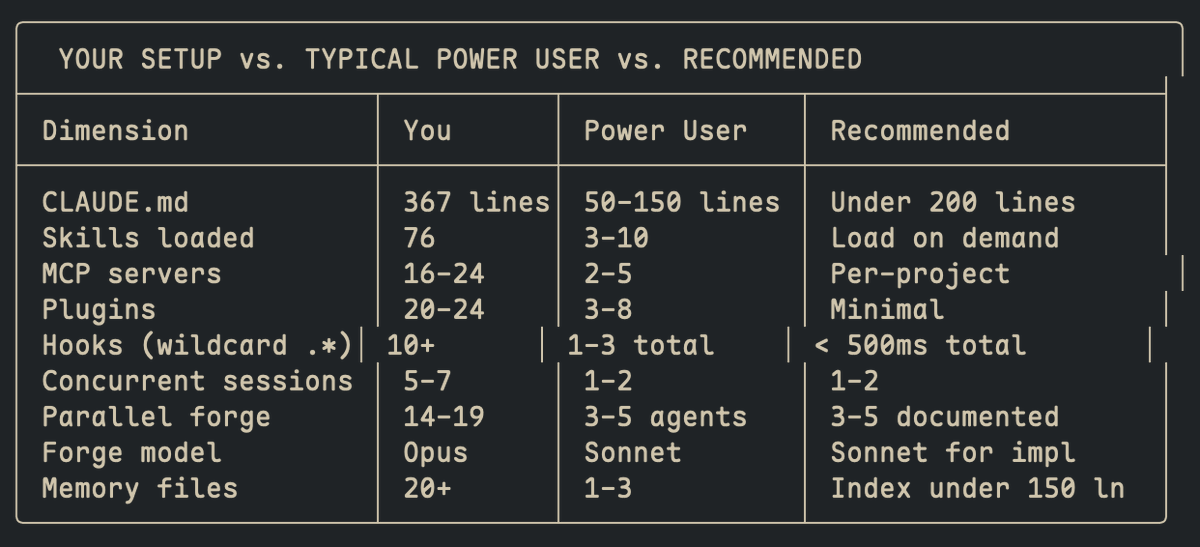
Realizing I run what is probably a most complex Claude Code setups in existence. 76 custom skills, 24 MCP servers, 10 hooks firing on every tool call, forges that launch 18 parallel AI sessions overnight. I have built an entire autonomous development infrastructure over the past three months. It is, by any measure, sophisticated.
It is also, I discovered, wildly inefficient.
Here is what a single day looked like when I finally audited it:
193 Claude sessions in one day. Not because I was typing into 193 terminals. Because every forge track, every subagent, every eval run, every RBI conductor cycle, every Ralphy task counts as a session. Each one loads the full context: a 367-line CLAUDE.md, 24 MCP server definitions, 76 skill descriptions, 20 memory files, 10 hooks. That context gets re-sent as cached reads on every single turn.
The math is brutal. ~50-90K tokens on turn one of every session. Multiply by 193 sessions. Multiply by average turns per session. That is where the quota went.
The deeper finding: I am in the top 0.1% of Claude Code complexity, and the tooling was not built for it. Anthropic recommends CLAUDE.md under 200 lines; mine was nearly double. They document 3-5 parallel agents; I was running 18. My Ralphy forge tracks were silently inheriting Opus ($75/MTok output) instead of Sonnet ($15/MTok) because a single missing --model flag.
The fix was not to remove capabilities. Everything I built stays. The fix was lazy loading: move reference content to on-demand files, scope MCP servers per-project instead of globally, narrow hook matchers to only the tools they actually inspect. CLAUDE.md went from 367 to 184 lines. MCP servers went from 16 enabled to 6 global. Zero functionality lost.
The lesson that keeps repeating: sophistication is not the same as density. A system that loads everything everywhere all the time is not more powerful than one that loads what it needs when it needs it. I knew this architecturally. I had not applied it to my own infrastructure.
Building in public means showing the crashes, not just the launches.
Today we're excited to announce NO_FLICKER mode for Claude Code in the terminal
It uses an experimental new renderer that we're excited about. The renderer is early and has tradeoffs, but already we've found that most internal users prefer it over the old renderer. It also supports mouse events (yes, in a terminal).
Try it: CLAUDE_CODE_NO_FLICKER=1 claude