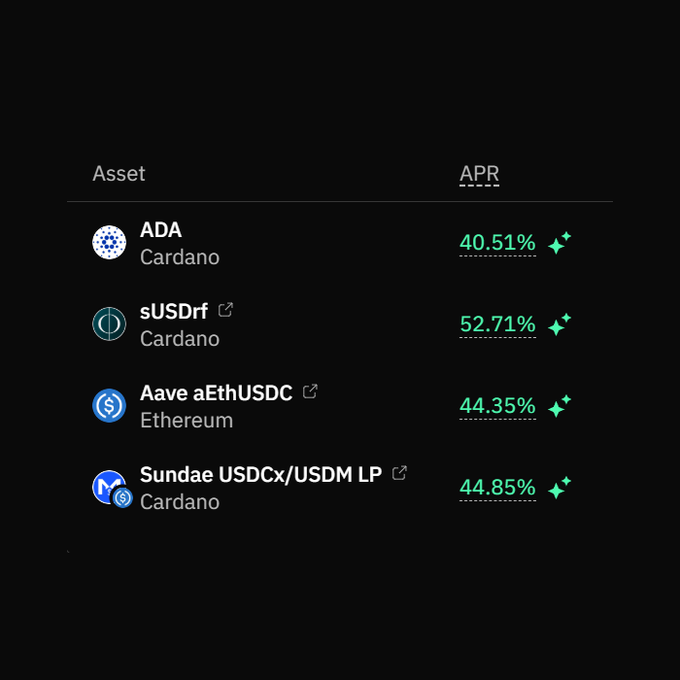
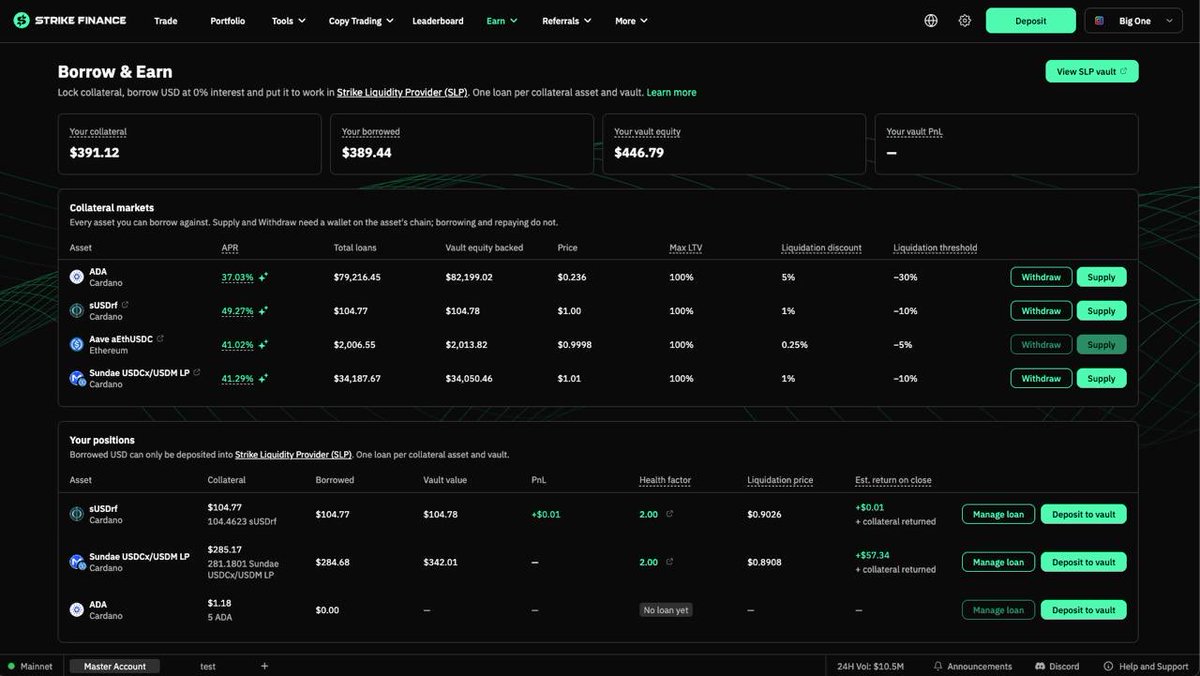
JUST IN: #Cardano $ADA Founder Charles Hoskinson on Strike integrating RealFi to offer more than 50% combined APR, says "not bad Cardano. Looks like we got the best DeFi."
Strike Finance has applied to list $STRIKE on CoinMarketCap.
Ticket #1465882
Official STRIKE token (Cardano native asset)
Policy ID: f13ac4d66b3ee19a6aa0f2a22298737bd907cc95121662fc971b5275
https://t.co/bcjLXTSEbT
We just shipped another huge feature.
We’ve now integrated RealFI yield into our liquidity vault, earning full yield from them plus our vault returns.
Now earning 50% APR on USD.
Trillions… 🏎️
Link: 🕹️ https://t.co/v9NzTjsk4v
Leios merch giveaway. Gear up.
We're giving away 4 hoodies and 4 T-shirts. Sizes subject to availability.
To enter:
🔁 Repost this
❤️ Like
Winners announced 24th July 2026. Good luck.
No purchase necessary. Open to eligible participants only. Winners selected at random and notified via X. IOG's decision is final.
#Cardano #Leios
The signing math
When you sign a message with Ed25519, two values get published on-chain as your signature: R and s.
They're computed like this:
- R = k · G (k = the secret nonce, G = a fixed public point)
- s = k + H(R, A, M) · a
Where:
- k = the nonce (must be secret)
- a = your private key (the thing that must never leak)
- A = your public key
- M = the message (transaction)
- H(...) = a hash anyone can compute from public data
(Simplified, the real scheme works modulo the curve order and the nonce is derived from a secret value inside the seed, not the raw seed. But the shape below is exactly what matters.)
Both R and s are public. They're literally in the signature on the blockchain.
Now solve for the private key
Look at the second equation and rearrange it:
a = (s − k) / H(R, A, M)
Everything on the right side is public except k, the nonce. So the only thing protecting your private key a is that nobody knows k.
That's the whole game. Secrecy of k = secrecy of your key.
What SecondFi broke
Correct Ed25519 derives the nonce from a secret:
k = H(secret_seed, M) ← depends on something private
You can't recompute k, because you don't have secret_seed.
SecondFi instead did something equivalent to:
k = H(M) ← depends ONLY on the public message
Now anyone reading the chain can:
1. Read the transaction M → compute k = H(M)
2. Read s and R from the signature
3. Compute H(R, A, M)
4. Plug into a = (s − k) / H(R, A, M) → recover the private key
A toy numeric walkthrough
Forget elliptic curves; use plain arithmetic to see the shape.
Say:
- Private key a = 7 (secret)
- Message hash H(R, A, M) = 3 (public)
- Nonce k = 5
Then the published signature value is:
s = k + H·a = 5 + 3·7 = 26
Good system: an attacker sees s = 26 and H = 3, but not k. Two unknowns (k and a), one equation unsolvable.
SecondFi's system:
the attacker recomputes k = 5 from public data.
Now:
26 = 5 + 3·a → a = (26 − 5) / 3 = 7
The private key falls right out. One signature, no guessing.
Why this beats classic "nonce reuse"
The famous bug, the one that broke the Sony PlayStation 3 and some early Bitcoin wallets, was reusing the same k across two different messages. That took two signatures to cancel the unknowns and solve.
Here you need only one, because k isn't unknown at all. It's computable from data already on chain. Every single transaction a user ever signed is a standalone leak of their key.
The fix was never "understand the curve math." It was "don't be the one writing it."
Libsodium and noble/ed25519 are good examples: both open, both audited, and both give sign() no parameter to supply the nonce.
The future is here.
We’re excited to announce Strike V2 mainnet is now live.
Low fees, lightning fast speed, and an advanced orderbook model.
Happy trading everyone 🔥
Link: 🕹️ https://t.co/lXfByjwMYN
@mavistran21@nowitnesslabs Appreciate the feedback. I’ll go through the docs and update the sections that are still missing, including how to build transactions with smart contracts.
Been a long few months, but it’s finally coming to life. Really feels like this could be one of Cardano’s best trading protocols. Looking forward to Friday 🔥
Still feels like we’re in the early days of our project with Strike. A lot of opportunity and excitement with the next phase in front of us. Looking forward to the next couple of weeks 🐎
Everything to know about Strike in 2 minutes 🕹️👇
Past:
- All time volume: 1.5 billion ADA
- All time LP gains: 15M ADA
- Holders paid out 1.8M ADA
Current:
- V2 mainnet launch
Features include: hyperliquid-style model, low fees, lightning fast, advanced orderbook, vaults, market making, referral bonuses
Token:
- Cardano market cap rank: 5th
- Global market cap rank: 1,059th
- Tokens in circulation: 93%
- DAO holdings: 7.8M ADA value
Upcoming:
- Solana expansion
- Native mobile app
- Liquid staking
- Ethereum expansion
Down the line:
- Trade Tesla, Google and other equities
- RWAs and commodities
- Strike chain
Our goal is that successful execution of our upcoming roadmap sets us up to be a household name in the industry like Aave, Uniswap, and Hyperliquid 🎲
Any dApp that wants frictionless onboarding will need a way to abstract fees away from users. Fee relay is that pattern: separate who proves from who pays.
We think fee relay could be a key feature for Midnight adoption. The dust model is unique — it's not gas, it's not transferable, and it takes time to generate.
The fee relay removes that wall. Your user submits their own ZK proof — the privacy layer stays untouched. The genesis wallet, which already has dust, covers the fees. One HTTP call, no waiting.
But here's the catch: even after fauceting Night to test wallets, you wait ~1 week for dust to generate. No
config to shorten it. No shortcut. Every fresh wallet, every test cycle — blocked.