Functional movement disorders rarely come with a single "aha" moment. One of the messages from Tony Lang's outstanding Aspen Movement Course lecture this morning that really resonated with me was that there is no single smoking gun for making the diagnosis. Instead, we gather positive clinical clues over time: an inconsistent tremor, a fixed painful posture, a characteristic gait, stuttering speech, distractibility, or other features that, taken together, tell a story. Just as important, these patients deserve our patience. The diagnosis often unfolds over multiple visits, and successful treatment almost always requires a village that includes the patient, family, neurologist, physical therapist, psychologist, psychiatrist, and other members of the care team. These disorders are real, common, and potentially treatable. Our job is to recognize the pattern, communicate the diagnosis with empathy, and stay engaged for the journey.
Continuous subcutaneous apomorphine infusion (CSAI) may benefit selected patients with multiple system atrophy. In a French multicenter cohort (n=50), CSAI improved motor symptoms in 90% at 6 months, with acceptable tolerability. #MSA#Parkinsons#DAT#Apomorphine https://t.co/xDuNU9lJaJ
The Honolulu Aging Study was really a landmark in our field. Look at how early they figured out the relationship of Parkinson risk to smoking, coffee, plantation work, uric acid and milk consumption. Decades of subsequent work showed Web Ross, Carlie Tanner and others were right. Web Ross hit it out of the park in his plenary session today in Hawaii. So fitting this meeting is here! @movedisorder@FixelInstitute@ParkinsonDotOrg
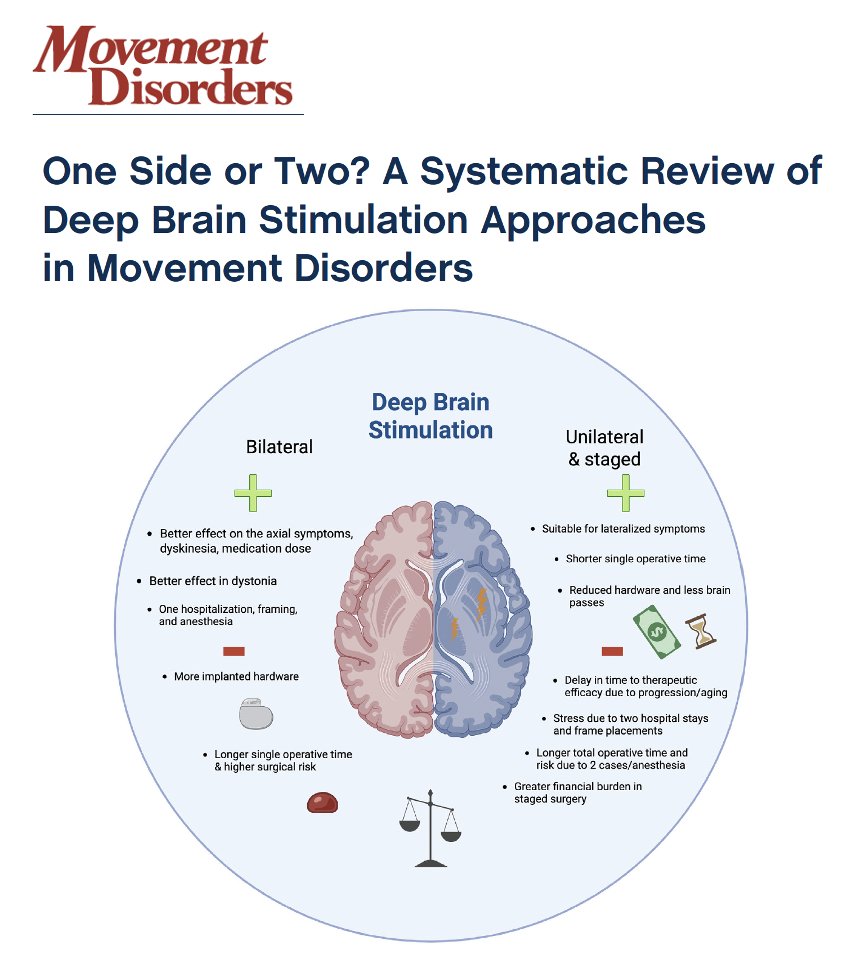
Should you have DBS on one side or two sides of your brain? Do you know why the answer isn’t in the averages? A paper by Vetkas and colleagues presents pooled data and we should be cautious how we interpret. When it comes to deep brain stimulation (DBS) for Parkinson’s and tremor, the choice between unilateral and bilateral surgery isn’t a one-size-fits-all decision. This new systematic review reminds us that pooled data tell only part of the story and that the real art lies in personalizing therapy for each person's unique symptoms, goals, and disease course.
Key Points:
- Of course bilateral DBS generally provides greater motor improvements up to 66% vs. 30–37% for unilateral.
- The cost is higher stimulation-related side effects.
- In asymmetric Parkinson’s disease, unilateral DBS can deliver substantial benefit.
- Pooled analysis shows that half of people eventually require surgery on the second side, usually due to disease progression.
- The decision for one or two should consider symptom asymmetry, progression rate, cognitive and speech risks, and most important the person's priorities.
- We must move beyond just average outcomes from large datasets.
My take: Our society is addicted to binary outcomes. Yes or no. Unilateral DBS or bilateral DBS. One target is always better than another. We must move past this mentality. Here are 5 take home points for me about this dataset. 1- Every brain and every case of Parkinson’s or tremor is different. DBS plans need to embrace and reflect the known differences. 2- Performing DBS on both sides of the brain of course gives more benefit, but also increase risks like speech or balance issues. We should always have this conversation. 3- For people with symptoms mostly on one side, starting with one lead is a safe and efficacious approach. It may be the right choice for some folks. 4- Numbers from big pooled studies are helpful, but your health care team's job is to see you, not just the averages. 5- The best DBS plan comes from weighing your unique symptoms, goals, and risks—not from a “one-size-fits-all” formula.
https://t.co/NbDZCdSEWy #parkinson @DBSThinkTank@FixelInstitute@ParkinsonDotOrg@MDCP_Journal
While freezing of gait (FOG) is the most widely recognized manifestation within the freezing spectrum, other forms, such as freezing of the upper limb and freezing of speech, are increasingly acknowledged.
Parkinson's OFF periods can strike at any time - but they are particularly common in the morning.
In this video people with #Parkinsons share their experiences with morning OFF periods.
Find more expert information here: https://t.co/o7TrfLesHT
Do you have early morning OFF periods? Tell us below 👇
Huge thanks to everyone who took part in this video, including
@morethanatremor@christinejeya@SalsbergMathews@studiosree and @TimHagueSr
In partnership with Bial. #BialParkinsons
[This video represents the individuals' personal experiences and is not a substitute for medical advice.]
#Parkinson
Should we be worried about venous thromboembolism (VTE and DVT) in Parkinson's? Yep, and especially when mobility is limited. How does it work? A clot forms, breaks loose and then migrates and gets stuck in your lungs. This is called a pulmonary embolism or PE. Wang, Tan and colleagues bring us up to speed. on the topic relevant to Parkinson's in the European Journal of Neurology.
Key Points:
- The authors embarked on this study as prevalence and relative risk of venous thromboembolism (VTE) in Parkinson's was under-explored.
- They conducted a meta-analysis by gathering 13 high quality studies on the risk of VTE in Parkinson's.
- VTE risk was elevated (RR 1.73, 95% CI 1.47–2.04).
My take: Mobility, mobility, mobility. Any condition that decreases mobility should draw attention to the possibility of clot formation and venous embolism. Other potential factors include "autonomic dysfunction, inflammatory changes, endothelial dysfunction, medication side effects, genetic predisposition, dehydration, and impaired respiratory function." The authors highlight that in Parkinson's, it is thought that there is greater venous stasis (for nerds this is part of Virchow's triad: stasis, vessel damage, and hypercoagulability), and this sets people up for DVTs.
If you encounter new onset swelling or edema do not be – nolens volens – willy-nilly, as venous thromboembolism can kill. Stretching and movement are important for prevention even if wheelchair bound.
https://t.co/mqvqeXhFsV #parkinson #DVT @ParkinsonDotOrg@FixelInstitute@EurJournalNeuro
What 'treatable' movement disorder can be missed by conventional genetic testing? Think dopamine! Dopa responsive dystonia. Li, Yang and colleagues share w/ us another unique dopa responsive dystonia case in @tremorjournal and they educate us on the broad phenomenology and genetics.
Key Points:
- The authors remind us that there are many variants in the GCH1 gene which encodes for guanosine triphosphate cyclohydrolase.
- The clinical disease is called dopa-responsive dystonia (DRD).
- They used whole-exome sequencing.
- Variants were confirmed by Sanger.
- Their case was a 50 year old woman.
- 10 yrs of rigidity.
- She had a 23 year history of cervical dystonia.
- Levodopa (dopamine replacement) helped her symptoms but not as much improvement w/ the neck.
- 4 other family members affected.
- The cause: GCH1 variant (NM_000161.3: c.–22C > T) in the 5’-untranslated region (5’ UTR).
- The authors hypothesize that there are decreased BH4 levels and 'disrupted dopamine synthesis' with this variant.
My take: There used to be an oral board examination in the United States, and if you missed on a case of dopamine responsive dystonia (DRD) you failed your neurology boards. This is 'treatable.' We don't think of this condition enough, and clinicians should be aware that there are many mutations which can lead to DRD, and that conventional genetic testing can miss most of them. As clinicians, we need to be more liberal with trials of dopamine. How about this 50 year old they present to us. The person presented with symptoms in her adult years! If you try levodopa and the person responds, remember this is dies Faustus – a day that bringing good fortune –for the remainder of the lifetime. https://t.co/hkB0x125IH #parkinson #dystonia
Striatal Dopaminergic Function and Motor Slowing in Essential Tremor Plus - Kuusela - Movement Disorders Clinical Practice - Wiley Online Library https://t.co/Y4d75wRsNu @AinoKuusela
Check out this case of ATP1A3-Associated Paroxysmal Dystonia by LeDoux @tremorjournal. Triggers can include chocolate. There was dysarthria, appendicular and gait ataxia, chorea, dystonia, and genu valgum. Did you know that paroxysmal episodes can be triggered by emotional excitement, heat, cold, exercise, chocolate, and menses. They may last 5 min.
https://t.co/N5vj9AIA0b #dystonia
What a day! Our Director of Fundraising & Comms, Dayna, joined Ben & Sarah on the famous red sofa to raise awareness of #Dystonia. Thank you to Teresa for sharing her story & to Ben & the BBC team for this amazing opportunity! Watch from 1:20:01-1:30:37 - https://t.co/bB5KLrByg1
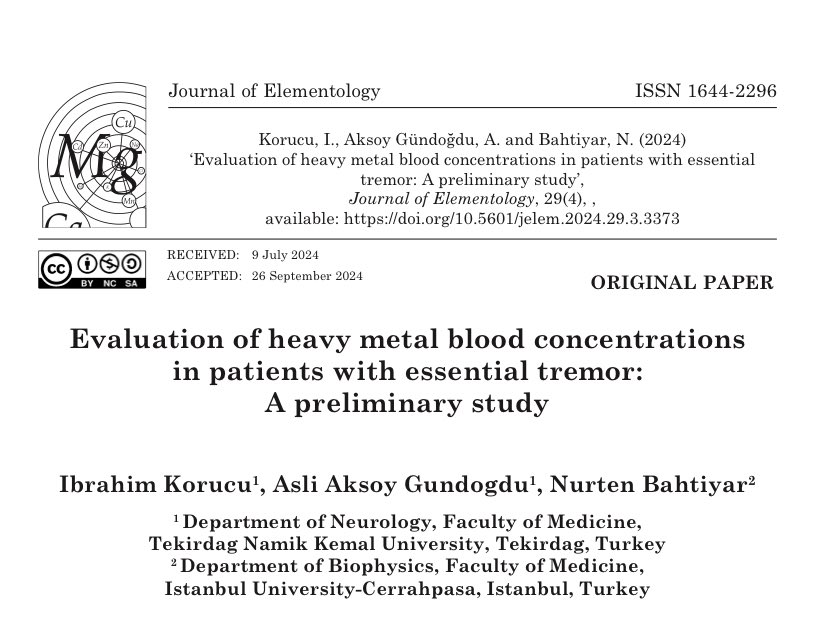
I am honored to share our valuable work. Movement disorders are always an interesting area in neurology.
@movedisorder@cerrahpasatipf @tekirdag_nku @uwm_olsztyn
''Evaluation of heavy metal blood concentrations in patients with essential tremor''
https://t.co/H0LMR7Js6F