@JesusFerna7026 I think you're overselling how similar India is to ROW! The TFR decline looks similar, but it's happening **despite** 1) ~universal marriage/coupling, 2) everyone has first child 3) stagnant/low FLFP (25%) 4) stable and high religiosity
@_ADeshpande The reason researchers keep harping on regressive attitudes and male honor is that every other place at our GDPpc with gender-imbalanced domestic/care work (LatAm, East Asia a few decades ago, SSA today) still manages ~2x our FLFP. It can't ALL be just the chores.
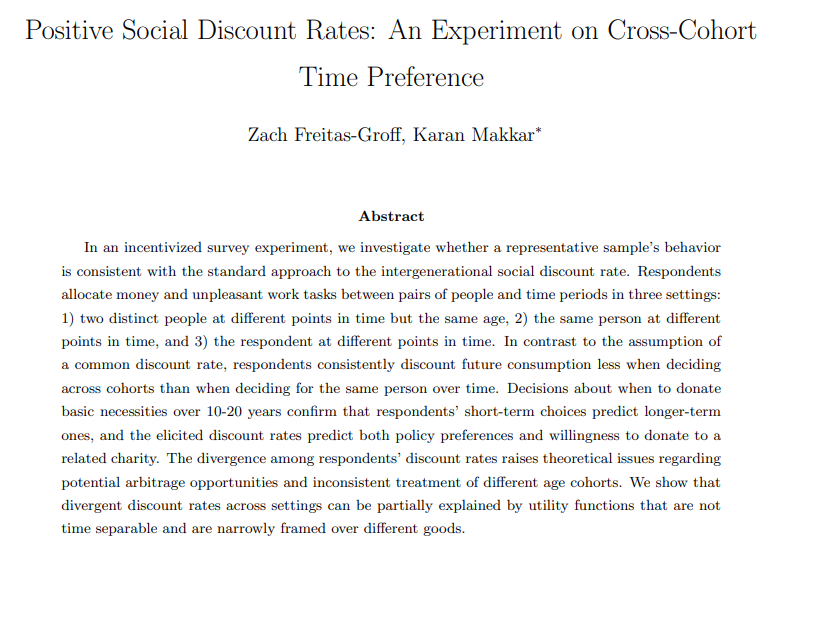
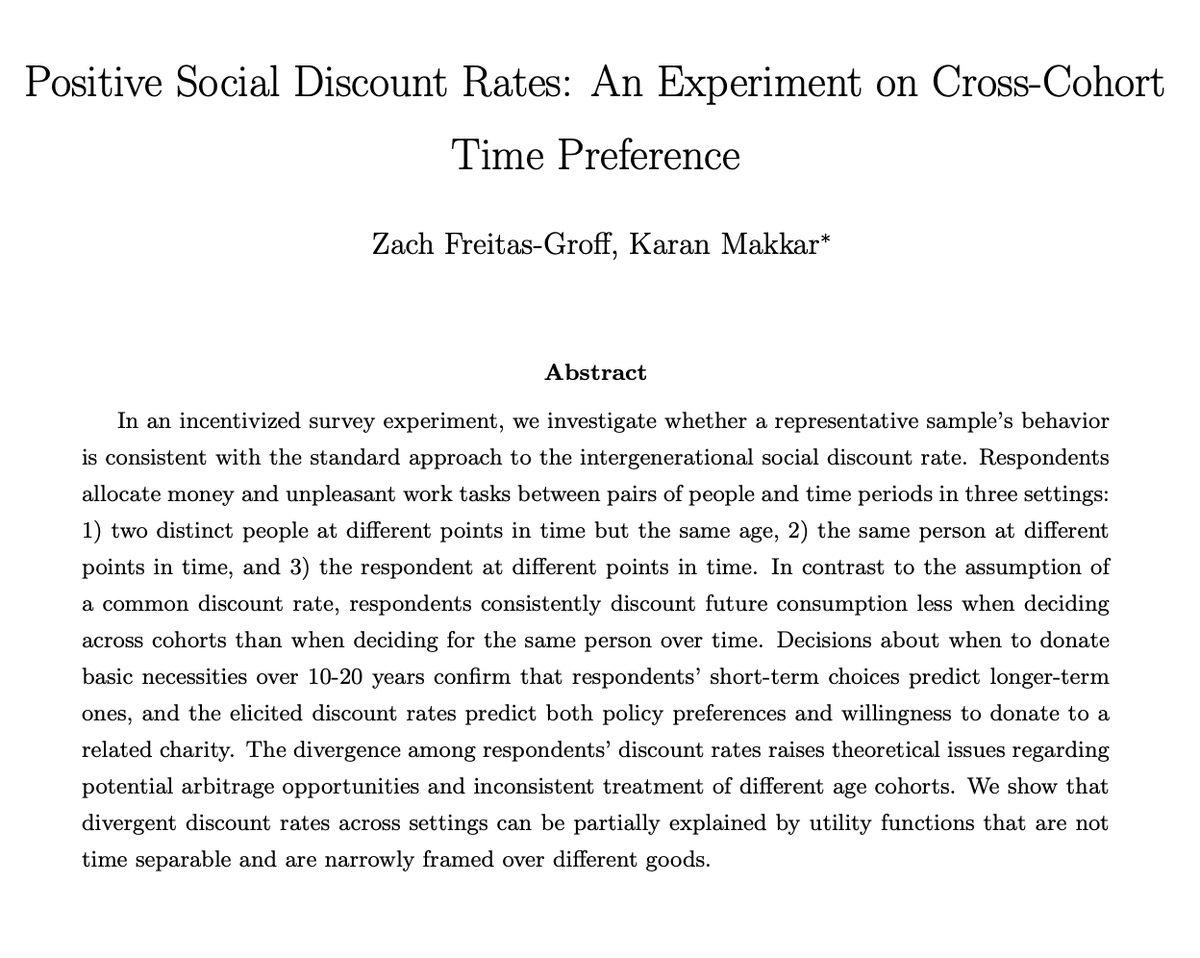
🧵🧵New paper w/ @zdgroff on the social discount rate and how policy should trade off costs and benefits for future generations.
TLDR: Contrary to standard cost-benefit analysis practice, people discount future generation's welfare far less than their own
In summary, the discount rate debate isn't just about normative philosophy vs positive economics. The public's revealed discount rates for future generations are much lower than their personal discount rates--not from philosophical arguments, but from actual choices
📈New paper out (joint w/@karan_makkar)!📉
Economists apply a discount rate to later cohorts' welfare, but this is controversial on the ethical view that people matter equally at any point in time.
Does the public agree with economists or philosophers? Neither.
@captgouda24@_LukasFreund_ I found their response to Wiebe (https://t.co/vuM8eI9MdA) somewhat compelling .
The fact that the intercept is much higher for highly regulated cities is imo the bigger issue. They try to say it's all amenities/housing quality, but I'm skeptical
@JerusalemDemsas@ezraklein@DKThomp@pahlkadot 2. If yes, what's their alternative to DOGE?
What political coalition/change in political institutions prevents Democrats from caving to interest-group opposition to permitting/zoning/FDA/civil service reform?
@JerusalemDemsas@ezraklein@DKThomp Do they agree with @pahlkadot (https://t.co/6sBFmOFRED) that careful technocrats don't have the political leverage to pass their reforms over entrenched interests, and that getting them through could require Elon-style chaos and collateral damage?
@captgouda24 1. Present-bias/impulsivity is ubiquitous in romance
2. People will think with their hormones and make lots of stupid binding commitments that they’ll regret
3. There aren’t a lot of relationship-improving investments that require P(divorce) = 0 to be profitable
@hendrycks@ericschmidt@alexandr_wang 8/ Evidence that 1) and 2) above are possible seem like crucial steps for showing that MAIM can be a stable equilibrium
@hendrycks@ericschmidt@alexandr_wang 7/8 All of this to say: the workability of MAIM hinges on
1) The escalation ladder being clearly defined, and
2) US and China having A LOT of transparency into what the others’ models are being used for