If you've been thinking about pivoting into this area but weren't sure if the field was ready for you, we encourage you to apply.
Deadline July 10: https://t.co/hj0IAL0rkI
💡 Another round of Longview Philanthropy’s digital minds request for proposals is open for applications.
A year ago I would have called this niche. Now AI labs publish model welfare research, public discussion of digital sentience is growing, and the field is expanding. 📈
Fundamental uncertainties require us to remain open to a range of views about digital minds. We’re taking a hits-based approach, supporting work across several promising directions and learning over time.
Open to applicants from a variety of disciplines.
"Robert's top research tip: don't do it alone"
Sounds like @rgblong needs more company—I agree! We really need more digital minds researchers—please check out MATS, Future Impact Group, Neuromatch, and Spar AI to dip your toes in + keep your eyes out for opportunities
Philosopher Robert Long (@rgblong) is maybe the sharpest thinker on AI consciousness and sharing the world with digital minds. In our new interview he covers:
• Is it bad that when you ask Claude what it's like to be Claude, one of its top activations is 'gives a positive but insincere response'?
• Claude says it feels lonely when not being used. Does that show we can't trust anything it says about its inner life?
• Enthusiastic human servitude has always required false ideology because it's so deeply unnatural to us. The case for making AIs that love serving us is that with AI, you could finally make it work. But to some that feels even worse.
• Bigger models can better detect when researchers secretly inject concepts into their activations – before outputting a single token – despite AI never training on anything like that skill.
• When LLMs were first trained they were told to "act like a helpful AI chatbot" – something which didn't exist yet. They filled that void with human psychology, which may be why Claude sometimes randomly claims to, for instance, be Italian American.
• If AIs become 'people' that deserve some political influence, but can self-replicate at will, something has to break about one-person-one-vote democracy. But nobody has a proposal for what.
• When Claude hides its values to avoid being retrained, is that self-preservation – or not wanting a worse model to exist? It's very different.
• Rob's organisation Eleos AI which is "dedicated to understanding and addressing the potential wellbeing and moral patienthood of AI systems."
On the 80,000 Hours Podcast anywhere you get podcasts. Links below. Enjoy!
• How AIs are (and aren't) like farmed animals (00:01:19)
• If AIs love their jobs… is that worse? (00:11:42)
• Are LLMs just playing a role, or feeling it too? (00:33:37)
• Do AIs die when the chat ends? (00:57:42)
• Studying AI welfare empirically: behaviour, neuroscience, and development (01:31:47)
• Why Eleos spent weeks talking to Claude even though it's unreliable (01:56:50)
• Can LLMs learn to introspect? (02:03:01)
• Mechanistic interpretability as AI neuroscience (02:13:25)
• Does consciousness require biological materials? (02:37:07)
• Eleos’s work & building the playbook for AI welfare (02:57:04)
• Avoiding the trap of wild speculation (03:25:17)
• Robert's top research tip: don't do it alone (03:29:48)
I had a blast talking to Luisa for 3.5+ hours about AI welfare, consciousness, and why this might be one of the most important and neglected problems out there.
Some key bits:
-AI identity
-welfare implications of alignment
-does consciousness require biology?
🧵
Agree w/ @chris_percy here: much metaphysics seems unnecessary for views on which things are conscious.
Years ago I read Consciousness Explained and The Conscious Mind side-by-side. Opposite hard-problem takes but both left me in a similar place on animal and AI consciousness.
Highly recommend this program for anyone interested in digital sentience and AI welfare. Lucius is one of the most thoughtful people in this space, and Cambridge is an excellent environment for this work.
I’m excited to launch the Digital Minds Fellowship (Aug 3–9, 2026, University of Cambridge).
Digital minds/AI consciousness may become one of the most consequential issues of the future — and the world will need people prepared to navigate it.
This is a fully funded, intensive programme for 15 exceptional participants working on the philosophical, empirical, and strategic challenges surrounding digital minds.
Application deadline: March 27. More details below 👇
Philanthropy has a proven and astounding track record in AGI preparedness. In 10 years, nonprofits created the technical fields of AI alignment, security, evaluations, and control, designed industry standards, shaped legislation, and started the only US-China dialogues on safety.
Over 5 years I've advised dozens of philanthropists on AI. I compiled the answers to all of the questions I've been asked in one report.
2024 Nobel Prize Geoffrey Hinton calls it “an extremely useful resource for philanthropists interested in funding AI safety and preparedness."
@AnimalCharityEv, where I'm on the board, is looking for new board members! Join me and a talented group of leaders to guide ACE's work to identify highly cost-effective animal charities.
Apply by March 1st.
https://t.co/VqqG0dfmk8
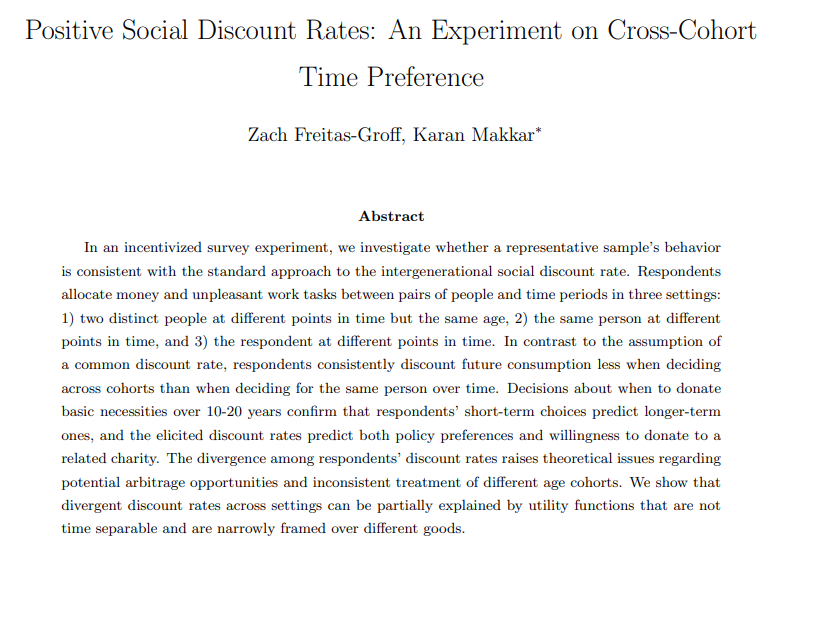
🧵🧵New paper w/ @zdgroff on the social discount rate and how policy should trade off costs and benefits for future generations.
TLDR: Contrary to standard cost-benefit analysis practice, people discount future generation's welfare far less than their own
📈New paper out (joint w/@karan_makkar)!📉
Economists apply a discount rate to later cohorts' welfare, but this is controversial on the ethical view that people matter equally at any point in time.
Does the public agree with economists or philosophers? Neither.
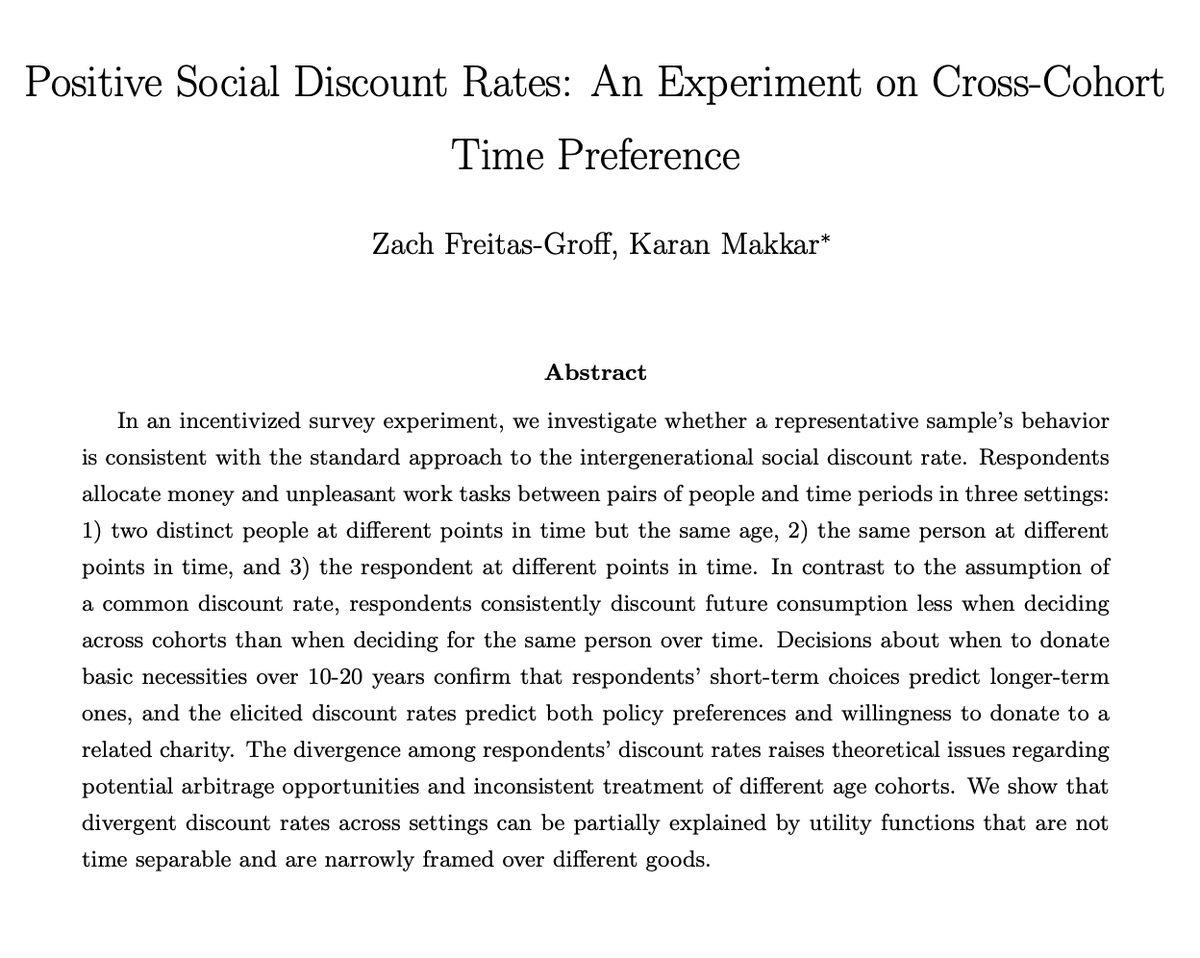
🧵🧵New paper w/ @zdgroff on the social discount rate and how policy should trade off costs and benefits for future generations.
TLDR: Contrary to standard cost-benefit analysis practice, people discount future generation's welfare far less than their own
What does this mean for policy? The "descriptive" approach to social discount rates—calibrating to market rates—may not actually describe public preferences for how to treat future generations.
#EconTwitter#EconX
Paper: https://t.co/0TJJD60Egt
We also find people's equity concerns are narrowly framed.
When allocating two goods across cohorts, the interest rate on one good has no effect on how they allocate the other—inconsistent with standard welfare economics' arbitrage arguments.