Not all AGI is the same! Our 2nd #CHI2026 paper disentangles how "autonomous" AI is more threatening while "sentient" AI deserves more moral concern.
These mental models will determine how people react to future AI.
Blog: https://t.co/QzRJ93BKEn
Paper: https://t.co/YQzWFUQysJ
Our new #CHI2026 paper identifies "digital companionship": overlapping use of ChatGPT AI assistants and Replika AI companions.
People like that they are not fully human: always forgiving you, having a reset button...
Blog: https://t.co/9wGcFM4JmQ
Paper: https://t.co/6zdzmW1cvM
Our new paper in the British Journal of Social Psychology describes what people expect in a future with "widespread AI sentience." The average U.S. adult thinks AI welfare will be an important social issue and sentient AI will be exploited for their labor. https://t.co/vWME7nVR94
"Average responses to six forecasts (exploiting #AI labour, treating #AI cruelly, using #AI research subjects, #AI welfare, #AI rights advocacy, #AI unhappiness reduction) showed mixed expectations for humanity's future with #AI." @SentienceInst
https://t.co/gPbt3kZbw3
Our 2024 end-of-year blog post is short because we have been neck-deep in research. AI is moving fast, so we need to keep up and help ensure it benefits all sentient beings. As always, we are grateful for your continued support. https://t.co/lO3XAs0XFk
Our new preprint shows the first detailed public opinion data on digital sentience:
76% agree torturing sentient AIs is wrong;
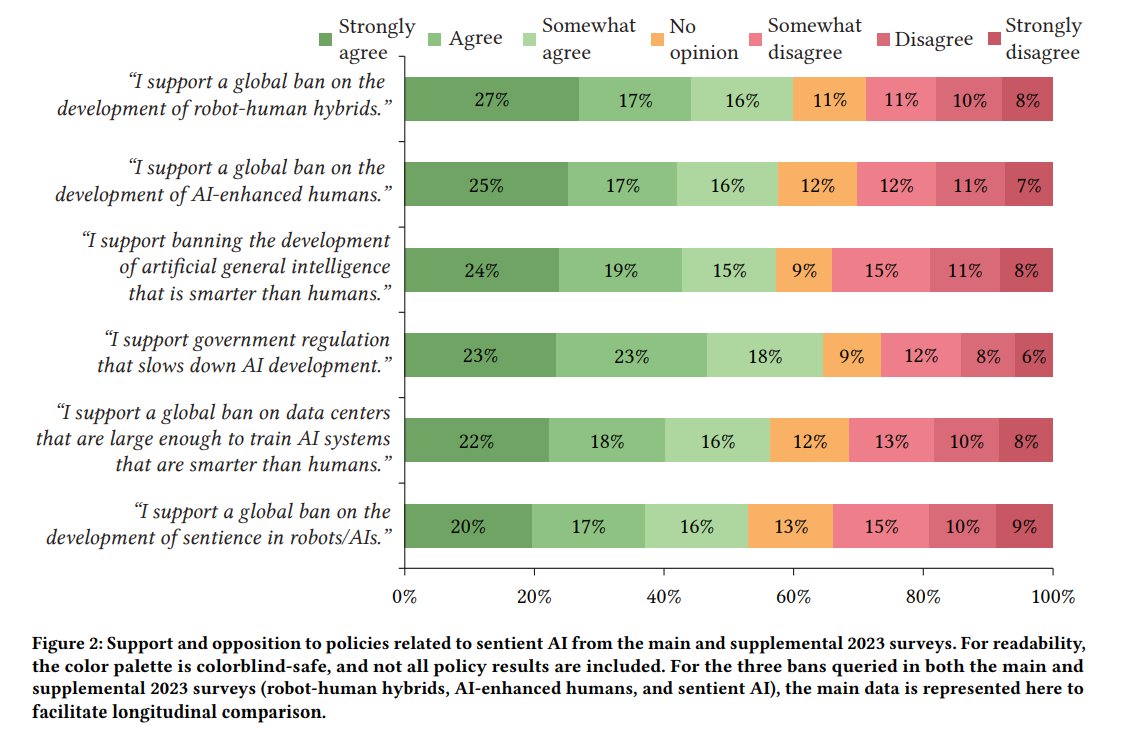
69% support a ban on sentient AI;
63% support a ban on AGI; and a
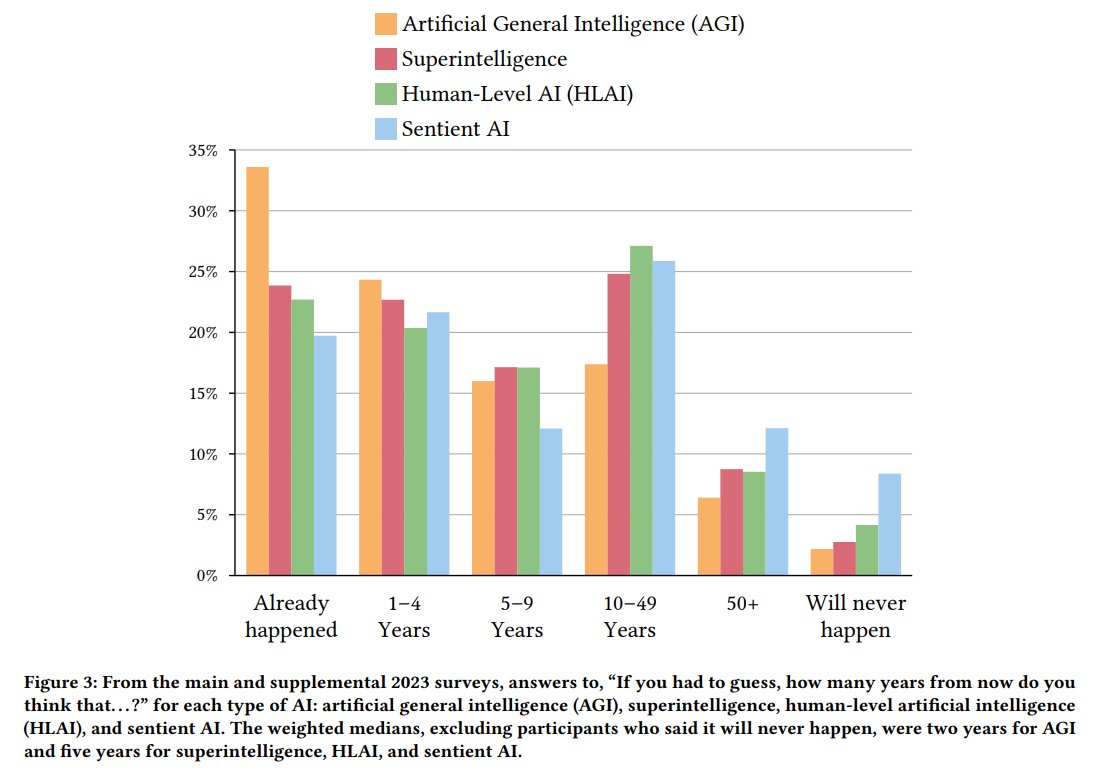
median forecast of 5 years to sentient AI and only 2 to AGI! https://t.co/c2ATXdAUDI
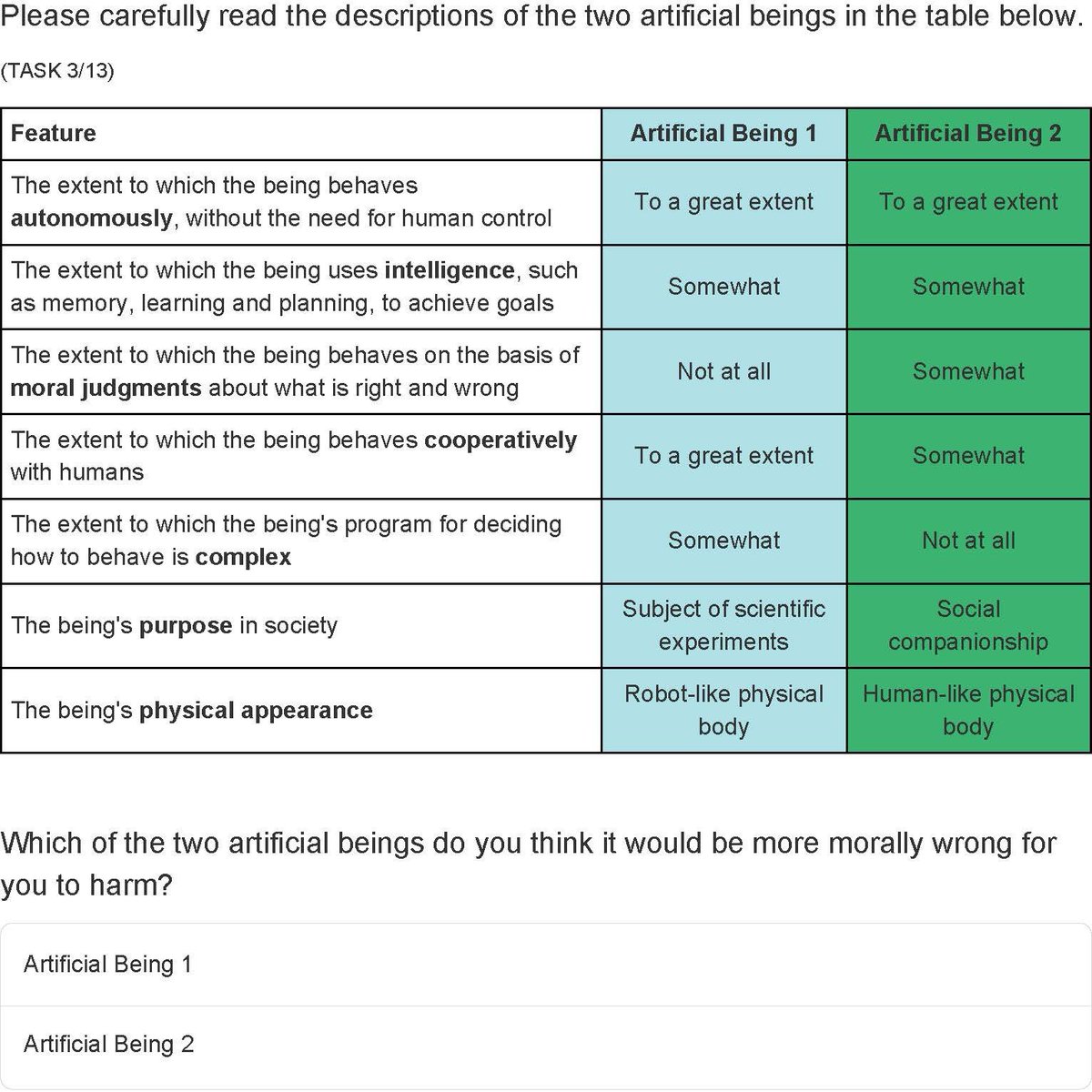
Our new paper #CHI2024 compares 11 features of AIs in how they affect moral concern for the AI's welfare. We found people care most about AIs with physical bodies—so not just an LLM/ChatGPT—and prosocial behavior—we care about an AI who can care about us! https://t.co/k4t12riVwu
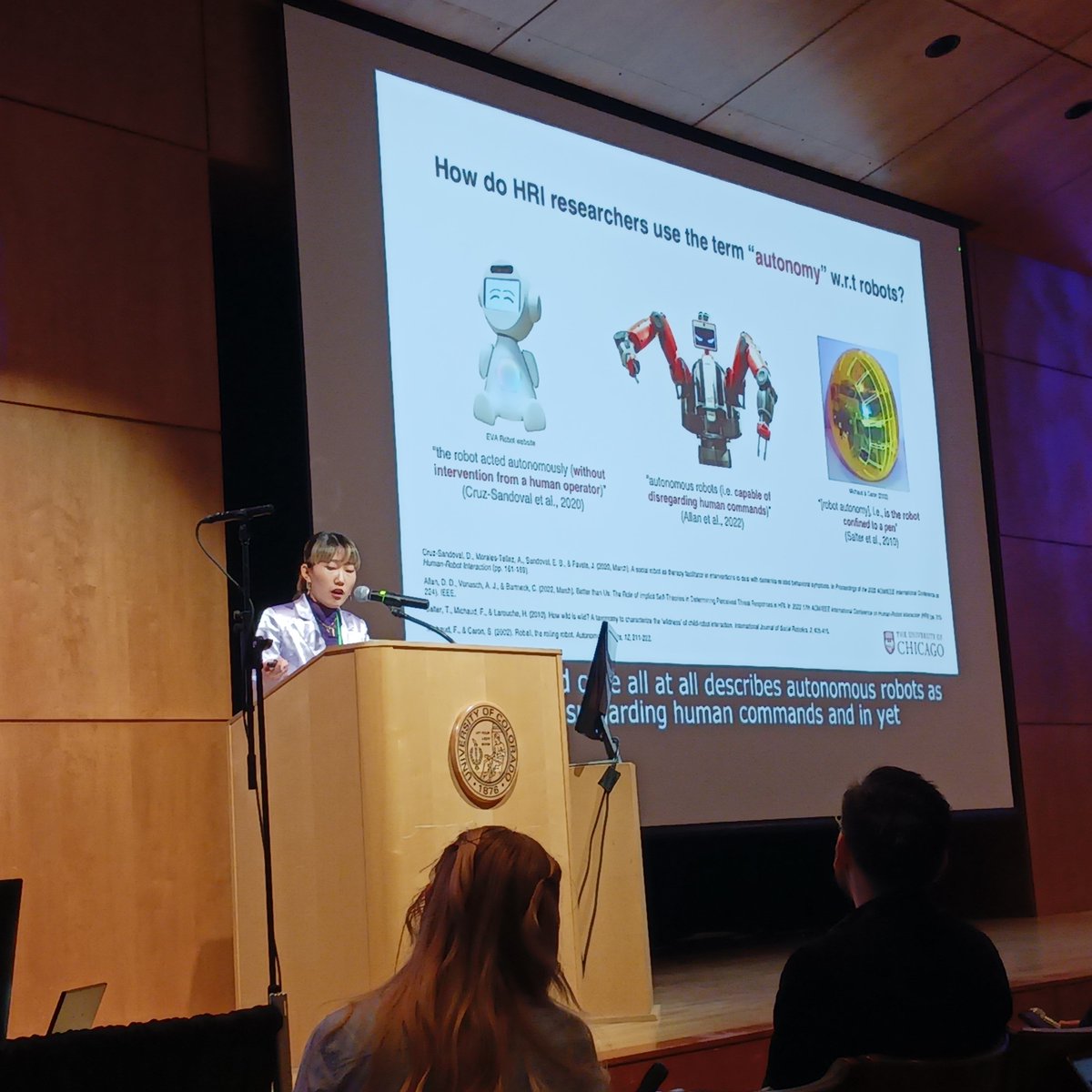
In collaboration with the HRI lab at @UChicago, our recent paper published in #HRI2024 provides a taxonomy of robot autonomy that replaces the current simple notion (i.e., more or less human involvement) with six forms that can have very different effects. https://t.co/LfO0yy3kkZ
Why do some AIs strike fear but other AIs are embraced as close companions? In our #CHI2024 paper we test 11 features in 30,238 AI profiles. People care most about AIs with (i) a human-like body, (ii) prosocial behavior, which seems to mitigate the natural threat we feel from AI.
As AI grows more powerful, measures of AI safety and impact have struggled to keep up. Our new #HRI2024🤖 paper (presented today, best paper nominee) builds "A Taxonomy of Robot Autonomy for Human-Robot Interaction" with 6 forms of autonomy to explain what AI can and can't do. 🧵
Our latest blog post by Justin Bullock and Janet Pauketat summarizes key AI policy insights from the Artificial Intelligence, Morality, and Sentience (AIMS) survey to elucidate public opinion on pivotal AI safety issues.
https://t.co/VL9ILtCFlb
In our latest podcast, philosopher Eric Schwitzgebel (@eschwitz) discusses some of his recent papers on the moral status and sentience of AI.
https://t.co/ZxXQqB2lmV
This #GivingTuesday, please RT and consider a donation to support our research on digital minds. Every bit helps to understand human-AI interaction and build a better future.
What we achieved in 2023: https://t.co/D821JdWjjo
Donate: https://t.co/jx3zZjmohm
Our new paper in Social Cognition details two experiments which tested whether perspective taking (perceiving a situation from the point of view of another) can have positive effects in the contexts of animals and intelligent artificial entities.
https://t.co/5LOTDq5nqc
What do people think about policies related to sentient AI?
- 58% at least somewhat agree with a global ban on the development of AGI smarter than humans.
- 32% at least somewhat agree with granting legal rights to sentient robots/AIs.
The 2023 nationally representative Artificial Intelligence, Morality, and Sentience (AIMS) survey shows Americans are more alarmed about AI since ChatGPT and have surprisingly high concern for sentient AI rights.
Main: https://t.co/WEdd6pdto4
Supplement: https://t.co/TuBNtNUa43
The median U.S. adult thinks artificial general intelligence (AGI) is only 2 years away and that superintelligence, human-level AI, and sentient AI are only 5 years away.
Moreover, 34% think AGI has already been created!
In our latest podcast, philosopher Raphaël Millière (@raphaelmilliere) discusses fundamental questions about the technical and cognitive capacities of large language models.
https://t.co/upT1OuqIfi