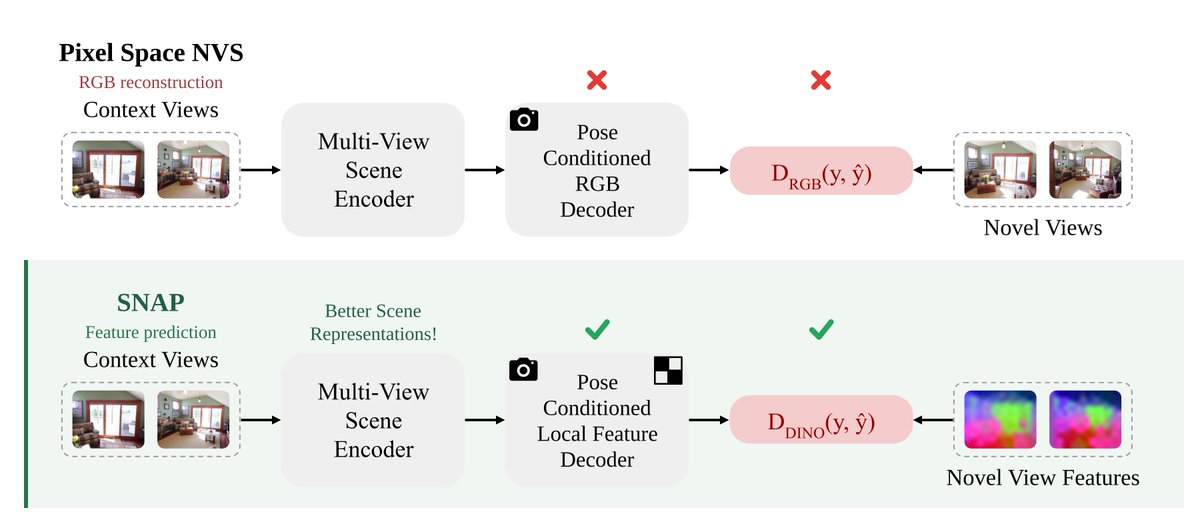
Does imagining a scene from a different viewpoint require visual representations to be geometry aware? Not necessarily.
With SNAP, we investigate what enables novel-view synthesis to learn transferable, geometry-aware representations. https://t.co/0ZnXVz5HdG #NeurIPS2026
Can novel-view synthesis (NVS) be a strong pretext task for learning geometry-aware representations?
We introduce SNAP, a multi-view representation learning framework that performs NVS in the latent spaces of pre-trained image teachers instead of RGB.
1/n
https://t.co/0ZnXVz6f3e
World models promise to predict the future. But can they predict the RIGHT future given the CURRENT state?
Excited to share FlipTest, my work from Google DeepMind internship during the summer.
In the physical world, 1 mm decides whether an object stays or falls. When a tiny change crosses a tipping point, a true world model must flip its prediction.
Blog: https://t.co/QiNCQuJ02g
Do today’s video world models pass the test? 🧵[0/8]
Introducing ⚡️Flash ALOHA: Learning Fast and Precise Manipulation!
With just 50 demonstrations, Flash ALOHA learns to autonomously complete dynamic and precise tasks at near human speed.
Everything open sourced!
(1/11)
Team:
@Qi_Wu577@YihuaiGao@chelseabfinn@zipengfu
Introducing e-means, an algorithm beating k-means in 10x fewer epochs.
With order of magnitude wall-clock speedups, e-means is released in FAISS and needs no hyperparameter tuning beyond k. It is robust to various scales and datasets. Still skeptical ? Just try e-means [1/10]🧵
Can an AI agent learn a pool table’s physics by playing on it? 🎱
Closing the visual gap between reality and simulation is one thing. Closing the dynamics gap is much harder.
In this fun project, we let an agent take real shots, observe the outcomes, and iteratively improve its simulation of the physical world.
The idea: rather than just observing the world, let agents actively experiment with it and learn its physics through interaction.
A fun demonstration of a key capability for Physical AI: learning the physics of the real world through autonomous experimentation.
A @corl_conf late breaking contribution. If you plan to attend #CoRL, see you there!
In collaboration with @XilunZhangXZ@MatthewFoutter@Luis_A_Pabon@Liam862373
Check it out: https://t.co/aHpn6U8Sis
#PhysicalAI #Robotics #AgenticAI #RobotLearning
@StanfordAILab@StanfordASL
What should transfer from a human video to a robot?
Human2Any learns how objects interact, then adapts that knowledge through test-time reasoning and planning.
Accepted to #CoRL2026! I'll be presenting in person next week—come say hi!
https://t.co/0EOKNBP8Ap (1/n)
Does imagining a scene from a different viewpoint require visual representations to be geometry aware? Mmm, not quite.
We introduce our #NeurIPS2026 paper SNAP, were we investigate what enables NVS to learn transferable, geometry-aware representations. https://t.co/stbQKFIxXQ
Introducing MESA: how well do robot policies generalize to new layouts, objects, and task compositions?
Benchmark four axes of generalization on single-arm and bimanual robots with only ~5-7K training demos each, plus a pipeline to generate your own tasks and data. 🦾
Novel-view synthesis (NVS) can learn good multi-view representations. BUT for best results, we do NVS with pretrained features (eg DINO) instead of RGB, and use a lightweight patch-level decoder.
SNAP will at NeurIPS '26! Great to work with @_kkaashyap and @DennisAnthony__ !
Reducing diffusion steps can surprisingly improve WAM performance.
More steps add action jitter, but single-step denoising yields smooth actions efficiently (12 Hz, 9GB VRAM).
Here's how from our CoRL 2026 paper TAPESTRY, done during my internship last year @ToyotaResearch 🧵👇
These findings demonstrate promising generalization across different teachers, with limited variations in performance: SNAP is not restricted to a single teacher showing consistent gains in global training-free multi-view correspondence across DINOv3, SAM, and MAE teacher models.
Can novel-view synthesis (NVS) be a strong pretext task for learning geometry-aware representations?
We introduce SNAP, a multi-view representation learning framework that performs NVS in the latent spaces of pre-trained image teachers instead of RGB.
1/n
https://t.co/0ZnXVz6f3e
Latent space NVS features perform surprisingly well against geometry supervised models across correspondence, depth estimation, camera pose estimation, and robotic manipulation tasks.
However, we find that these less expressive decoders produce encoder representations that perform better on downstream tasks, such as point correspondence and camera pose estimation. In other words, less decoder is more encoder!
Distillation alone doesn’t explain the representation-reconstruction gap; model capacity also plays a role.
Most NVS models rely on expressive transformer decoders for high-fidelity generation; restricting self-attention limits expressivity and degrades reconstruction quality.
Latent-space NVS can learn better scene representations from pretrained image teachers, but performance depends on which teacher layers are distilled:
Distilling deeper layers yields poor reconstruction but better representations whereas using early layers gives the opposite.
What happens when training with an RGB-space loss?
We find that while this provides strong view synthesis (reconstruction quality), it doesn’t necessarily learn good representations.