What are the data structures used in daily life?
A good engineer needs to recognize how data structures are used in our daily lives.
🔹 list: keep your Twitter feeds
🔹 stack: support undo/redo of the word editor
🔹 queue: keep printer jobs, or send user actions in-game
🔹 heap: task scheduling
🔹 tree: keep the HTML document, or for AI decision
🔹 suffix tree: for searching string in a document
🔹 graph: for tracking friendship, or path finding
🔹 r-tree: for finding the nearest neighbor
🔹 vertex buffer: for sending data to GPU for rendering
To conclude, data structures play an important role in our daily lives, both in our technology and in our experiences. Engineers should be aware of these data structures and their use cases to create effective and efficient solutions.
Over to you: Which additional data structures have we overlooked?
—
Get a Free System Design PDF (158 pages) by subscribing to our weekly newsletter today: https://t.co/FIzCeaWsZV
Uma bela demonstração de como a matemática é maravilhosa. A animação faz uma brincadeira com um boneco que caiu em uma universo. O video apresenta como o boneco está usando a matemática para retornar a sua origem #Animation vs. #Math#science https://t.co/BaEKAxgTy2
Git has many helpful features you can use to more easily update your code.
And the rebase command is one of them - but it can be a bit scary if you're not familiar with it.
In this guide Nick explains how rebase works + when and why you should use it.
https://t.co/BjANHi8L49
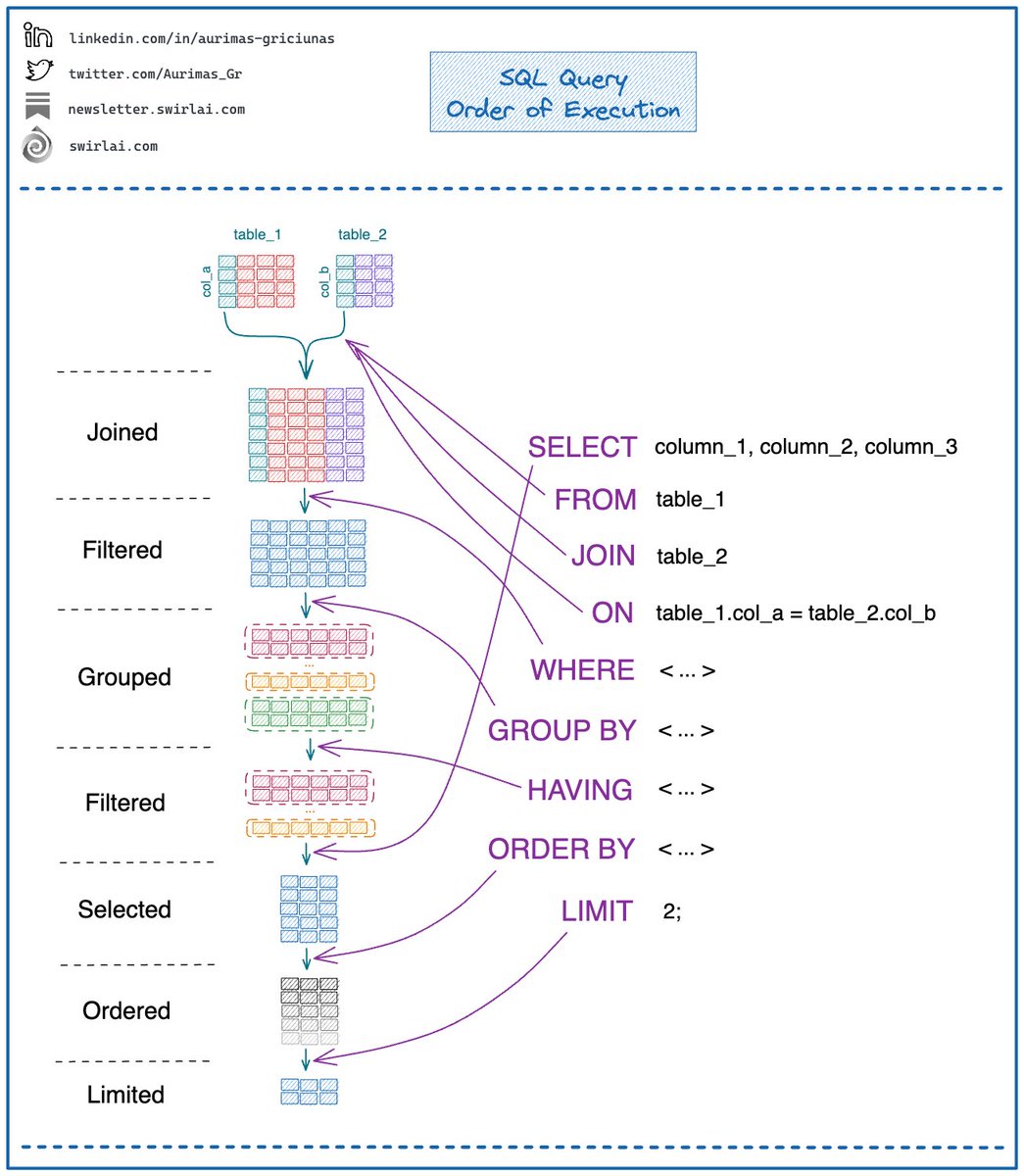
What is the 𝗦𝗤𝗟 𝗤𝘂𝗲𝗿𝘆 𝗼𝗿𝗱𝗲𝗿 𝗼𝗳 𝗘𝘅𝗲𝗰𝘂𝘁𝗶𝗼𝗻?
There are many steps involved in optimising your SQL Queries. It is helpful to understand the order of SQL Query Execution as we might have constructed a different picture mentally.
The actual order is as follows:
𝟭. 𝗙𝗥𝗢𝗠 𝗮𝗻𝗱 𝗝𝗢𝗜𝗡: determine the base data of interest.
𝟮. 𝗪𝗛𝗘𝗥𝗘: filter base data of interest to retain only the data that meets the where clause.
𝟯. 𝗚𝗥𝗢𝗨𝗣 𝗕𝗬: group the filtered data by a specific column or multiple columns. Groups are used to calculate aggregates for selected columns.
𝟰. 𝗛𝗔𝗩𝗜𝗡𝗚: filter data again by defining constraints on the columns that we grouped by.
𝟱. 𝗦𝗘𝗟𝗘𝗖𝗧: select a subset of columns from the filtered grouped result. This is also where 𝗪𝗜𝗡𝗗𝗢𝗪 𝗳𝘂𝗻𝗰𝘁𝗶𝗼𝗻 𝗮𝗴𝗴𝗿𝗲𝗴𝗮𝘁𝗶𝗼𝗻𝘀 happen.
𝟲. 𝗢𝗥𝗗𝗘𝗥 𝗕𝗬: order the result by one or multiple columns.
𝟳. 𝗟𝗜𝗠𝗜𝗧: only retain the top n rows from the ordered result.
Below is a nice way to visualize it.
What are your thoughts? Let me know in the comment section 👇
--------
Follow me to upskill in #MLOps, #MachineLearning, #DataEngineering, #DataScience and overall #Data space.
Also hit 🔔to stay notified about new content.
𝗗𝗼𝗻’𝘁 𝗳𝗼𝗿𝗴𝗲𝘁 𝘁𝗼 𝗹𝗶𝗸𝗲 💙, 𝘀𝗵𝗮𝗿𝗲 𝗮𝗻𝗱 𝗰𝗼𝗺𝗺𝗲𝗻𝘁!
Join a growing community of Data Professionals by subscribing to my 𝗡𝗲𝘄𝘀𝗹𝗲𝘁𝘁𝗲𝗿.