Two books I’d recommend to anyone interested in business / businesses + a couple takeaways from each
Traction (Gino Wickman)
- Lead with your core values. Agree on them as a team and make decisions based on them
- Know your focus (your purpose and your niche)
- Have a clear long-term vision, then chip away with shorter-term priority-based goal setting (all the way down to 90 days at a time)
- Have complimentary / diverse people (skillsets / ways of thinking / etc) sitting in the right seats
- Create just enough structure, systems, and accountability that it sets great people free to operate
- Must be open-minded, growth-oriented, and vulnerable
The Outsiders (William Thorndike)
- Capital allocation is as important as operations, make sure you are being thoughtful on both fronts over time
- Measure success based on a metric that truly matters to you or the business (like FCF), not a number that makes you feel better (like revenue or YoY growth)
- Cash flow is king. Great businesses produce and grow cash flow in the long run
- Buy aggressively when you have conviction. Be very patient when you don't
- Decentralize operations. Lean HQ, trusted operators
- Think independently, the crowd doesn't usually know best
I suggest typing this into your favorite chatbot about your home or a place that is important to you. Incredible native history all over our country that we don’t learn enough about. Some of the most interesting to me is the nomadic tribes of the mountain west / Pacific Northwest.
“Tell me about the history of the Native American people that were in the Teton Valley and Jackson Hole area. Tell me mostly about when they got there, what their life was like, how it changed with the seasons, and when / what the conflict and result was like with the settlers. Skip all the headers so that I can listen to the response easily”
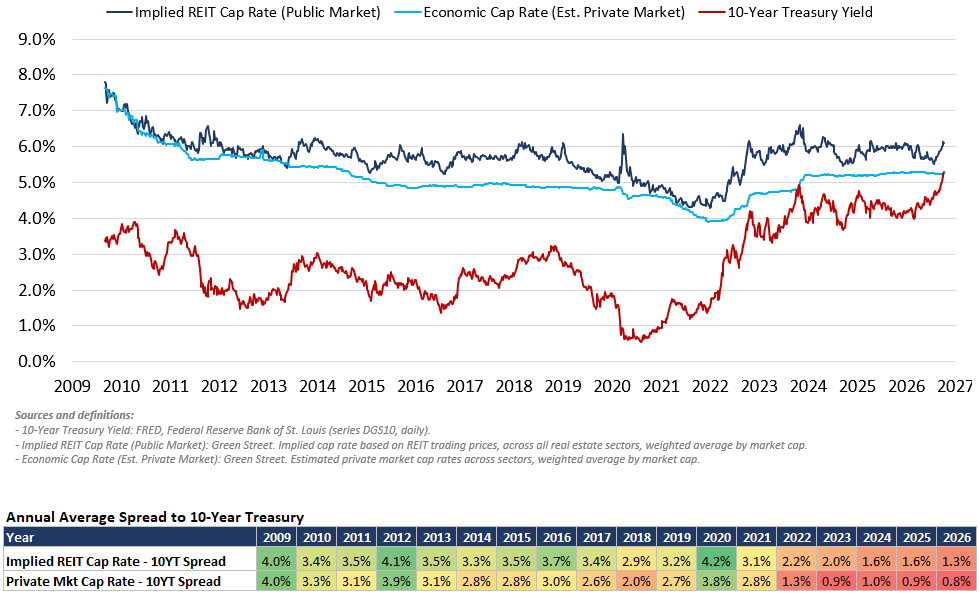
If you're a larger real estate investor buying right now, I would love to know why / how you think it makes sense? One-off unique situations are one thing, but the real estate sector as a whole, feels pretty mispriced to me (for years now, but especially with 10YT above 5%)...
What the data says (see chart/table)
- Private mkt cap rates (Green Street est.) ~5.2% vs. 10YT ~5.3% → spread at 0
- Annual avg private spread was ~3% for most of 2010-21; has been ~1% or less every year since '22 (0.8% YTD)
- Public REITs imply ~6.1% caps, ~90bps wide of private → public mkt has repriced more than private marks, but still not fully relative to historic
- Since end of '21: 10YT up ~375bps (1.5% → 5.3%), private cap rates up only ~135bps (3.9% → 5.2%)
My hypothesis (though many factors are at play)
- ~2017-2022 vintage large funds are kicking the can on sales given selling = crystallizing marks / admitting weak performance to LPs → leading to lower trade volume, little real price discovery
- ~2023-2026 vintage funds sitting on record dry powder w/ LPs that expect it deployed → willing to pay more than they should for the fewer assets that are trading
- Result: thin transaction availability + forced buyers = prices held artificially high (a small bubble the industry created for itself)
- Predicition: Music stops sometime in the next ~5 yrs when LPs get wise (extension fatigue, DPI pressure, etc.)... UNLESS rates fall meaningfully and bail everyone out
Where I'm leaning instead
- Stable, proven operating businesses at 3-7x CF with upside levers
- ~15-30%+ cash yield unlevered vs. ~5-7% cap RE
- Important to ensure structural resistance to AI threat (i.e. blue collar services)
- Not relying on cap rate compression or rate cuts to get paid, earning current cash
This is nothing new to AI power users, but:
I had a friend ask me a great question about real estate investing as he is thinking about getting into it. Fairly complex / multi-pronged question.
I decided to run a quick experiment. I thought about it hard for about 10 minutes and then took another 5 to write it up - drawing from my last 5+ years of experience. Sent it off to him.
Then typed his question into Gemini (which I like to use for everyday / research based questions - “chat” items).
Flawless answer in 5 seconds, same content as mine but more clearly laid out.
My takeaway is more optimistic than others who might say this experiment is proof AI will take all our jobs. Instead, I think:
(1) this “expert” analyst / assistant we all have should give us all the ability to spend the large majority of our time focused on what really matters, relationship building and creative thinking - I have been trying to spend at least 75% of my time on that, where as 2 years ago it was probably more like 10%
(2) in order to build real relationships and share ideas with others, face to face interaction is unbeatable, and to do that effectively, you still need the knowledge to show well in a conversation / meeting / brainstorming session. Getting texted a question is one thing, but selling (or listening to) an idea at a dinner is another. Maybe neuralink will change that at some point by brining latency to 0
(3) sure, my friend could have just asked Gemini, but now I know that he is thinking intelligently about real estate investing, and I am more likely to make network connections as things come up. The power of the butterfly effect cannot be understated, and the more time you spend looking down (at a computer) instead of looking up (at the world), the less chances you give yourself
Have any of these teams trained AI models on the entire history of NFL plays, team tendencies, player tendencies, etc. to provide in-game play calling / scheme support for coordinators? Likely approaching (or already) better than any experienced play caller
My favorite artists breakdown into a couple of categories and are a big part of my life at the moment - probably listening to music 75-90% of each day:
Classic rock & roll:
-pink floyd
-led zeppelin
-the doors
-dire straits
Modern psychedelic/alternative rock:
-khruangbin
-tame impala
-parcels
Jam:
-billy strings
-goose
House:
-anotr
-&me
-solomun
-mochakk
-flavour trip
Left a bunch off of course but lmk if I should add any categories or artists
There should be a word in English with the same meaning as schadenfreude. Taking pleasure in someone else's troubles is a common, natural, but still deeply troubling trait.
I used to have a strong case of it. I cared as much about my relative standing as my absolute position. Life was a race and if someone else stumbled I felt I was better off.
The field of trading is particularly susceptible to the trait. Markets are viewed as zero-sum. Performance is inherently relative. Still, it's possible to be ultra-competitive, to get joy out of your own success, and not get enjoyment out of other's pain. It took me a while to learn that.
The same instinct plays out far beyond markets. I think schadenfreude is at the root of much of today's political dysfunction. Too many people are more upset by someone else's success than they are happy about their own. Since there will always be someone more successful, living that way is a recipe for discontent. That gets reflected in the voter booth.
I eventually grew out of the emotion. Maybe self-awareness of my personal faults helped me overcome it. Maybe I just had enough professional success to where my confidence rose enough. I like to think it was the former.
Either way, I'm happier that I overcome it. When someone stumbles, I'm just bad for them. Spending emotional energy celebrating others' losses is a lousy way to live.
It’s been 5 days since the launch, and The PM Pulse has 483 subscribers and is currently the #15 Rising newsletter in Finance on Substack.
Thank you to everyone for the support and helpful feedback.
The mission is clear: build the #1 daily newsletter for prediction markets.