Does the idea of college as a great equalizer apply to when and whom one marries? In a new paper out in Demography (@PopAssocAmerica), I use first-gen college grads as a test and find that it does not appear to apply to marriage, for a number of reasons. https://t.co/t4fDCgiZBU
Who receives social safety net benefits?
Find out with new #CensusData from our 2023 Survey of Income and Program Participation.
Explore fact sheets, data tables and our #DataVisualization: https://t.co/zNlISfrj5g
#SIPPdata#DataViz
20.7% of households with children received Supplemental Nutrition Assistance Program benefits in 2021, compared to 11.4% of households without children.
Check out more #CensusData on #SNAP.
▶️ https://t.co/Ih67lIYeWi
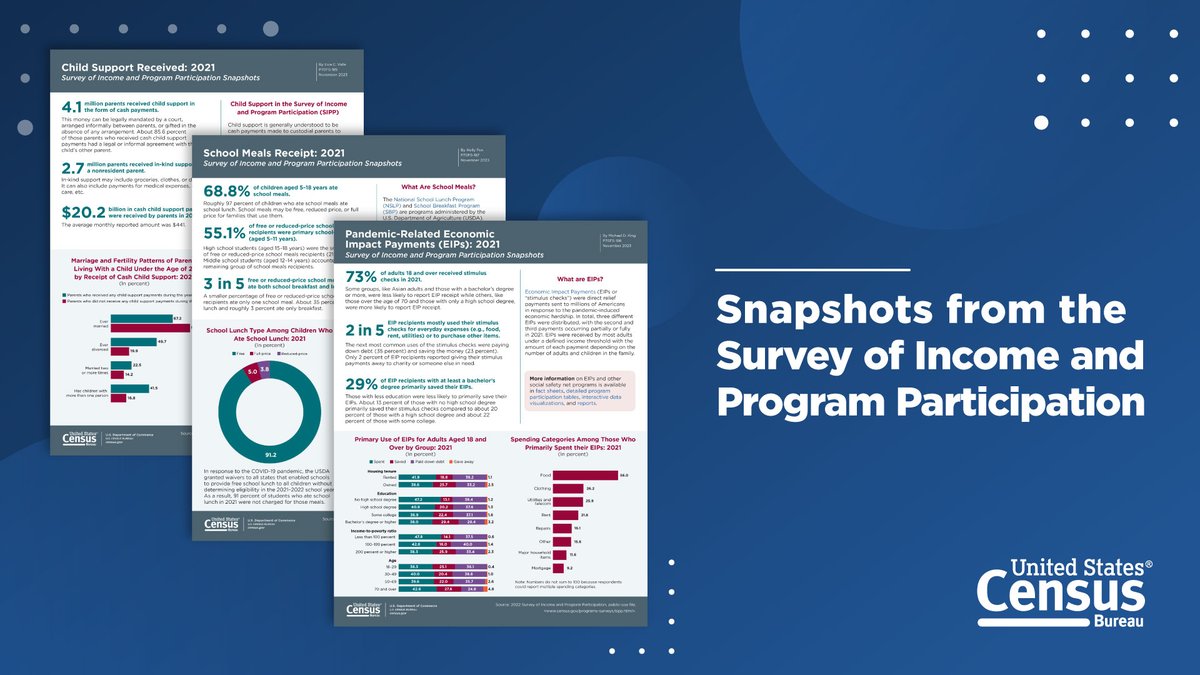
73% of adults 18+ received pandemic-related Economic Impact Payments (EIPs) in 2021.
Check out our fact sheet to learn more about how these stimulus checks were used: https://t.co/6kKkjPBREe
#COVID19#CensusData#SIPPdata#DataVisualization
#CensusData highlights from our 2022 Survey of Income and Program Participation are now available in short, digestible data snapshots.
Explore #SIPPdata on income and social safety net participation of individuals and households in the U.S.
👉 https://t.co/9dqbXBV0dZ
March 1, 2023 marked the end of extra Supplemental Nutrition Assistance Program (SNAP) benefits in 32 states and the District of Columbia, resulting in smaller monthly #SNAP payments for roughly 32 million people.
Learn more ▶️ https://t.co/mjy96CjPmT
#AmericaCounts
#CensusData show that the plan to reduce student loans by $10,000 would completely wipe out balances for 29.0% of those with #studentdebt and that certain demographic groups would benefit more than others.
Read more: https://t.co/TIWMQg3xrO
#AmericaCounts#surveys
@ProfWhitmoreEdu Good question. I’m not sure what to expect at this point. And we unfortunately won’t be able to see any impacts in the data we used (SIPP) for many years. @NM_Bennett might also have thoughts.
Our new interactive data tool sheds light on the demographic and socioeconomic characteristics of the individuals and households that received a range of social safety net benefits from 2013 to 2019.
Learn more 👉 https://t.co/wcW6GpJha6
#AmericaCounts
BLS is planning a new survey of young people, with a focus on their education, important life events, and movement into adulthood and the labor force. We want your help in shaping the new survey by answering some questions at https://t.co/xeRoYzz0Hv #BLSdata#NLSY
Prior to the COVID-19 pandemic, 1 in 6 older adults participated in a wide range of needs-based assistance programs, according to an analysis of recently released data from our Survey of Income and Program Participation.
Learn more 👉 https://t.co/XA2LHBLj71
#AmericaCounts
@MaxJordan_N There’s some discussion of this in the paper and appendix (main findings are largely consistent), but unfortunately the data can’t fully support detailed comparisons by first-gen status AND race.
Does the idea of college as a great equalizer apply to when and whom one marries? In a new paper out in Demography (@PopAssocAmerica), I use first-gen college grads as a test and find that it does not appear to apply to marriage, for a number of reasons. https://t.co/t4fDCgiZBU
Also, a big thanks to all those from @UWSoc and @UW_CDE who helped make this paper what it is, including Christine Schwartz, @ArianeOphir, and many others! https://t.co/t4fDCgiZBU
I argue prior lit on college as an equalizer may overstate mobility by ignoring non-economic outcomes, like marriage. First-gen women may not be reaching the full potential of their upward mobility if they aren't concentrating advantage through marriage like other college grads.