In Applied #AI, Agentic Governance and Tokenomics are next big things.
Most architects ignore these. Those who don't will be game changers.
#llm#tokenomics
"If all you have is a hammer, everything looks like a nail."
And that's what is exactly happening with most AI initiatives. The hammer here is "AI Agents".
As an AI Architect, always start with these 5 questions - which may sound trivial, but sets your solution in the right direction.
1️⃣ What is the right solution type for this problem? (Gen AI, ML, Agents, Rule based or Hybrid)
2️⃣ What data does the solution need and is it available at the desired quality level?
3️⃣ What will be measured once the solution goes live? (both tangible and intangible)
4️⃣ For solutions with Gen AI, what improvements will be needed to achieve desired outcomes? (prompts, grounding with RAG, fine tuning, domain models, SLM)
5️⃣ What data points will be needed to make a build, buy and/or partner decision?
With these foundational decisions in place, you'll be at the right spot to design an enterprise AI solution.
#AI #AIStrategy #AppliedAI
Stripe just agreed to pay over $7B for OpenRouter, per Bloomberg. Three months ago OpenRouter was valued at $1.3B.
Why would a payments company pay 5x for a model router?
The surface read is metering. OpenRouter fronts 400+ models for 8 million users and prices every call. Plug that into Stripe and every AI request gets a price tag and a receipt. Useful, because most enterprises can quote their token bill but cannot quote what a completed task costs.
But a router sees calls, never outcomes. A completed task exists only in the orchestration layer, and whether it truly succeeded is known only to a verifier. Cost per completed outcome is a join across three streams: the meter, the task boundary, and the verdict. Almost nobody has that join today.
Now read the deal again. Whoever owns the router sits inside every agent loop at the moment value is created. Add a verdict signal and outcome pricing gets a referee. Vendors like Intercom already charge $0.99 per resolved support ticket, but today the vendor grades its own homework and disputes land at quarter end. A rail that releases payment when the outcome verifies settles the argument the way card networks settle a charge. Verification becomes the clearing function.
The move for CTOs: build the join now. Propagate a trace ID from orchestrator through every model call, emit task start and end, attach a verdict. Whoever holds clean outcome ledgers negotiates from strength when outcome-priced AI arrives.
The meter tells you what AI costs. The rail that pays only on verified outcomes turns agent work into a market.
This is a very important post, coming from a pioneer in the #AI industry. @AndrewYNg
3 out of 4 skills are "still" related to software engineering - designing, building and deploying apps. Coding agents help to make the entire process faster and iterative.
For all young computer engineers out there.
1️⃣ Be strong with your fundamentals.
2️⃣ Learn to build and deploy software apps, products.
3️⃣ Understand the nuances are building AI Products (LLM, RAG, Context engineering, Token economics, Evals etc.).
4️⃣ Use AI tools to make you more efficient, but remember, still you are the "artist".
Why do so many AI agents feel slow and expensive to run? 🤔
The answer often comes down to one thing: the system prompt.
📦 Stuff everything into a single massive prompt — every guideline, every piece of context, every rule — and the model has to wade through it all on every single call. Slow. Costly. Unnecessary.
The better way? Skills. 🧩
Instead of one giant prompt, the model gets access to a set of focused, on-demand capabilities — 💻 coding, 🌐 translation, ✍️ summarization — picked based on what the query actually needs.
The result:
⚡ Lower latency
💰 Lower token cost
🚀 Better performance
A small shift in architecture, a big difference in production.
Sometimes the smartest optimization isn't a bigger model — it's a smarter prompt and better skills. ✨
#AgenticAI #GenerativeAI #LLM
LLM model routing - choosing the best model for the job, on the fly - is an underrated topic but can bite the pockets big time, when your AI agents are live.
I anticipate a strong traction in this space and here's what #Google is doing.
https://t.co/8GffS3zuBo
Meta and Anthropic building their own AI chip team. Nvidia building chip architectures optimized for #AgenticAI.
#AI players are looking for vertical integration, which specialists are churning out specialised chips. Interesting market dynamics
Anthropic pays $785K/year for Forward Deployed Engineers
In this 20-minute talk, an Anthropic FDE engineer explained the full roadmap:
• step 1 → you're not selling software or time. you're selling an outcome. "a leader in oil and gas cares about throughput, not how the data is organized"
• step 2 → FDE exists for one case only: technical product + non-technical buyer. everything else runs on DevRel or sales
• step 3 → every AI platform is now agentic & customizable - every AI company is in that case now. "your customers have no idea what you actually do"
• step 4 → the result: Palantir's ACV is $4M per customer. ServiceNow $1.2M. Workday $600K. no other public SaaS cracks $500K
watch, then read the guide below ↓
Personal update: I've joined Anthropic. I think the next few years at the frontier of LLMs will be especially formative. I am very excited to join the team here and get back to R&D. I remain deeply passionate about education and plan to resume my work on it in time.
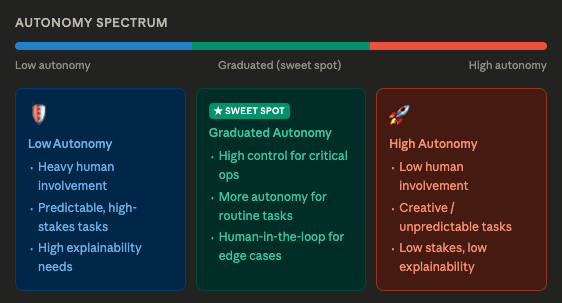
Agentic solutions are not binary conversations.
But that's how it's seen at most places.
The question is NOT: Can this use case be agentic? ❌
The actual question is: What kind of autonomy is suitable for this use case? ✅
👍💡🔥
🟢 Graduated autonomy (the sweet spot) — Where most production systems will fall
→ High control for critical operations
→ More autonomy for routine tasks
→ Human-in-the-loop for edge cases
🧠 Trying to understand Anthropic's Product Stack? Here's a quick breakdown.
Anthropic is the company behind Claude — one of the leading LLMs for everyday use.
Here's how their stack is grouped:
🔌 Within Claude, Cowork, and Code, Anthropic offers what they call "Plugins" — extensions for specialized tasks like document search, deep research, browsing, and more.