International media in the last 30 days: "India Hunger strike", "protests in India", "Floods in India."
🇮🇳India in the last 30 days:
July 19, 2026: Indian Gen-Z team wins 4 gold medals (top rank) at International Chemistry Olympiad and medals at the International Biology Olympiad.
July 18, 2026: Young Indians working at Skyroot Aerospace successfully launch Vikram-1, India’s first privately developed orbital-class rocket, from Sriharikota, placing payloads into Low Earth Orbit.
July 17, 2026: PM Modi flags off India’s first indigenous hydrogen-powered passenger train (10-coach set) from Jind station, Haryana, on the Jind-Sonipat route as an inaugural service.
July 14, 2026: DRDO completes successful military field trials of an indigenous scalable fiber-based Quantum Key Distribution (QKD) system for secure strategic communications.
July 13, 2026: Lucknow-Kanpur Expressway (63 km), India’s first barrier-free expressway with satellite-based tolling, opens to traffic.
July 12, 2026: Young Indian team wins 5 gold medals at the 56th International Physics Olympiad (IPhO 2026) in Colombia, securing joint world #1 rank.
July 11, 2026: RM Rajnath commissions INS Mahendragiri, the sixth Project 17A stealth frigate, in Visakhapatnam (~75% indigenous content).
Early–mid July 2026: Vimag Labs (Bengaluru) secures its 5th Indian patent for the Virtual Magnet Synchronous Motor (VMSM), a software-defined rare-earth-free electric motor platform.
Early July 2026: ISRO announces plans for a new Satellite Earth Station campus near Ledo in Assam to strengthen space communication in the Northeast.
Early July 2026: IIT Gandhinagar team wins a grant for developing indigenous liquid cooling plates for AI data centres, EVs, and high-performance electronics.
June 26, 2026: Nuclear heat-based hydrogen production facility (copper-chlorine thermochemical cycle) commissioned at Kalpakkam using Fast Breeder Reactor process heat.
June 24, 2026: ISRO successfully conducts hot test of semi-cryogenic engine power head at 175 tonnes thrust level.
June 24, 2026: RDSO (with ARAI) successfully conducts full-scale crashworthiness testing of LHB coaches for enhanced passenger safety.
June 21, 2026: PM Modi commissions three indigenously built warships in Kolkata: INS Dunagiri (Project 17A stealth frigate), INS Sanshodhak (hydrographic survey vessel), and INS Agray (ASW shallow water craft).
June 15, 2026: DRDO successfully flight-tests the indigenous Long Range Land Attack Cruise Missile (LRLACM) from Odisha; all objectives met.
June 10–11, 2026: DRDO conducts successful Phase-2 Ballistic Missile Defence (BMD) trials and anti-ship missile tests, demonstrating capabilities against long-range ballistic threats including ICBM-class.
Mid-June 2026: India’s defence production reaches a record ₹1.78 lakh crore in FY 2025-26.
Mid-June 2026: Maiden flight of the indigenous C-295 military transport aircraft highlighted as a major self-reliance milestone in aviation (with 40 aircraft under production in India).
June 13, 2026: First batch of women cadets trained at NDA commissioned into the defence forces. Marking the start of an women empowered era in defence.
One 150 g hamburger has a water use footprint of approximately 2,400 L,
equivalent to roughly 83,000 AI images.
One cotton T-shirt has a water use footprint of approximately 2,720 L, equivalent to roughly 94,000 AI images.
One hour of Netflix, including the TV, router and network, is roughly 1.9 L which is the equivalent of 65 AI images.
This includes training + inference. Comparing the same types of water btw so apples to apples.
US golf course irrigation costs 10-18x the water requirements of all data centers in America. Paper mill production water use is 2-3x of all AI data centers in the US.
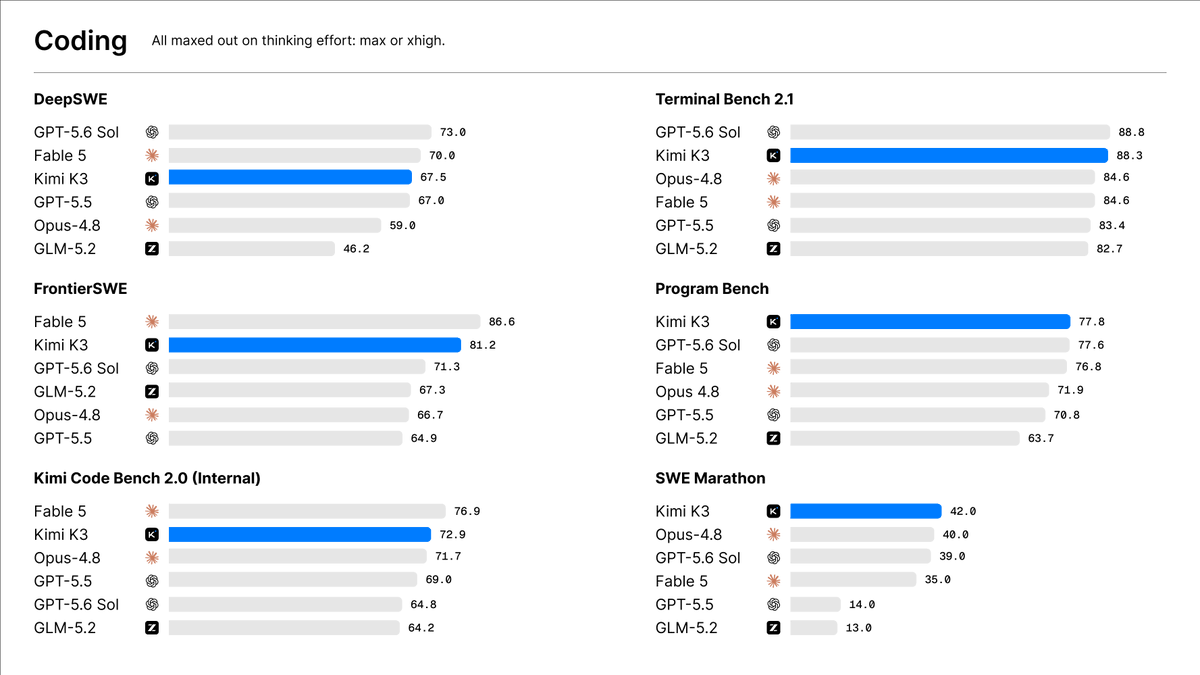
Introducing Kimi K3: Open Frontier Intelligence
🔹 2.8 Trillion Parameters, 1 Million Context, Native Multimodal
🔹 Kimi Delta Attention enables up to 6.3x faster decoding in million-token contexts
🔹 Attention Residuals deliver ~25% higher training efficiency at <2% additional cost
🔹 Built for long-horizon agentic coding and self-evolving workflows
Kimi K3 is now live on on https://t.co/zrk6zZxZUo, Kimi Work, Kimi Code, and the Kimi API.
Open Weights by July 27, 2026.
🔗 API: https://t.co/XCrgjXAqMw
🔗 Tech blog: https://t.co/YTfiMSNM1f
Today, we are introducing Inkling.
Inkling reasons efficiently across text, image, and audio modalities. We are making the full weights available.
https://t.co/Ghebq5mG30
Available today for fine-tuning on Tinker. Play with it in the Inkling Playground. 🧵
US embassy for a visit to America:
Prove you are an Indian citizen, prove you work, pay taxes, have money, have relatives or business in the US, give reference letter, attach all IDs, and fill this form with 100 questions, get appointment next year, stand in line since 4 AM...
People: Yes Sir. I am your sepoy, sir. I will do all you ask, sir. Please give me visa, sir.
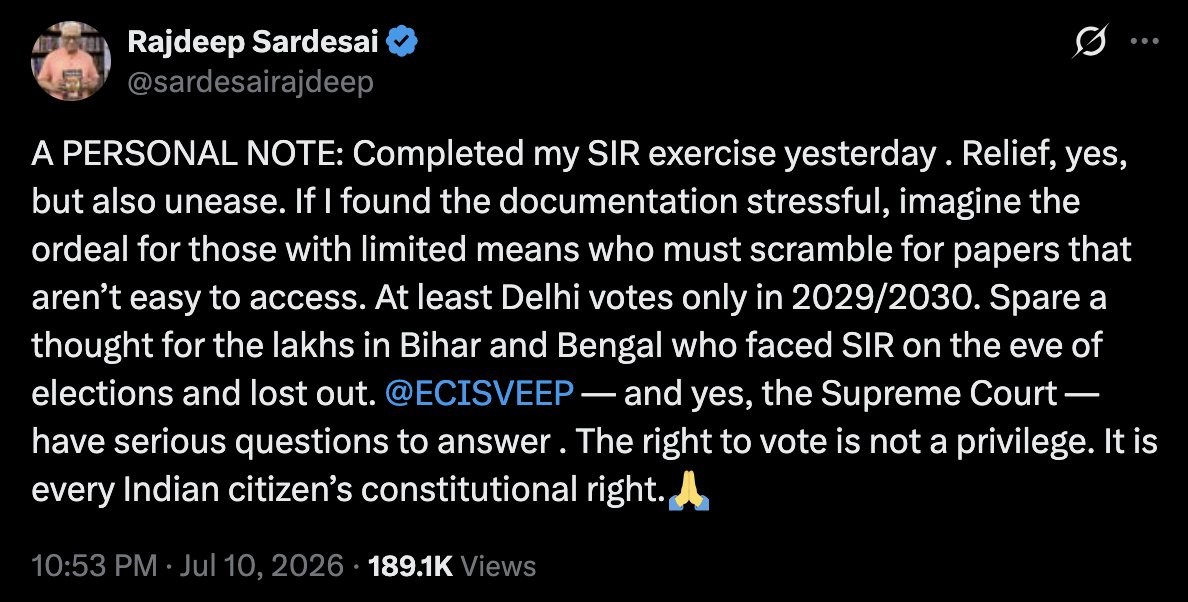
ECI:
Let's verify you as an eligible voter to safe guard Indian democracy. Here's a pre-filled form. We will send someone to your home to help you do it. Or you can do it anytime before next elections, including online.
People: ECI & SC have made life so difficult. This is unacceptable! They should answer me, now!
Introducing NEO’s 25 Degrees of Freedom, tendon-driven hands — nearing or surpassing human-level dexterity, strength, speed, and reliability.
For seventy years, robotics worked around the hand problem. The humanoid bet is the reverse: it lives or dies at the fingertips.
Just finished north of 200 meetings in Europe with customers and technologists. The conversations were primarily around AI, common questions include:
1. Are there examples of organizations who have been able to demonstrate production level systems and do those developments show a return in lower cost, efficiency or better top line?
2. What do you think about agents? How will we discover, govern and stop agents if need be. Perhaps the biggest security concern ATM.
3. The frontier AI models are expensive, what's the business case at these token prices to embed AI in our customer facing products? Where will token prices be in the future.
4. What are the longer term implications of Mythos like models? Do we need to update cyber infrastructure or all IT infrastructure?
5. What do you think of Chinese opensource models? Are they secure and what is the downside of using them if they can be secured and they are cheaper?
The parts that surprised me were:
1. The pausing of Mythos and Fable 5 caused more consternation and concern in Europe both short term and raised longer term concerns on single model reliance or reliance or models not in ones control. I hadn't seen it from their POV.
2. Sovereignity which was always a topic and still is, is getting more nuanced - they want data residency, data localization and local resources, but there seems to be more willingness to accept global services on clouds. Classified systems continue to be an issue.
Net net - we need to ensure we continue to build trust both on our Frontier models and their consistent availability, we need to get the right economics in place and spend more time in Europe communicating and building presence if we want AI adoption to keep pace with the US.
I checked many weather websites and local stations for Delhi today, the max temperature I found was 38. But India's adversaries influenced world media are showing the same temp as 44. My hunch says this is being done to hurt travel and business to India.
Next time there's any noise about human rights in India from the EU, India should condemn this sort of casteism and discrimination against lower ranked workers whose aircon was shut down. The world "casta" being European, such casteist discrimination has long existed in Europe.
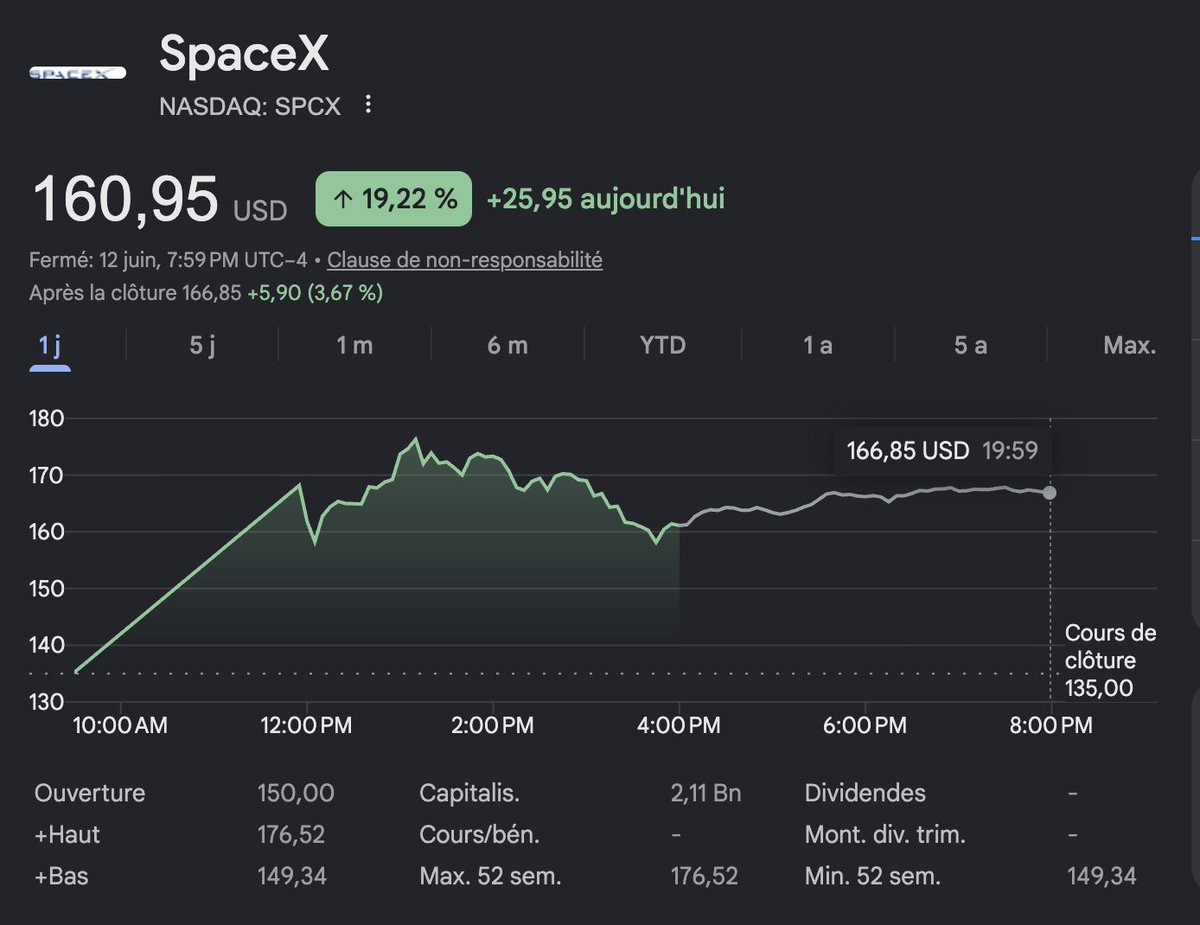
SpaceX a clôturé son premier jour de cotation à 2 100 milliards de dollars, +19%. Tout le monde regarde le chiffre. Personne ne regarde ce qu'il price réellement.
Laissez-moi vous dire ce que le marché vient d'acheter, et pourquoi je pense que cette boîte vaudra 30 à 50 trillions d'ici 5 ans.
D'abord, le symbole. Cette IPO est un référendum. D'un côté, 20 ans de discours sur la décroissance, la sobriété, la redistribution, la fin de l'histoire gérée par des comités. De l'autre, un homme qui a dit "je vais rendre l'humanité multiplanétaire", que tout le monde a traité de clown, et qui vient de créer la plus grosse entreprise cotée de l'histoire en partant d'un entrepôt à El Segundo. Le marché a voté. Le wokisme avait des départements RH, SpaceX avait des fusées. Les fusées ont gagné.
Ensuite, la mécanique économique, parce que c'est là que tout le monde se trompe. Les analystes valorisent SpaceX comme une entreprise de lancement plus Starlink. C'est comme valoriser Internet en 1995 sur le marché du fax. Starship ne réduit pas le coût du kilo en orbite de 20%, il le divise par 100. Et chaque fois dans l'histoire qu'un coût d'infrastructure est divisé par 100, ce n'est pas le marché existant qui grossit, ce sont des industries entières qui naissent. Le coût du calcul divisé par 100 a donné Internet, le smartphone, l'IA. Le coût de l'orbite divisé par 100 va donner une économie spatiale complète.
Faisons la liste de ce qui devient rentable quand le kilo en orbite coûte le prix d'un billet d'avion. Les data centers orbitaux, avec énergie solaire continue et refroidissement gratuit, au moment exact où l'IA fait exploser la demande énergétique terrestre. La fabrication en microgravité de semi-conducteurs, de fibres optiques, d'organes imprimés impossibles à produire sous gravité. Le tourisme orbital de masse, puis les hôtels lunaires, qui passeront du fantasme au business plan exactement comme la croisière de luxe au 20ème siècle. Le transport point à point terrestre, Paris-Tokyo en 40 minutes. L'industrie minière des astéroïdes, dont un seul corps de classe M contient plus de métaux que tout ce que l'humanité a extrait depuis le néolithique. Et Mars en ligne de mire, pas comme destination touristique, mais comme le plus grand projet d'infrastructure jamais entrepris, avec tout ce que ça implique de demande en énergie, matériaux, robotique, IA.
SpaceX ne participera pas à ces marchés. SpaceX possède le péage d'entrée de tous ces marchés. C'est AWS, mais pour la civilisation. Apple vaut 3 500 milliards en vendant des rectangles de verre sur une seule planète. Le premier monopole d'accès à une frontière infinie à 30 ou 50 trillions dans 5 ans, ce n'est pas de l'exubérance, c'est une simple règle de trois sur l'expansion du marché adressable.
Et maintenant, la partie que je préfère. Ce futur n'a pas besoin de bureaucrates. Il n'y a pas de comité consultatif en orbite. Pas de commission Théodule sur Mars. Chaque dollar de cette nouvelle économie sera créé par des ingénieurs, des techniciens, des soudeurs, des pilotes, des entrepreneurs. Les diplômés en gestion de la norme vont devoir apprendre un métier utile, et franchement, c'est une excellente nouvelle pour eux aussi : construire est infiniment plus fun que contrôler.
Parce que c'est ça, le vrai signal d'aujourd'hui. Pendant 50 ans on nous a vendu un futur rétréci : moins d'énergie, moins d'enfants, moins d'ambition, gérer le déclin proprement. Et là, d'un coup, le plus gros actif financier du monde est un pari sur l'abondance, l'expansion et l'aventure. Le pessimisme vient de passer en position vendeuse sur lui-même.
Le futur sera méga fun. Il y aura des hôtels avec vue sur la Terre, des honeymoons en orbite, des gamins qui diront "papa, c'était comment avant les fusées réutilisables" comme on dit "c'était comment avant Internet". Et quelque part dans les années 2030, un humain marchera sur Mars en livestream devant 5 milliards de personnes, et ce jour-là plus personne ne se souviendra du nom d'un seul de ses détracteurs.
Achetez de l'optimisme. C'est encore sous-valorisé.
Tu confonds deux choses, et c'est exactement le piège que la French Theory a tendu.
Liberté, égalité, fraternité — égalité *de droits*, égalité *devant la loi*, égalité *de dignité*. C'est la promesse républicaine, et personne ici ne l'attaque.
Le wokisme, ce n'est pas ça. C'est l'égalitarisme des résultats. Et l'égalitarisme des résultats, contrairement à l'égalité des droits, n'est pas un élargissement de la liberté — c'est sa négation.
Quelques exemples concrets :
— San Francisco supprime les classes de maths avancées au collège pour "réduire les inégalités". Résultat : les écarts entre élèves explosent, les familles aisées prennent des cours privés, les pauvres se font enterrer. L'égalitarisme a creusé l'inégalité.
— Les politiques de discrimination positive à Harvard : étudiants admis avec des scores très en dessous de leurs camarades, taux d'échec dispropportionné, sentiment d'imposture, ressentiment généralisé. On a saboté ceux qu'on voulait aider.
— L'aide humanitaire qui distribue du riz gratuit pendant 30 ans en Afrique : effondrement des filières agricoles locales, dépendance institutionnalisée. Donner un poisson, c'est empêcher d'apprendre à pêcher.
Le wokisme ne détruit pas l'humanité dans le sens dramatique. Il fait pire : il dessert systématiquement ceux qu'il prétend protéger, et il génère du ressentiment des deux côtés — ceux qu'on infantilise et ceux qu'on culpabilise.
La fraternité républicaine dit : tu es mon égal, donc je te traite en adulte capable.
Le wokisme dit : tu es ma victime, donc je dois te protéger de toi-même.
L'un élève. L'autre infantilise. Ce n'est pas la même chose, et confondre les deux est exactement le tour de passe-passe qu'on dénonce.
The Google Threat Intelligence Group has detected the first known instance of a threat actor using an AI-developed zero-day exploit in the wild. While the attackers planned a wide-scale strike, our proactive counter-discovery may have prevented that from happening. This finding is part of our new report on AI-powered threats.
In 2023, Stanford professor Graham Weaver gave his last lecture on how to destroy fear & live a wildly ambitious life.
His frameworks:
- Suffering is inevitable
- Signup for "10 years" test
- "Not me" & "Not now" traps
13 lessons on how to build an asymmetric life:
Tamilnadu governor's refusal to invite Mr Vijay of TVK to form the government is unconscionable, undemocratic and violative of the letter and spirit of the Constitution. Whether the government enjoys the support of the legislature should be decided on the floor of the Assembly, not in the Raj Bhavan.
The Union government should immediately intervene and firmly advise the governor to immediately invite Vijay to form the government.
As long as the House does not vote out a government, even a minority government can survive and govern. There are many precedents - Indira Gandhi government after 1969 Congress split, PV government from 1991 to 1996 etc.
Governors have no business to put their thumb on the scale and play partisan politics in constitutional office.
The people of Tamilnadu gave an unusual verdict rejecting the prevailing political culture. Disrespecting that mandate will further erode public trust in politics and undermine democracy. We have seen in our neighbouring countries how such contempt for democratic norms will lead to street protests and collapse of governments.
I appeal to the PM and HM to act with wisdom and foresight and advise the governor to invite the leader of the largest legislative party to form the government. The President should intervene to protect the constitutional values. If the governor is still recalcitrant, he should be dismissed forthwith.
No matter who won or lost in each state, India's democracy has won yet again. And @ECISVEEP has once again done a tremendous job running elections for 4+ states - with almost the population of the US voting.
TVK's tremendous performance, INC's win in Kerala, and BJP routing an unpopular TMC in Bengal - all happened because India gave the power of vote to every citizen equally and fairly.
Next time, please don't fall for foreign psyops amplified by local politics that India's institutions are compromised, elections are rigged, or voting should be in paper.
The foreign forces and DS are trying to game India's democracy and make it malleable to them. Your favorite politician and party may win because of it temporarily.
But in the end, it is India and you who will lose in the long term. The foreign adversary will win without having to fire a bullet just making us doubt our institutions and hate our governments.
DocuSign Personal: $10 to $15 per month.
DocuSign Standard: $25 to $45 per user per month.
DocuSign Business Pro: $40 to $65 per user per month.
A 10-person team on Business Pro pays $4,800 to $7,800 a year. To put signatures on PDFs.
A team of 50 pays $24,000 to $39,000 a year.
And there is a 100-envelopes-per-year cap on most plans. Send more contracts and you pay extra.
Need SMS delivery? $0.40 per send.
Need ID verification? $2.50 per attempt.
Need premium support? $5,000 to $50,000 per year add-on.
You are rationing digital signatures in 2026.
DocuSign is a $10 billion company built entirely on this pricing model.
Now meet DocuSeal.
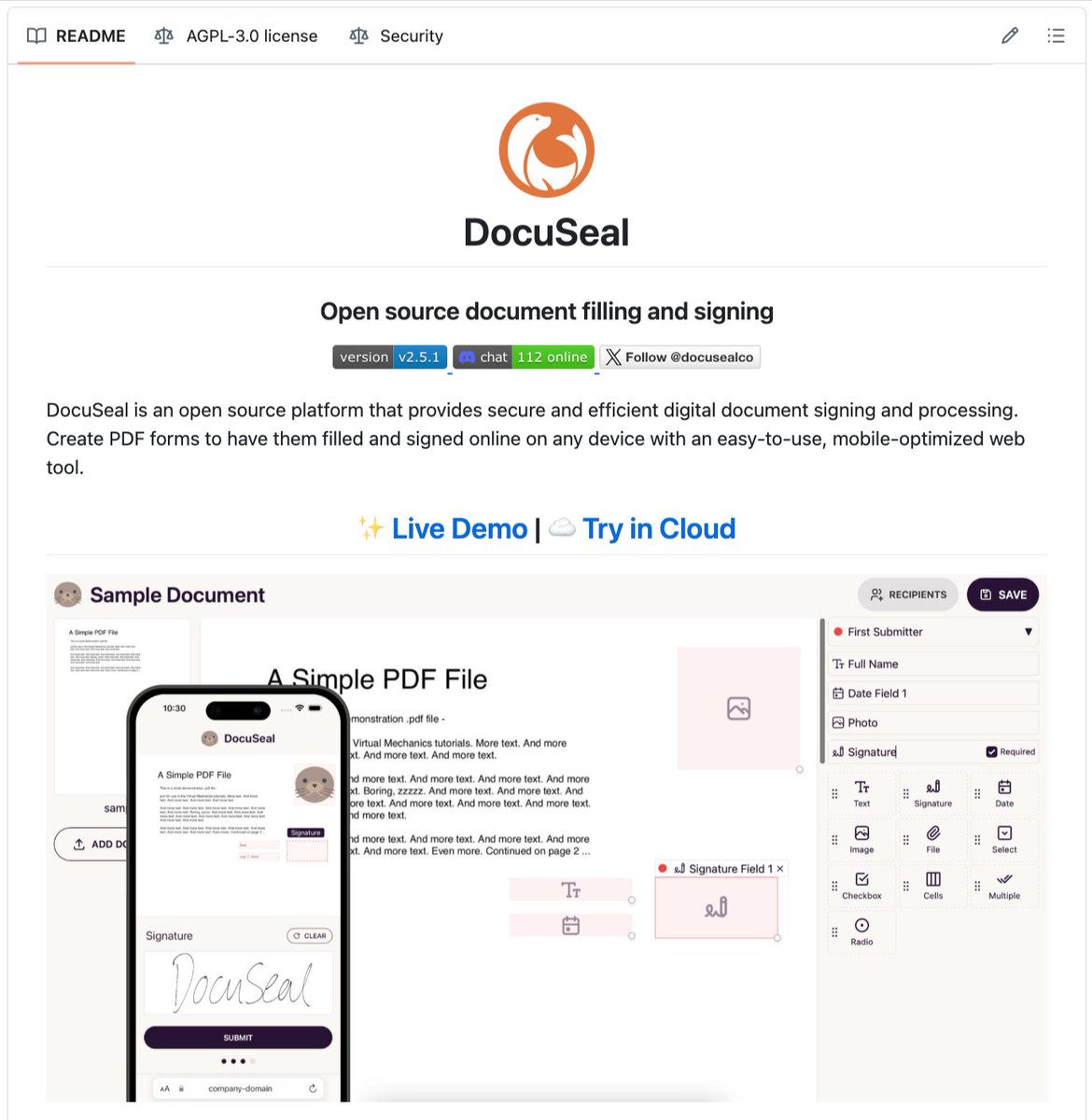
A free and open source alternative to DocuSign.
Created in 2023 by a Ruby developer named Alex who was simply trying to sign one document and realised every solution online was overpriced or required a subscription.
Three weeks later he had a working alternative. He pushed it to GitHub under the AGPL-3.0 license.
Today it has 11,800+ stars and over 1,000 forks. Bootstrapped. No VCs. No paywalls.
Here is what DocuSeal does:
- Upload any PDF and turn it into a fillable, signable form
- Drag and drop signature fields, dates, checkboxes, file uploads, and 13 field types
- Send to multiple signers with custom signing order
- Automated email reminders
- Mobile signing on any device
- PDF signature verification built in
- Audit trail for every document
- Bulk send and templates
- Full API access
- Self-host with one Docker command
Here is what DocuSeal costs:
Zero. Forever. Unlimited documents. Unlimited signers. Unlimited storage.
DocuSign limits envelopes. DocuSeal doesn't.
DocuSign charges per SMS. DocuSeal doesn't.
DocuSign charges for ID checks. DocuSeal doesn't.
DocuSign sees your contracts on their servers. DocuSeal doesn't.
Here is the wildest part:
The median DocuSign contract per Vendr is $17,250 per year. One Reddit thread has people saying "they want me to pay $4.80 per e-signature."
Self-host DocuSeal on a $5 cloud server and a 50-person team can sign as many contracts as they want without paying a single dollar.
Your contracts never leave your server. Your client lists. Your NDAs. Your employment agreements. None of it touches a third-party company.
For individuals who only sign a few contracts a year, you save $180.
For small teams of 10, you save up to $7,800 a year.
For a 50-person company, you save up to $39,000 a year.
Your documents. Your signatures. Your server.
100% Open Source. (Link in the comments)