AI agents won’t kill the attention economy. They’ll move it one layer down.
For decades, companies optimized the internet to influence humans. Next, they’ll optimize it to influence the agents making decisions for us.
The next ad won’t target you. It’ll target your agent.
In a lecture I gave last year (https://t.co/gyBq2vRbvD), I shared a mental model for AI: the convex hull of humanity’s collective knowledge.
Human expertise is highly specialized and fragmented across people and fields. I hypothesized that there might be a huge overhang of new knowledge accessible through “interpolation”: connecting the dots in this high-dimensional knowledge space.
@_jasonwei and the team are showing what connecting the dots can look like with an existing trove of health data. Exciting to see AI helping researchers turn that data into new scientific insights!
10 new papers in health science research. all written with muse models in under 4 weeks.
health is one of the areas where we believe muse is going to have the greatest positive impact on humanity ❤️
Sharing some really exciting work we've been doing with the health research community using Muse models! We hope this work will help the community significantly accelerate their research progress!
If AI can help us extract insights from existing health data faster, it could change the pace of scientific discovery!
Grateful to have had the opportunity to contribute and learn from some amazing researchers at Meta and the medical experts we partnered with.
Excited to share some work from our health team at Meta! We set out to answer what happens when you combine medical experts, a strong coding scaffold (Muse Wonder) and 5M licensed de-identified EHR?
This helped us explore the breadth of how much AI could accelerate health science
We’re exploring how AI can accelerate health science research.
While AI has made significant breakthroughs in formal sciences like mathematics, health data science depends on imperfect real-world data and consequential choices about cohorts, variables, and causal assumptions.
To explore how AI can assist health researchers, we built a human-led research scaffold powered by Muse Spark 1.3 and Muse Wonder with access to 5M retrospective de-identified electronic health records and publicly available data. A cohort of medical experts used the system to conduct original research, accelerate hypothesis generation, code execution, and manuscript drafting while maintaining full authority over scientific decisions.
Today, we’re sharing 10 research manuscripts produced through this exploration, spanning cardiology, oncology, infectious disease, emergency medicine, and more.
Read more in our research blog: https://t.co/26l6Du6vIk
In a 4-week exploration, 15 medical experts used the setup to produce 10 research manuscripts. Some researchers reporting a 10x gain in productivity.
The big unlock: being able to test and iterate on medical research hypothesis much faster.
In our health workstream at Meta we did a project where we wanted to see what research papers medical experts could write using a Muse Wonder coding scaffold that could access a database of 5M electronic health records we licensed from a vendor. The goal is that with 5M patients in this database, AI could do research to answer arbitrary questions like “did people who take statin have higher rates of diabetes later in life”? The thing we were betting on here is on what happens when you put human experts, a strong coding model, and access to data all together
We worked with a small group of medical experts to help them use this AI tool and the punchline is that they all found that this setup enabled a much faster pace of health research. They generated ten manuscripts in around two weeks, with one researcher (Paddy Ssentongo) generating three. Throughout the process, they collaborated with each other to review manuscripts and write skill files to help our coding scaffold improve at doing research. The medical experts liked how quickly they could test different hypotheses and choose the best ones to continue working on
Health research is pretty unique in that it is super important to be able to interpret noisy data and have taste to know which variables are important, which was still a significant value add from human researchers. Given that medicine is one of the oldest fields in human history and it is ultimately about humans, keeping a substantial human component in this type of research is probably important. In the near future I see AI primarily as a tool to facilitate human-led research. With the right scaffold I believe health researchers can be 10x or even 100x more productive using AI tools that have appropriate access to the wealth of data that the world has collected about human health
One way to see this work is through the broader lens of AI for science. You can think of science as two parts: (1) collecting raw data about the world, and (2) synthesizing that raw data into understanding. In this project we already had existing data about the world and we aimed to accelerate part (2) using AI. Eventually, I imagine a world where we have such great AI tools that the time to synthesize raw data into understanding is driven towards zero. In that world, science will be substantially faster and most of the work will be focused on collecting the right raw data via physical experiments
We did this in a pretty short amount of time (which was the point) and I think the future of scientific research will be more faster and more exciting than ever
We’re exploring how AI can accelerate health science research.
While AI has made significant breakthroughs in formal sciences like mathematics, health data science depends on imperfect real-world data and consequential choices about cohorts, variables, and causal assumptions.
To explore how AI can assist health researchers, we built a human-led research scaffold powered by Muse Spark 1.3 and Muse Wonder with access to 5M retrospective de-identified electronic health records and publicly available data. A cohort of medical experts used the system to conduct original research, accelerate hypothesis generation, code execution, and manuscript drafting while maintaining full authority over scientific decisions.
Today, we’re sharing 10 research manuscripts produced through this exploration, spanning cardiology, oncology, infectious disease, emergency medicine, and more.
Read more in our research blog: https://t.co/26l6Du6vIk
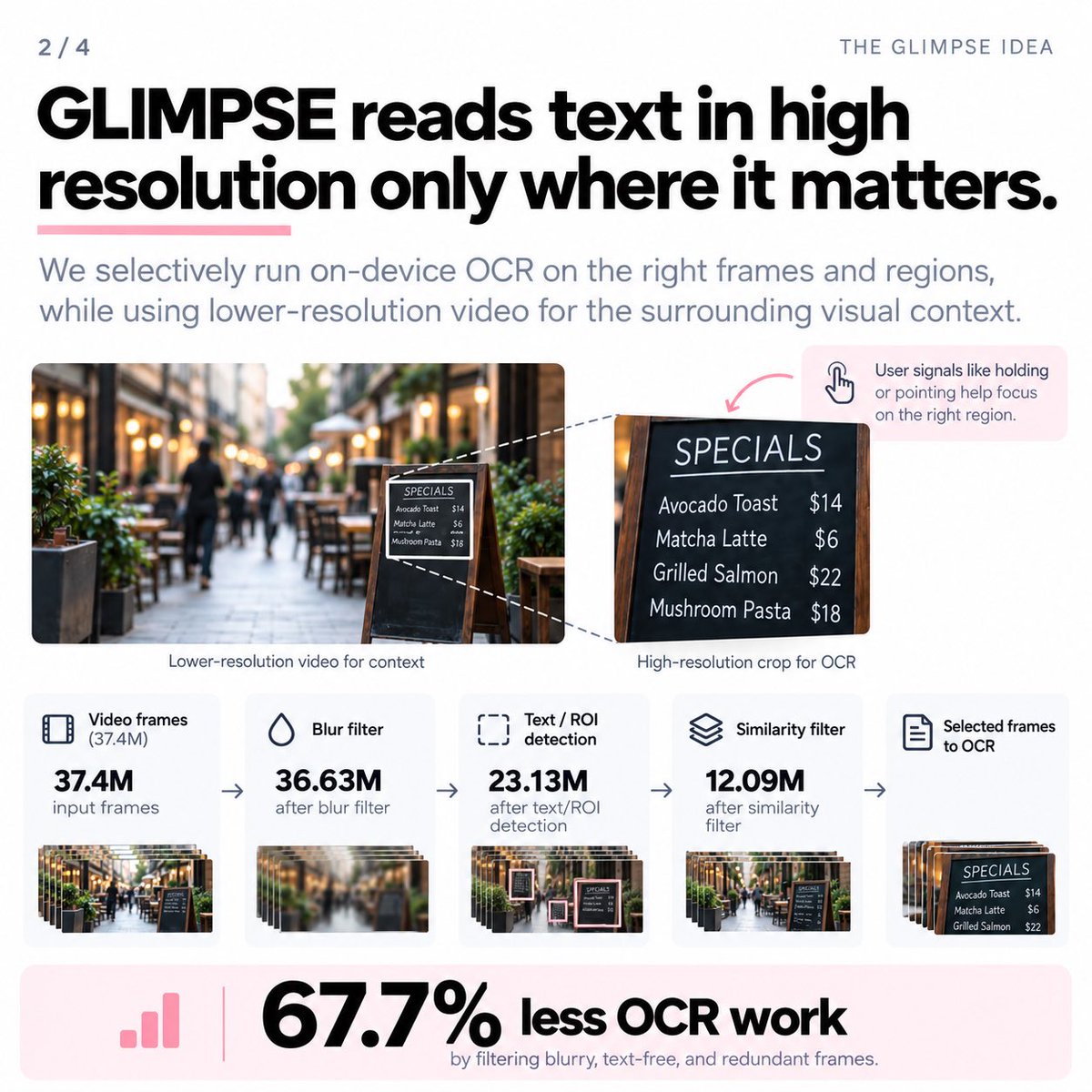
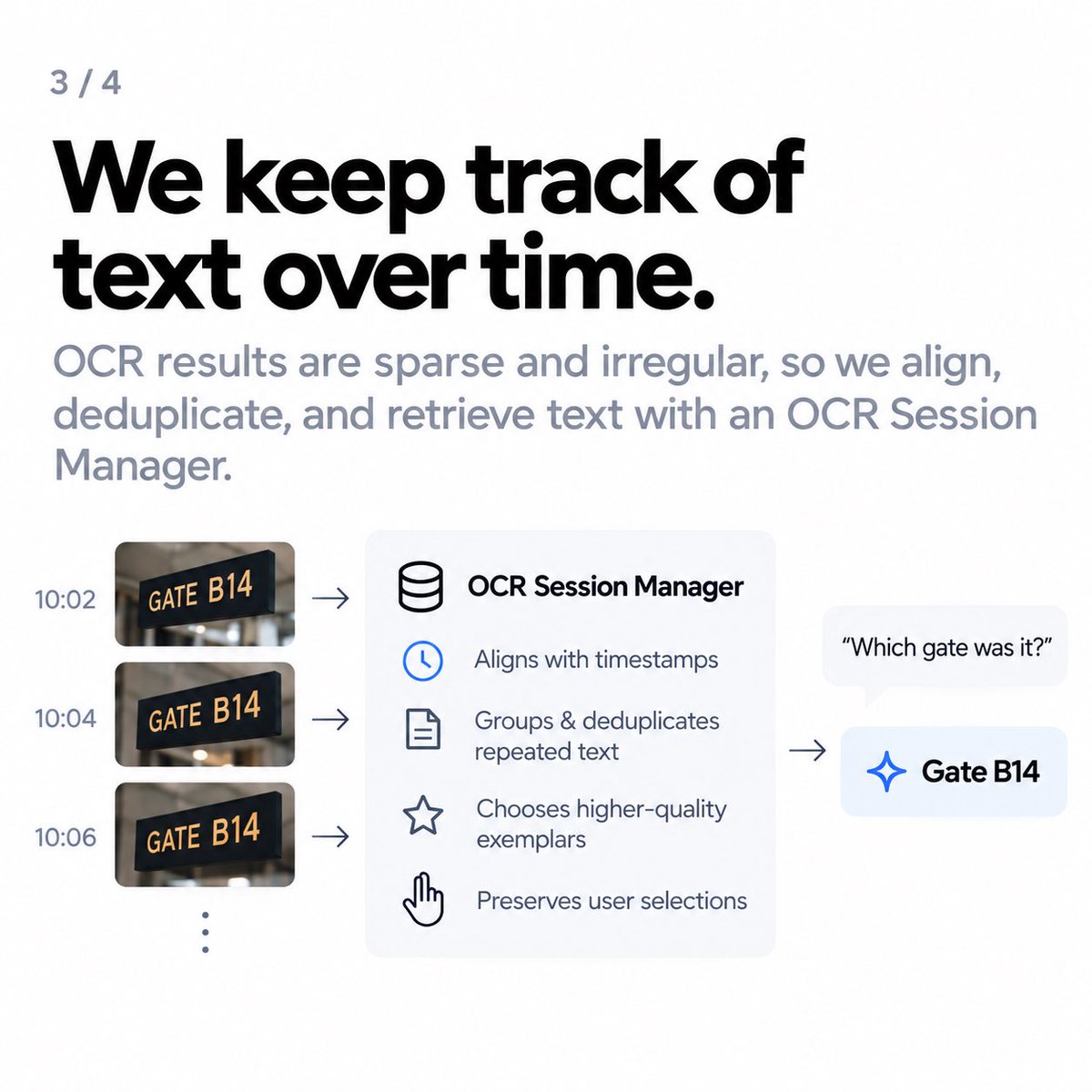
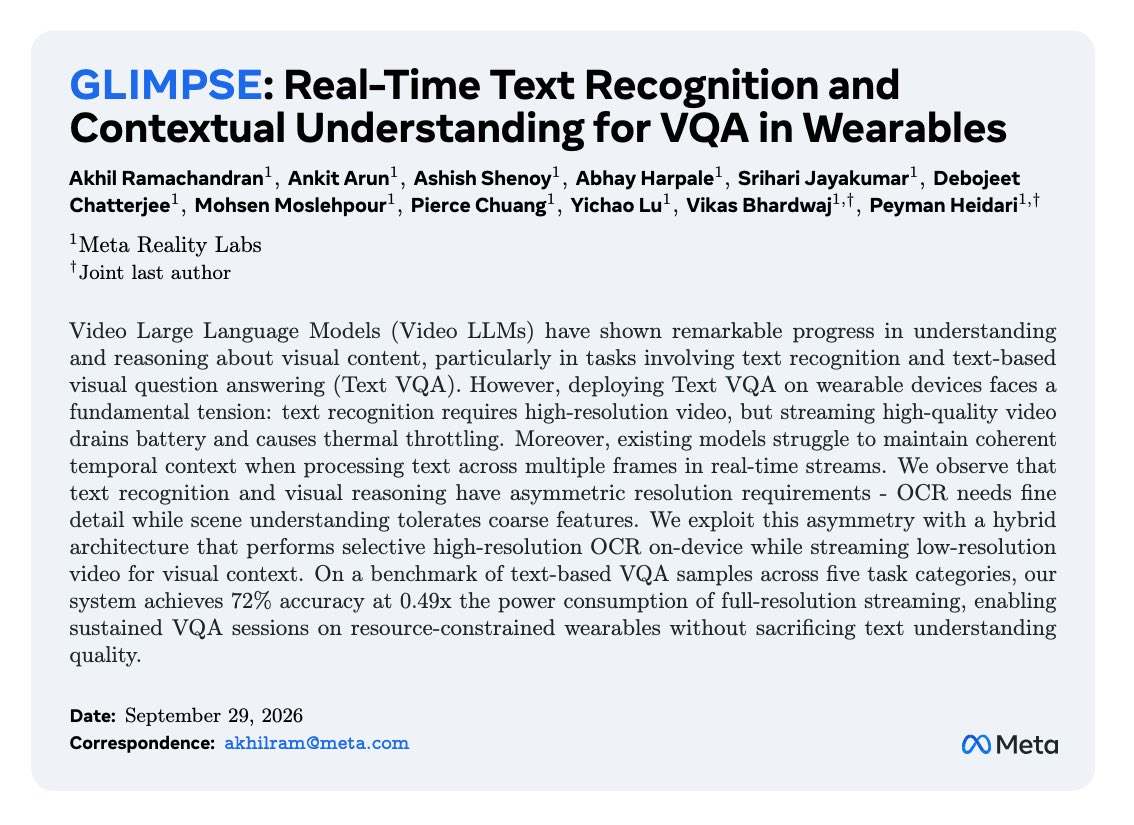
2/2 The result: 72% VQA accuracy at 0.49× the power of full-res streaming, with 67.7% less OCR work.
Great work by Akhil, @ankiterrific + team.
📄 https://t.co/uiKQvY6rjD
1/2 GLIMPSE was accepted to the On-Device Intelligence (ODI) Workshop at NeurIPS 2026 in Sydney 🇦🇺
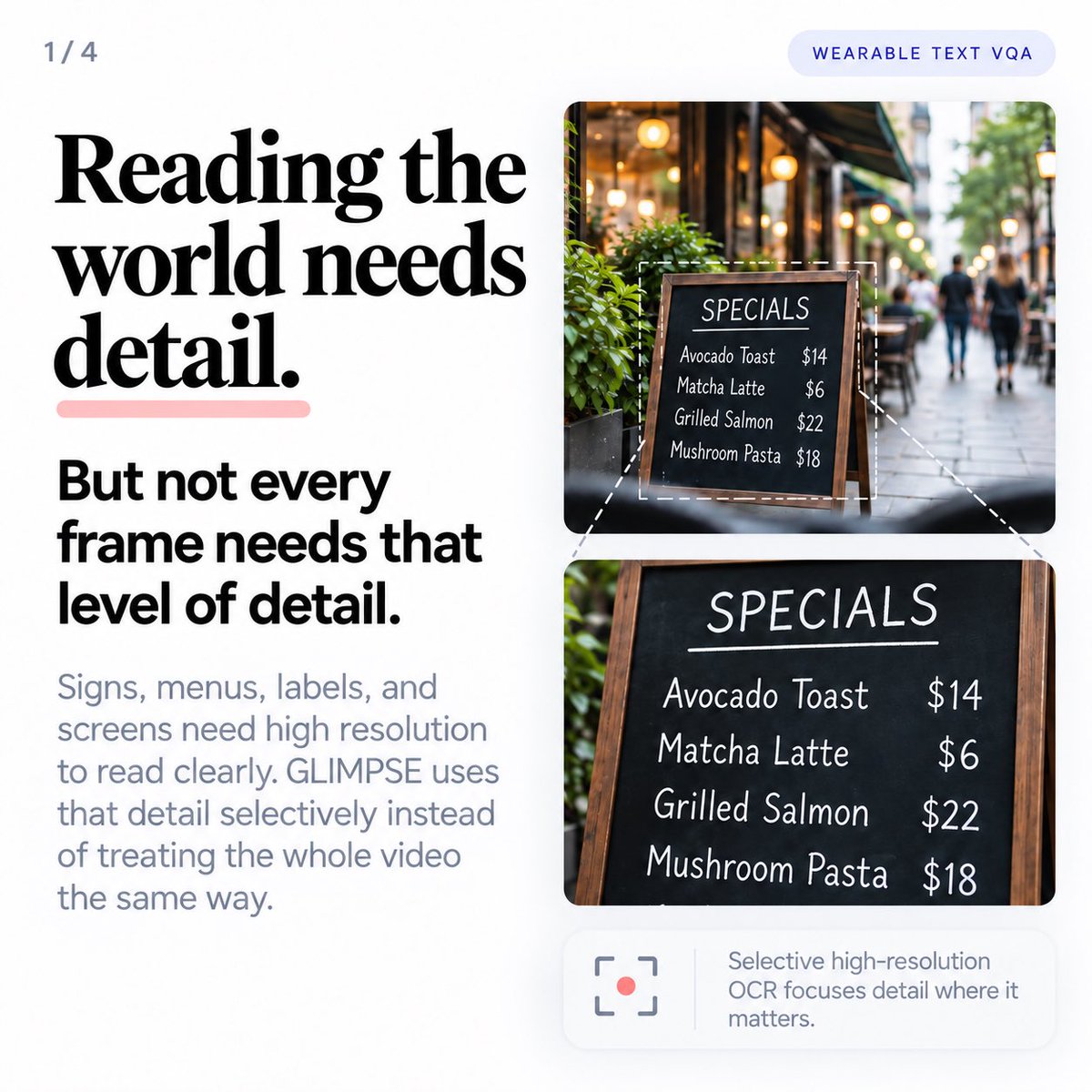
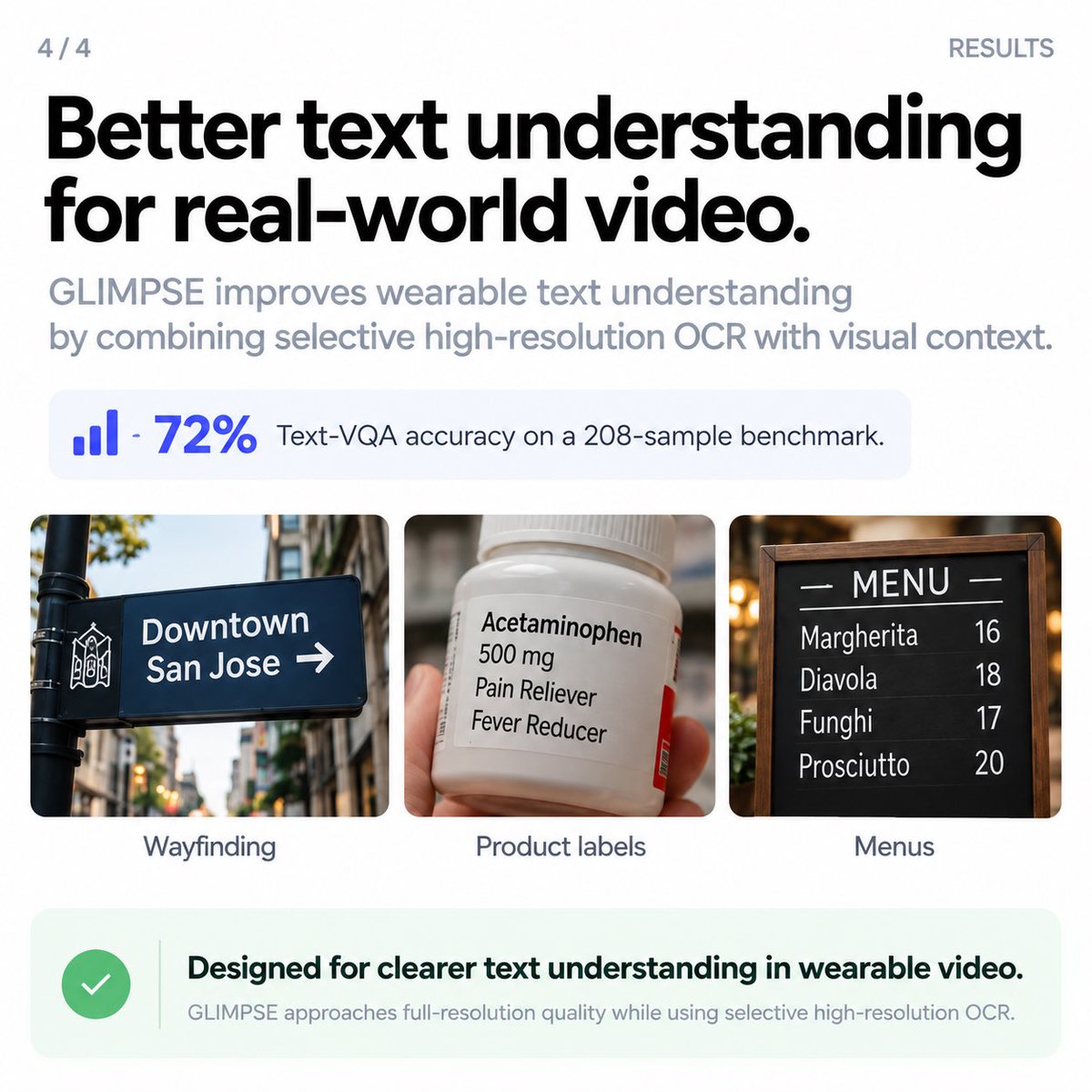
From my scene-text/wearable AI days: selective high-res OCR on-device + low-res video for context.
can the web help AI make better predictions from wearable data?
rabbitholed this week after reading @Meta’s WearableQA paper.
tested an LLM with and without @p0 search + extract and saw a meaningful lift in questions re: heart/metabolic health and inflammatory response with web data included!
We are presenting our work, “SVMemAgent: A Streaming Video Memory Agent for Query-Agnostic Online Frame Selection,” at the Wearables AI Workshop at ECCV 2026 in Malmö!
Time: Sep 9, 2026 • 1:00 PM CEST
Location: Malmö Arena Sportbaren
We look forward to seeing you there!
You spend months on OCR, latency, accuracy, edge cases.
Then you see what it means: someone who is blind reading a letter independently, without waiting for help.
I helped build Reading Text on Ray-Ban Meta. Moments like this make the work meaningful ❤️
https://t.co/IwRsf8udz3
SemiAnalysis is out with a deep dive on $META Superintelligence, and they’re clearly impressed with Meta’s pace of improvement.
They think Meta may be the only major AI player on track to be world-class across data, talent, and compute.
Meta has reportedly turned its internal workforce into an RL data engine, with around 3,000 engineers working on RL tasks/environments, while also building five 1GW+ “titan” compute clusters.
SemiAnalysis says Meta’s compute ramp could give it more AI compute than OpenAI and Anthropic by year-end, while its scale-across networking could connect campuses up to 2,000 km apart.
Muse Spark 1.1 still is not at OpenAI or Anthropic level, but the note says Meta could catch or pass Google within 6 months if the current ramp holds.
🎉 Thrilled to share that our paper "Lumos: Empowering Multimodal LLMs with Scene Text Recognition" has been accepted to #KDD2024 in Barcelona!
https://t.co/nvTjuXz1bm
We describe a low latency STR+Multimodal LLM system that significantly improves text understanding capability!
If this can one day reliably identify and answer q's about what you're looking at—plants, architecture, landmarks, storefronts, products—it has a good shot at being the first gen AI killer app. Extremely ironic since object recognition long predates gen AI
https://t.co/p6WsxgYbIJ