NEW REPORT | The Bangsamoro’s Moment of Truth
The peace process in the Bangsamoro, the newly autonomous Muslim-majority region in the southern Philippines, is confronting barriers. Manila and regional authorities need to work to continue the transition.
https://t.co/59J5J9zTSt
In this @WPReview briefing, I write about what might drive #Vietnam’s economy as To Lam targets 10% growth: export-led manufacturing, private sector reforms, and #infrastructure projects that aim to boost linkages in-country and with China to the north. https://t.co/AORT8mKors
Huge thanks as always to Editor @_IreneMia and the team at IISS. The report (covering July 2024 to June 2025) can be accessed here: https://t.co/N6OG9ZDnLk
It was great to see @IISS_org Armed Conflict Survey launched this week.
In the #Philippines: NPA insurgency persists, Bangsamoro elections again delayed. In southern #Thailand: peace talks stalled amid political upheaval and fallout from border conflict with Cambodia.
For context, no States Parties to @ISUCCM have used cluster munitions since the treaty entered into force in 2010 and all with stocks have since destroyed them, demonstrating its effectiveness.
Find out more: https://t.co/VfSgKuHI81
In Southeast Asia context: #Myanmar continues to produce and use air-dropped cluster bombs while #Thailand appeared to admit using cluster munitions in July border clashes with Cambodia. Lao PDR and Vietnam remain heavily contaminated long after use in 1960s-70s.
In @WPReview, I write that for the LPRP, securing future income from hydropower is tied not only to the state’s economic viability but also its legitimacy to govern, as #Laos seeks to forge a new national narrative centred on state-led economic development.https://t.co/qvOtysWkWX
In @Diplomat_APAC, based on research published in @ReviewPacific, @yaguerika and @hmberents argue that understandings of #peace and security in Southeast Asia can be enhanced via a focus on the role of #youth and their relationships with institutions. https://t.co/mXP3IqfSxq
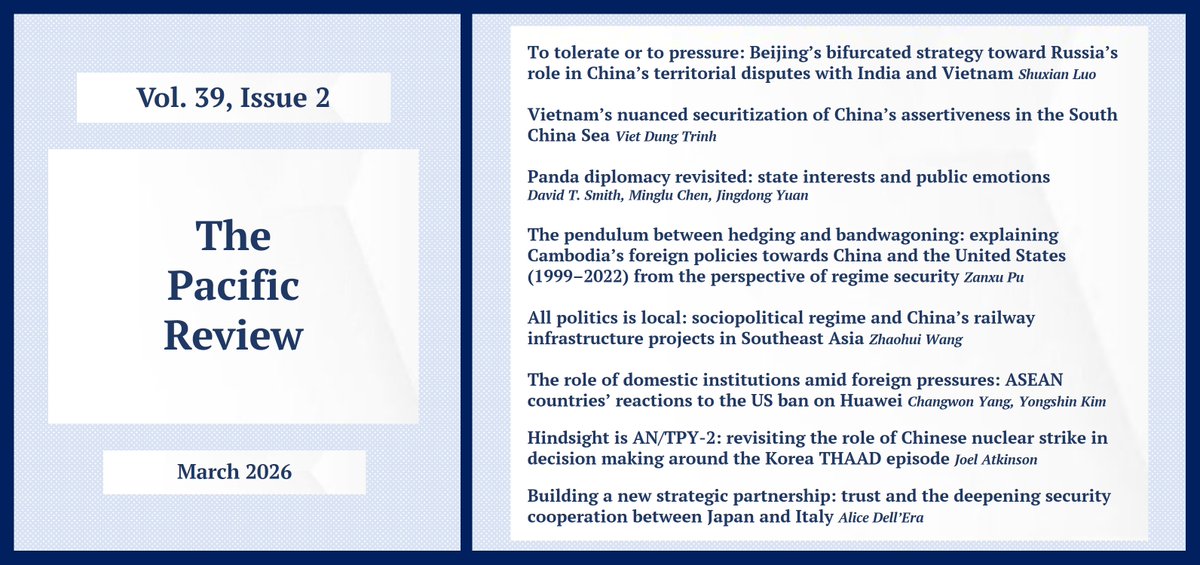
In this new article, Zhaohui Wang develops a sociopolitical regime framework composed of elite legitimization, inter-elite relations and elite-mass relations, to explain the outcomes of China’s railway infrastructure projects in Southeast Asia. ⤵️ https://t.co/cyHCEZz5kG
Essential that this de-escalates, particularly amid alleged use of cluster munitions and antipersonnel landmines. Most states have banned these weapons and for a reason – both are indiscriminate and continue killing civilians long after conflict ends. https://t.co/TcUvSpNDcH
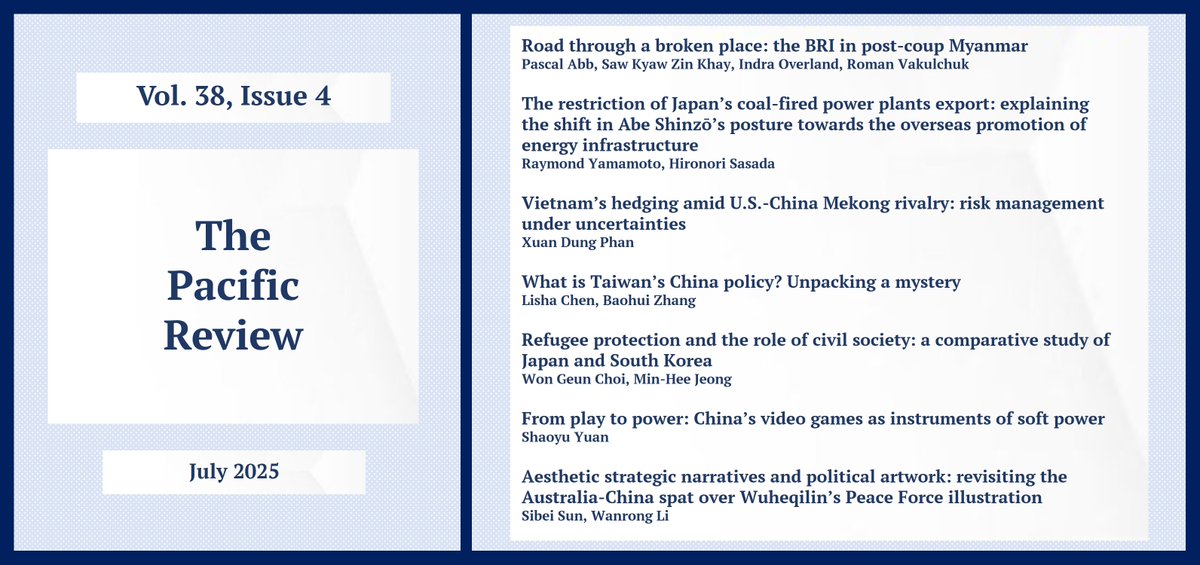
In our latest issue, Xuan Dung Phan explains that #Vietnam’s hedging amidst US-China rivalry in the #Mekong aims to limit its exposure to non-traditional security risks including ecological damage, water and energy insecurity, and economic vulnerabilities. https://t.co/oPKkbUZV2s
In @WPReview, I write that the implied message from Hun Sen, amid his stirring of #Thailand’s political divides is that one-party rule in #Cambodia is better than the repeated cycles of political chaos and jostling for power among parties across the border.https://t.co/PBga8PESuB
In this new paper, Qing Lu and Ravichandran Moorthy assess #Malaysia’s strategic responses to the intensifying United States–China semiconductor rivalry as a critical node in the supply chain. ⤵️ https://t.co/1MvIALxiAY
My preview of the Bangsamoro elections in @WPReview. If all goes well later this year, it will signal the end of Moro separatism, but clan warfare and local political violence in the #BARMM will threaten any peace. https://t.co/mxb4Ct4w3S