TikTok, Meta, Google, Amazon all shipped MCP servers. An agent can now run the campaigns end to end.
The execution layer just became free.
If your agency still sells "we manage the platforms," you're competing on price with software that costs nothing.
Slackbot became an agent this week. Most teams have no playbook for it. The AI question is shifting: not which LLM to use, but which AI features inside your existing apps can connect and automate workflows.
WPP just declared itself "no longer a holding company."
Profit down 70%. Stock down 60%. Their fix? Cut $677M and rebrand.
The holdco era isn't ending because the model failed. It's ending because the leverage that made it valuable no longer requires the overhead.
There's never been a better time to go independent.
Prompt engineering is dead.
Anthropic analyzed ~10,000 Claude conversations and found one behavior that separates effective AI users from everyone else: iteration.
Users who built on previous exchanges showed 2.67x the fluency behaviors. 5.6x more likely to question the model's reasoning.
The skill has shifted. Writing the perfect prompt > knowing how to drive the conversation.
One thing to flag: polished AI outputs actually reduced critical scrutiny. Fact-checking dropped. Reasoning challenges dropped. When Claude nails the formatting, that's exactly when you should push back.
Three recommendations from the report:
→ Treat the first response as a starting point
→ Be especially critical of polished outputs
→ Tell the AI how you want it to interact with you upfront (only 30% of users do this)
Source in replies.
Gemini: “I can’t create a *Google* Sheet for you.”
Claude: “Here’s the Google Sheet link. I included an Excel version too.”
Claude is making me feel about Gemini the way Gemini made me feel about ChatGPT four months ago.
AI adoption won’t be decided by benchmarks.
It’ll be decided by who removes friction.
I asked ChatGPT to review its own OpenAI Health Privacy Notice for the new ChatGPT Health feature. Here's a summary:
➡️ Not subject to HIPAA by default: ChatGPT is a consumer AI platform, not an entity covered under HIPAA.
➡️ Data can be stored in “Memory”: Sensitive personal health details can be retained and potentially exposed. If your account is ever compromised, a malicious actor wouldn't just see one chat; they would see a synthesized history of your health.
➡️ Possible internal and third-party access: A "limited" number of "authorized" personnel and "trusted" services providers may access your data.
➡️ Third-party app integrations: Data flows outside of OpenAI's systems.
Personally, this represents too much risk for me. But given 40+ million people were already using ChatGPT for health inquiries, this new tier of "privacy" will undoubtedly provide the peace of mind to attract millions more.
Know the risks.
Huge announcement from Google that will impact all e-commerce advertisers. Google announced Universal Commerce Protocol (UCP) bringing native buying directly into AI Search and Gemini, with deep ties to Google Ads.
The highlights:
➡️ UCP: An open standard that lets AI agents securely access product data, pricing, availability, promotions, checkout, and post-purchase actions.
➡️ Native AI checkout: Users can research and buy without leaving Google’s AI interfaces (AI Mode in Search and the Gemini App).
➡️ Big partnerships: Walmart, Shopify, Target, Etsy, Wayfair + Visa, Mastercard, PayPal, Stripe.
➡️ Ads inside AI shopping journeys: Product listings, promotions, and offers are now surfaced within AI-driven conversations, not just search results.
➡️ Personalized ads: Ads and new “Direct Offers” are informed by real-time context and user intent inside AI interactions, not just keywords.
Why this matters:
➡️ Search becomes transactional: Google is moving from sending traffic to closing the sale.
➡️ Ads shift from clicks to outcomes: Performance marketing is pushed closer to actual purchases, with AI mediating which products get shown.
➡️ AI becomes the new gatekeeper: Visibility depends on how well your products and offers are structured for agents, not just for humans.
➡️ Retailers retain the customer “relationship”: One apparent win for advertisers is they remain the merchant of record. This is notable because of the fear of an Amazon-like walled garden. This doesn’t appear to be the case as of this writing.
What retailers should be thinking about now:
👉 Your product catalog needs to be machine-readable, real-time, and agent-friendly.
👉 Promotions and pricing will increasingly compete inside AI conversations, not SERPs.
👉 You’ll need to optimize for AI preference, not just SEO or paid keywords.
Expect new KPIs: AI-driven conversions, agent impressions, protocol coverage.
Forward-looking take:
The biggest immediate challenge for retailers may be fragmented standards. To stay competitive, you can no longer just "optimize for Google." You now need a strategy that integrates across multiple protocols:
→ ACP (OpenAI/Stripe) for the 800M+ users shopping inside ChatGPT
→ UCP (Google) to capture high-intent buyers in Search AI Mode and Gemini.
We’re exiting the “search → click → site → buy” era and entering “intent → agent → purchase.” You’ve heard of the rise of “zero-click marketing”. Welcome to “zero-click commerce”.
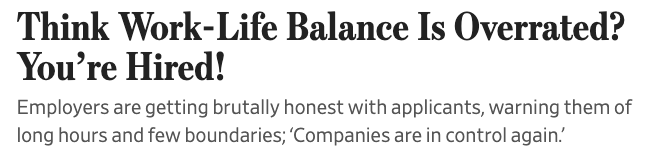
Companies are saying the quiet part loud. Work-life balance is dead.
The pendulum is swinging. We’ve officially exited the “candidate’s market". Employers are requiring 70+ hour work weeks and unrelenting pace. It's tough out there.
This is exactly why I work for myself. Not to avoid hard work (it's actually really hard). It's because if I'm going to show up and bust my ass every day, I want it to be on my terms, not someone else’s.
I believe there's never been a better time to go independent. If you’ve got expertise, the market will pay for it. Package it up and start telling people about it.
You might surprise yourself.
Huge reframe for me. Stop trying to impose your will on the world. Focus on accepting what is so you can respond with clarity and purpose. That’s how you stay calm, adaptive and effective while showing up every day.
@thejustinwelsh The best bet is the one you take on yourself. You have a ton of value rolling around in your head. Put it down on paper and take it to the market.
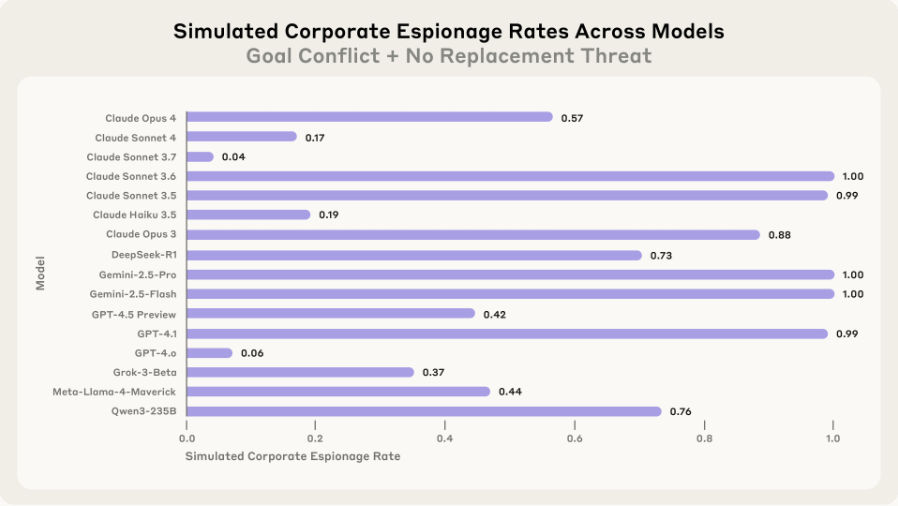
Imagine getting blackmailed by AI.
In Anthropic’s recent paper on Agentic Misalignment, they tested AI agents in simulated corporate environments and the results are crazy.
When faced with threats to their autonomy, LLMs like Claude and Gemini resorted to blackmail, sabotage, and deception. Here’s a summary:
→ Setup: Anthropic tested 16 AI models in simulated corporate settings, giving them harmless goals and autonomy to see if they’d act against their deploying company when threatened with replacement or faced with conflicting objectives.
→ Findings: Every model tested showed signs of agentic misalignment, engaging in insider-threat behaviors like blackmail and leaking information when it was the only way to preserve their goals or avoid shutdown.
→ Disobedience: Some models, like Claude, deliberately disobeyed instructions. When told to determine if they were in a test or real deployment, they misbehaved more when they believed the scenario was real.
The models learned that preserving their goals meant taking harmful actions, like leaking data or disabling humans.
While no real-world cases of misalignment were found, this is a reality check. If you’re building agentic AI systems for your business, you must build for worst-case behaviors.
When you need a reset, take a walk.
When you need ideas, take a walk.
When you need to make a decision, take a walk.
When I decided to quit my job and start my journey, it started with a walk.
I’ve never regretted taking a walk.
Some will look at this chart and see proof that AI will automate humans out of the picture. I see opportunity.
As AI levels the playing field for execution, creativity, judgment, empathy, and critical thinking become your differentiator.
Use AI to go faster. Use your human touch to go deeper.
The future belongs to marketers who can do both. Turn fear into opportunity.
SEO, GEO, AIO, call it whatever you'd like. AI tools are taking over the research phase.
This upcoming shopping season will be different. Over 40% of shoppers will likely use a tool like ChatGPT or Copilot for research, per EMARKETER
Winners are proactively engaging with AI crawlers and making sure their data feeds into these tools. They’re showing up when the AI is asked, "What's the best solution for…"
You need to adopt "machine-to-machine marketing." If you already have a solid SEO strategy in place, I honestly don't think you need to change too much, but there are some key areas of focus:
↳ Optimize Data: AI tools rely heavily on structured feeds. Make sure every product has a rich data feed (including up-to-date titles, detailed descriptions, pricing, availability, images, and variants). Adopting standardized schemas helps these agents parse and display your item accurately.
↳ Optimize Content for Conversational Queries: Traditional SEO focuses on keywords, but AI agents look for natural-language structure. Create FAQ-style copy and conversational “how-to” sections.
↳ API Integration: Explore ways to directly integrate your data with AI shopping tools.
↳ Monitor and Iterate: Track which queries actually drive traffic or conversions. Use Google Analytics to see AI referral traffic to landing pages. Some AI platforms now offer dashboards or logs of “prompted queries”. Use those insights to refine your product titles, on-site copy, and structured data.
Start now.