We just launched Velonos!
It’s a desktop app for anyone using AI with sensitive data. 🔒
You type: “Prepare an NDA between Northwind Ltd and Martin Keller.”
ChatGPT gets: “Prepare an NDA between [ORGANIZATION_1] and [PERSON_1].”
Redaction runs fully on-device.
Introducing Argent e2e
Your agent walks through your app once. Argent saves it as a test you can run on every PR
~/ npx argent init
➡️ Recorded by your agent, saved as YAML
➡️ Runs in CI without an agent
➡️ iOS, Android, Chromium, Electron and Fire TV
Software Mansion is now a Select partner in the Claude Partner Network 🎉
If you're looking for an AI-first team that builds with the latest tools, let's talk.
More in our blog post: https://t.co/HqGTmL2O3D
@AnthropicAI@claudeai
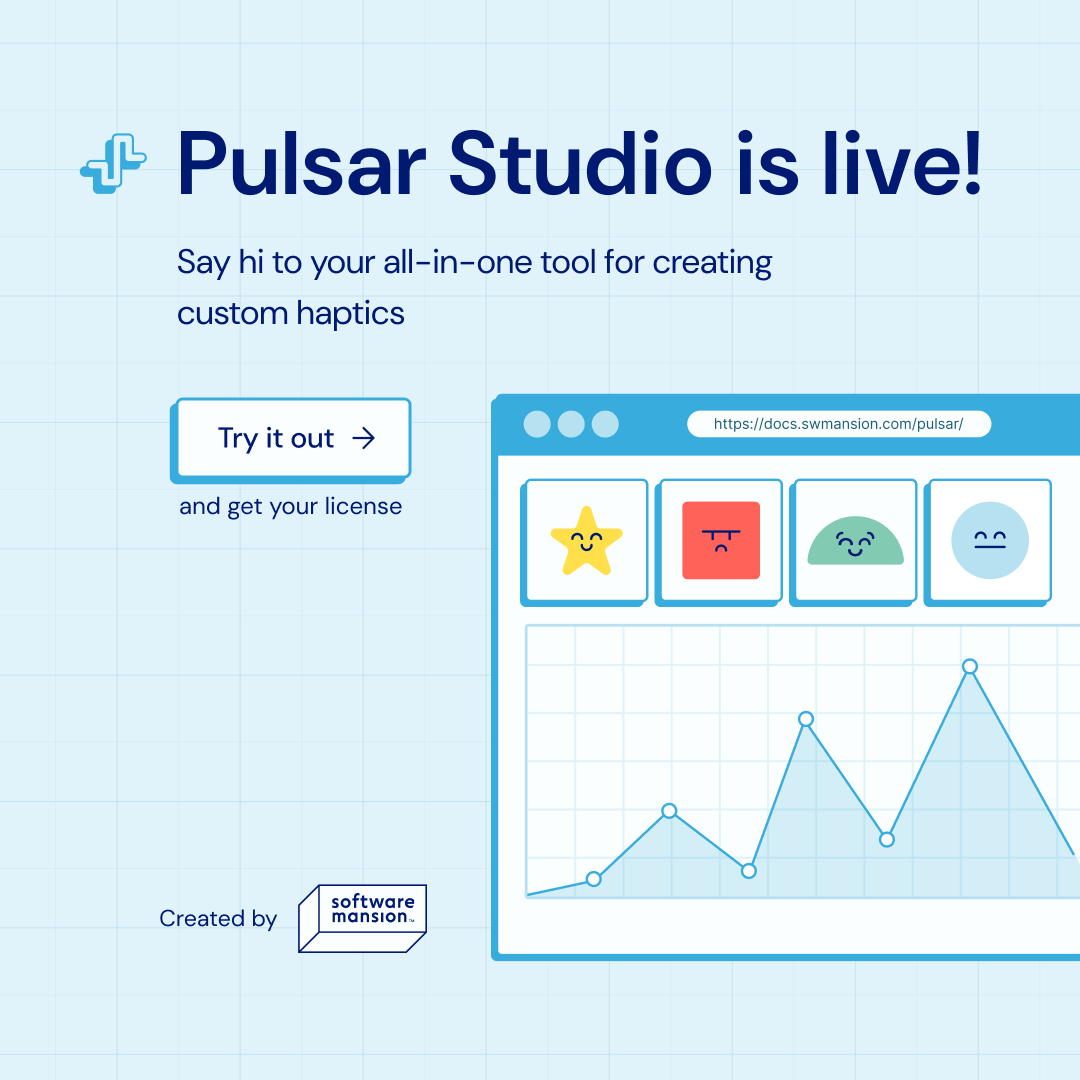
Pulsar Studio – a visual editor for creating custom haptic patterns – is now live! 🎉
It lets you design haptic patterns on a timeline, preview them as you work, and feel them on a real device. You can also generate haptics from audio and Lottie files, or modify 200+ presets from the Pulsar library. ✨
Picking the right tools has always been part of an engineer's job.
But agentic coding is changing that part of the job too. It is approachable (even at scale) to switch tech stack as the constrains change.
If you’re considering rewriting your app, talk to us at @swmansion. We’ve been moving things from JS to native iOS and Android for over 10 years and will help you make the right choice.
Here's what I think about the @ShopifyEng RN → native migration article:
When I rebuilt the Expo Go UI using Jetpack Compose last year, I already felt that all declarative UI frameworks are fairly similar in use, and that agents do a good job migrating between them when it comes to presentation layers. So I'm not surprised Shopify found it possible to fairly quickly rewrite an existing RN app into two separate native codebases. That was always the easier part.
I think the main problem lies in making sure the business logic layer doesn't diverge when there's nothing keeping it together. We introduced a few minor differences between the two Expo Go platforms despite trying very hard not to.
And consistency vs platform feel is one more question of taste, not something an agent will always solve for you.
I don't think react-native will go away, but I definitely feel react-native is evolving, will evolve further, and I have a couple of predictions:
➡️ More and more low level UIs as native components (either ExpoUI or local expo modules with native code files mixed with JS).
Agents are great at writing presentation layers, so why bother having JS lists with all that complexity and perf costs?
➡️ OTAs are more important than ever, prepare for changes ahead of time.
Slow app store review times vs cheap code push people to allow more customisability from JS, essentially treating the JS layer as server driven UI.
➡️ New UI paradigms mean RN remains valuable.
Think custom, per-user interfaces (made for you UIs streamed inside chat, customizable apps etc.) – you need an interpreted higher level abstraction layer that's easier to define and has an SDK.
➡️ Focus on brownfield with no clear set boundaries. Agents pick and choose if they want to build experiences in native or in JS, with most components/APIs/libraries available both as JS and native entrypoints.
In general: I don't think the falling cost of writing lower level code makes abstractions automatically obsolete. You get for free a lot of community effort on deciding/mapping platform quirks, stuff that would cost tokens and engineering effort otherwise, or even worse, would be missed and be a long-running paper-cut in your app.
I think it makes it necessary to make abstractions lock-in free. Use these opinions and higher level components when they make sense and give value, use lower level super easily and cheaply otherwise.
That's why I'm excited about stuff like Expo UI, the new modules API, our @swmansion libraries that work for both RN and native, and all the other effort we did as a community to make mixing those approaches possible and pain free.
Programmers use AI, AI uses artists.
Artists have every right to be mad at this point. AI is fascinating from a tech standpoint, but the relationship between professionals and AI is totally different in tech and art.
(1/n)