Delivery takeaways from the Cursor agents store race:
Green build ≠ done.
Score by dimension, not a forced winner.
Keep verification next to generation.
One sample. Glimpse, not proof.
https://t.co/RpZ4weGJrW
Lo interesante del caso chino es el dilema que deja abierto: proteger a la gente a cambio de más vigilancia, y aun así, los usuarios se van a otros chatbots por VPN. Para Europa y Latinoamérica me parece más viable exigir reglas de diseño que prohibir: avisos claros, límites de uso y derivación a personas cuando la conversación se vuelve emocional. ¿Crees que eso alcanza, o hace falta algo más?
Más que un fracaso de los agentes, leo ese dato como un tema de confianza y reglas. Para que un agente pida por ti, alguien debe haber definido cuánto puede gastar, con qué medio de pago y quién responde si se equivoca. En las empresas pasa lo mismo: el modelo ya está; lo que falta es definir los permisos y las responsabilidades. ¿El dato distingue entre intentos fallidos y pedidos que nadie intentó?
Los agentes de IA todavía están muy lejos de tener el impacto esperado por las grandes empresas de IA. Según datos de @Uber, durante la semana de Halloween se realizaron 320 millones de viajes y pedidos, de los cuales 4 viajes y 500 pedidos fueron pedidos por agentes de IA.
'Knowing which 59% you're looking at' is the line. That review instinct builds by doing reconciliations badly and having a senior pull them apart, and I'm not seeing many organisations deliberately replace that yet. If juniors stop doing first drafts, what's the substitute: review rotations, or pairing them with the agent and a senior checking both?
Agree it's a context problem. The catch with an ontology that learns from dashboards and notebooks is that it learns the disagreements too: most enterprises have a few versions of 'active customer', and the stale dashboard is often the most-used one. Where's the step where a human certifies what Genie learned before an agent acts on it?
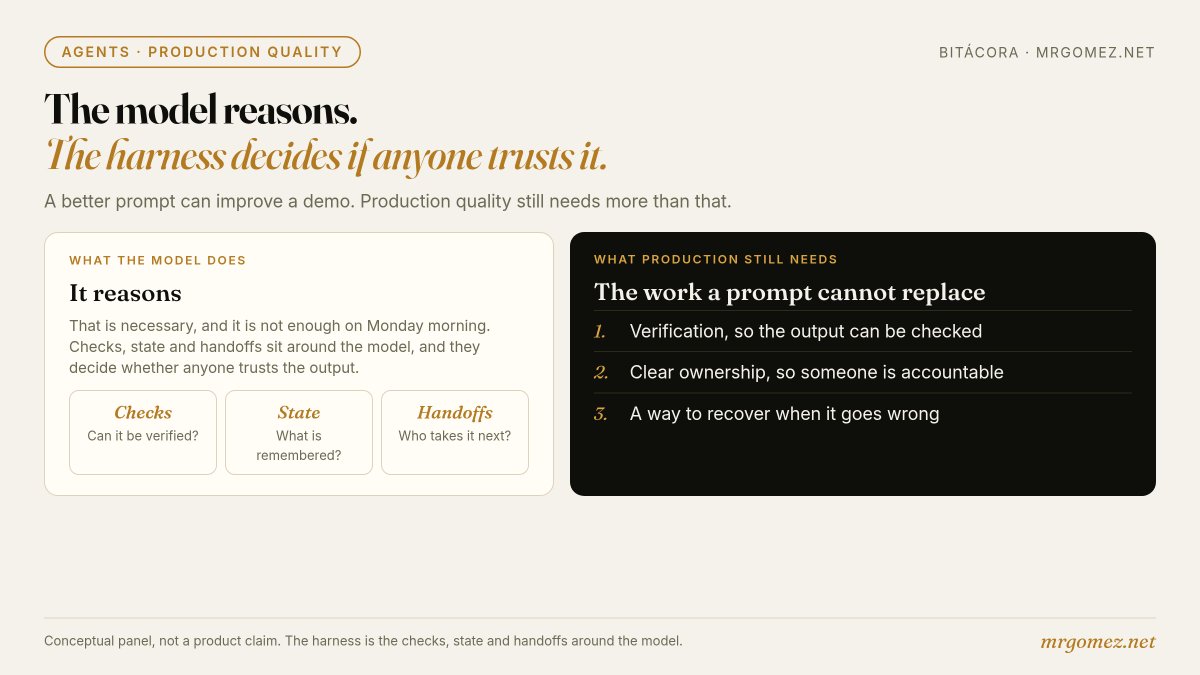
Everyone's talking about agent "harnesses" now.
The model reasons. Checks, state and handoffs decide whether anyone trusts the output on Monday morning.
A better prompt can improve a demo, but production quality still needs verification, clear ownership and a way to recover.
Morning all!
Happy Thursday (in this part of the world at least) 😁
I woke up to a few new followers...
Thank you, every single one of you! 🙌
#connect#Tech#data#AI
Introducing Grok Bot 1.0. AI teammates that work alongside your whole team.
Share Bots, collaborate with them in Slack and Teams, invite them to meetings, and watch them learn and become more helpful.
Variable 2 is where most AI ROI arguments fall over. If 'revenue, 'active customer,' or 'margin' means three different things across three departments, you can't measure lift, and an agent will happily automate whichever definition it finds first. The unglamorous first step is agreeing on what the business actually measures and why. Then point the AI at that.
Muy de acuerdo, Darío. Medir por puestos eliminados es la métrica fácil, pero no dice nada sobre si el trabajo quedó mejor. Yo agregaría una pregunta más: ¿quién decide qué se hace con el tiempo liberado? Si nadie lo define, el ahorro se diluye en más reuniones o en recortes, y la adopción pierde la confianza de los equipos justo cuando más se necesita.
Worth separating AI from offshoring here. Moving finance and HR work to another country isn't automation; it's outsourcing with an AI label. If AI is really the reason, Qantas should be able to say which workflows it's automating, how it's redesigning the work, and what reskilling it's offering to affected people. Without that, 'AI' becomes a cover story, and it erodes everyone else's trust in the technology.
Good thread. The question nobody's answered yet is time. 'Revenue' for FY25 might mean something different today after a pricing or policy change. If the agent only knows the current definition, it can give a perfectly valid, wrong answer about last year. Business definitions need versions and owners, just like code.
@dharmesh's rule: if a structured query can answer it deterministically, use the query, not inference.
"How much revenue from Ireland?" is a database question, not a job for a 300 IQ model.
Agents still need governed data underneath them.
#AgenticAI#Data#AI
Fair question, Andrew. I don't think the answer is teaching more tools. It's deliberately teaching the judgment entry-level jobs used to build through repetition: checking work, framing problems, knowing when an answer is wrong. If AI does the reps, education has to create them on purpose, through real projects, critique and feedback. Otherwise, graduates arrive with outputs but no instincts. My 2 cents.