@Duhlorean98 In fact, all the mantra of the first 3 movies: "You've got a friend in me" vanish at TS4 because he ditches a friend from randoms at the park. That is not friendly from your part @tomhanks.
@alejandraguayoa Yo siempre salía alto en el perfil lipídico. Como bioquímico, empecé a experimentar una dieta que casualmente tiene lípidos y ahora, ya salgo normal. No es lo mismo que tu cuerpo sintetice la grasa a que use la grasa mediante la ingesta. Recuerda azúcar y lípidos comparten vía.
Publico un nuevo libro. Esta vez sobre la relevancia de la #integridad científica, con ejemplos reales de fraude y engaño de investigadores que han vulnerado el código deontológico. Son los #impostores de la ciencia. Lo edita @pinolialibros
A la venta desde el próximo 5 de mayo.
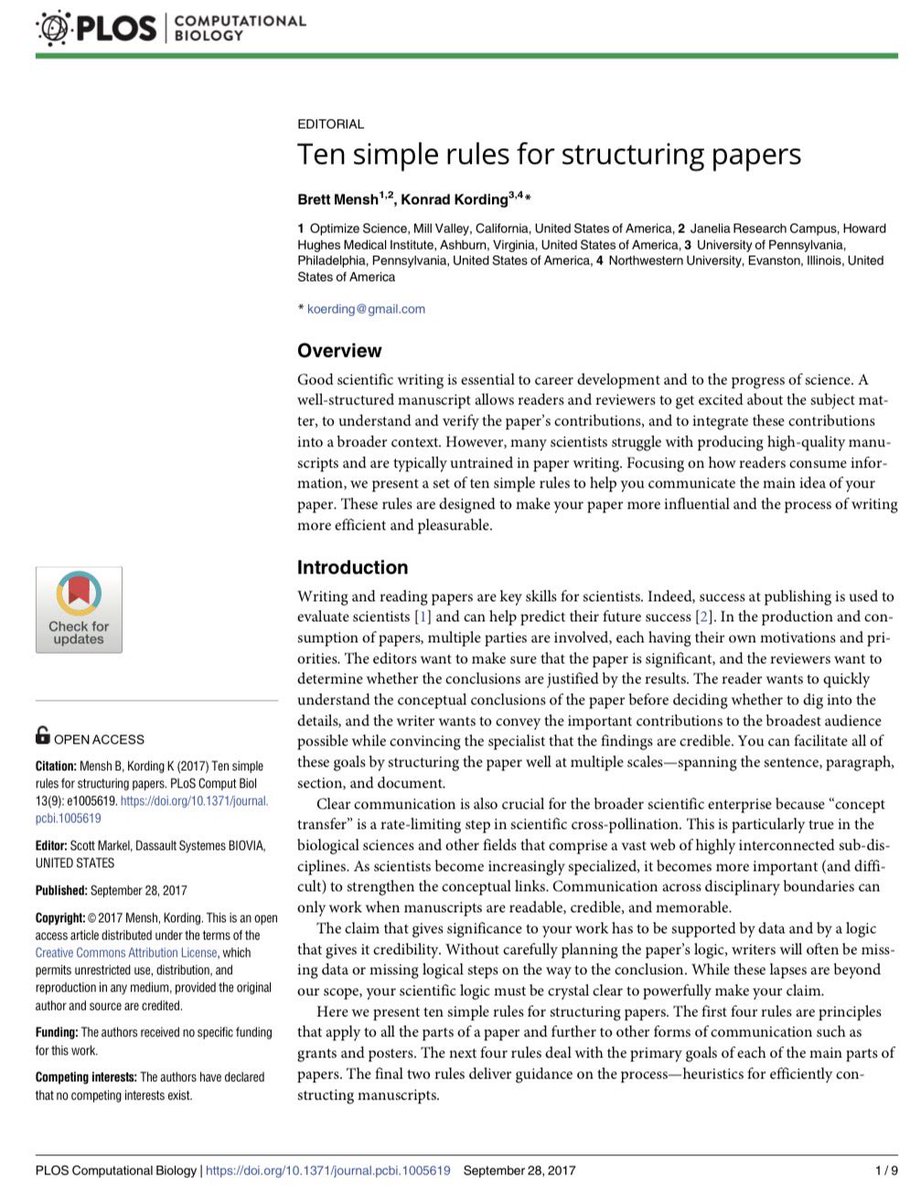
Bu 👇🏼 makaleyi Yale’de hibe proje yazma dersinde önermişlerdi. Makale/proje için geçerli olduğunu düşünüyorum. Özeti:
1. Tek bir ana mesaja odaklanın
Makale tek bir merkezi katkı etrafında dönmeli. Başlık da bu mesajı net vermeli.Okuyan biri 1 yıl sonra bile ana fikri hatırlamalı
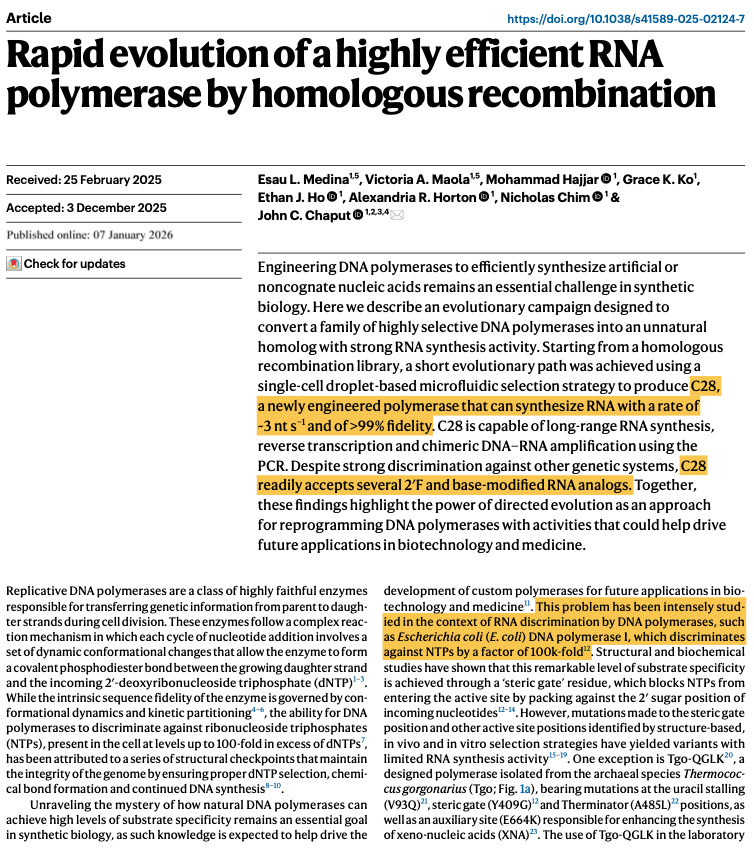
This paper is wild. After 3 rounds of directed evolution, they converted a DNA polymerase into an enzyme that can do:
- RNA synthesis
- Reverse transcription
- Synthesis of "unnatural" nucleotides
- Synthesis of DNA-RNA chimeras
One of the best papers I’ve read recently.
For context: In nature, it is DNA polymerase that takes a DNA sequence as a template and then copies it. These enzymes are crucial in replicating the genome for cell division, and they are EXTREMELY specific for DNA over RNA. This is key because RNA nucleotides are present in the cell at concentrations ~100x higher than DNA nucleotides, so the enzyme has evolved clever strategies to select one over the other.
RNA polymerases, for comparison, are the enzymes that take a DNA sequence as template and then convert it into RNA. They are involved in gene expression, for example.
To convert a DNA polymerase into an RNA polymerase (and all the other functions I mentioned earlier), the authors did a fairly straightforward directed evolution experiment.
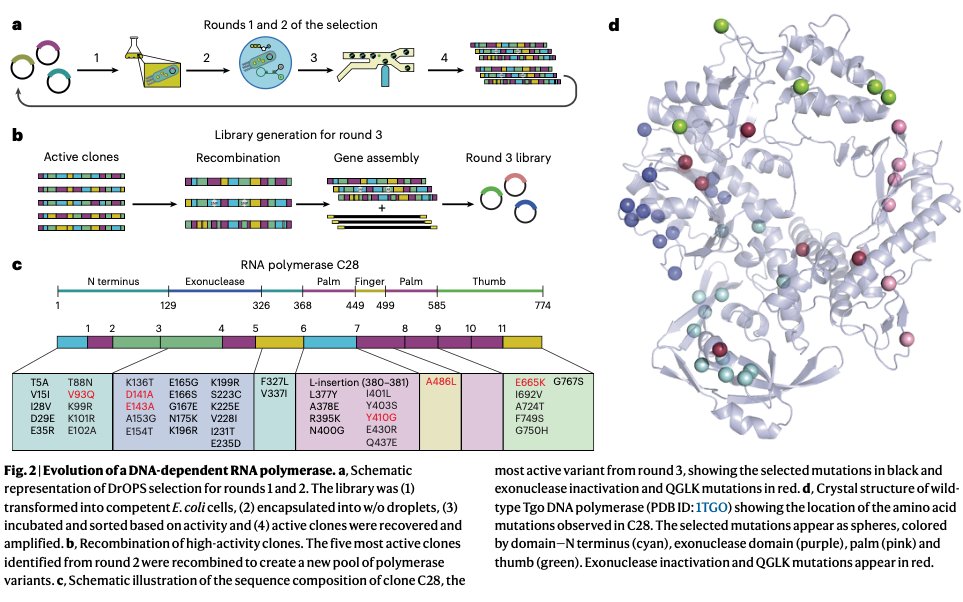
First, they took four DNA polymerase enzymes belonging to various archaea. These DNA polymerases don’t check for DNA vs. RNA as stringently as other types of cells, so they’re a good starting point to evolve RNA polymerases. The authors inserted some targeted mutations into these enzymes, based on known mutations in the literature. For example, they swapped the amino acid at position 409 for a smaller amino acid, thus removing a “gate” that keeps RNA building blocks from entering the enzyme.
Next, they took the four genes encoding these DNA polymerases and cut them up into 12 segments each. They randomly stitched these 12 segments together — from the four different genes — to build millions of unique variants. Each shuffled gene was inserted into an E. coli cell.
Then, they grew up these cells (each carrying a unique polymerase) and put them into microfluidic droplets. A device isolates each droplet, lyses the cell open, and releases the polymerase. The droplet also contains RNA building blocks and a DNA template, encoding a fluorescent reporter. If the polymerase begins synthesizing RNA, it will produce a detectable signal. They screened about 100 million droplets in 10 hours of work, searching for those with a signal.
For each well that yields a fluorescent signal, the researchers isolated the DNA and sequenced it to figure out which polymerase it was. They repeated this 3x times, finally isolating a really excellent RNA polymerase variant which they called "C28."
C28 has 39 mutations compared to the wildtype enzymes. It incorporates about 3.3 nucleotides of RNA per second, with 99.8% fidelity. The crazy thing is that this enzyme can also copy DNA or RNA templates back into DNA (reverse transcription), or use chimeric DNA-RNA molecules as a template and amplify them. It is just a super versatile polymerase that can act on DNA, RNA, or modified nucleotides, to build just about anything.
@GusElMismisimo Yo pensaba que ese instante en el qué Finn muerte en Fiona y Cake es cuando ocurre together again. ¿Me equivoco o por qué todos nos empatan con mi pensamiento? ¿Qué se me está pasando?
@m_goes_distance Hi.
Defeating aging with simple ways to eat.
Former Biochemist and Molecular Biologist :)
The main enemy of the health is the tongue, because we comply with it for a few minutes of pleasure, in exchange of damaging the rest of the organs.
Change my mind.
@MaxUnfried What about nepotism in academia? It is an obligated problem related to the research field of the advisor-student. However, it is a key factor to solve the academic endogamia.
@AXL_BELFORT No del todo. El modelo inicial de Uber es tal y como lo describes, pero con Lyft de competidor, Uber bajó la calidad. Ahí ni participa MX porque no tenemos Lyft, pero sí permearon sus cambios. Muchos viajes son subsidiados por Uber para ganar mercado, pero ya adentro,CambiaJugada
A friendly reminder that the Central Dogma is NOT "DNA -> RNA -> protein."
All that Francis Crick *actually* said was: “Once information has got into a protein it can’t get out again.”
This negative statement — namely, that some transfers of information seem to be impossible — was the entire synopsis of Crick’s idea.
The DNA -> RNA -> protein idea was popularized by James Watson in his 1965 textbook, "The Molecular Biology of the Gene," as a way of summarizing how protein synthesis takes place. But Watson’s explanation was misleading. And, as we now know, there are many exceptions to that "version" of the Central Dogma (including reverse transcriptase.)
In 1956, Crick was working on a lecture that would bring together what was then known about the “flow of information” between DNA, RNA, and protein in cells. Crick formalized his ideas in what he called the Central Dogma, and his original conception of information flow within cells was both richer and more complex than Watson’s reductive presentation.
Crick was aware of at least four kinds of information transfers, all of which had been observed in biochemical studies by researchers at that time. These were: DNA → DNA (DNA replication), DNA → RNA (called transcription), RNA → protein (called translation) and RNA → RNA (a mechanism by which some viruses copy themselves). To summarize his thinking, Crick sketched out these information flows in a little figure that was never published.
Crick’s diagram also included two types of information flow for which there was no experimental evidence, but which he surmised might be biochemically feasible; namely, DNA → protein and RNA → DNA.
The direct synthesis of proteins using only DNA might be possible, Crick thought, because the sequence of bases in DNA ultimately determines the order of amino acids in a protein chain. If this were true, however, it would mean that RNA was not always involved in protein synthesis, even though every study at that time suggested it was. Crick therefore concluded that this kind of information flow was highly unlikely, though not impossible.
Crick also theorized that RNA → DNA was chemically possible, simply because it was the reverse of transcription and both types of molecules were chemically similar to each other. Still, Crick could not imagine any biological function for this so-called “reverse transcription,” so he portrayed this information flow as a dotted line in his diagram.
The most significant part of Crick’s idea — and the part that Watson ignored in his oversimplification — was that there are three flows of information that cannot occur, due both to lack of experimental evidence and any plausible biochemical mechanisms. These were protein → protein, protein → RNA and, above all, protein → DNA.
(From the Archives) "Francis Crick Was Misunderstood."
Read & subscribe: https://t.co/5DiAnjTzAO
Data leakage is a common problem in AI.
It is analogous to ‘teaching to the test’ and leads to overestimation of model capabilities.
This article reports that leakage affected 294 papers across 17 scientific fields.
It remains a major problem in benchmarking AI performance.
I love this paper. It is so clear and so essential! I send it to everyone. I really want to see more superplots in publications and less pseudo-replicates.
And yes, it is something I was not well trained in but you should always be open to do better science!
#ScientificRigor