[ICYMI] PetroSA is fighting for its survival after a former business partner, Nako Energy, applied to have the struggling state-owned petroleum company liquidated over R606-million in unpaid fuel bills.
But court papers filed this week reveal another side to the dispute: Nako itself owes PetroSA R833-million for a cargo of diesel it bought and never paid for. If the two debts were offset, Nako would actually owe PetroSA R227-million.
So why did PetroSA spend 18 months doing seemingly nothing to recover the money? And why did it continue awarding business to Nako, even after Nako's financiers began demanding payment?
The dispute stems from a controversial fuel deal that left PetroSA struggling to sell petrol containing the chemical additive N-methylaniline (NMA). After motorists complained that the fuel was staining their vehicles, major fuel companies refused to buy more of the product.
PetroSA's own court papers acknowledge that the deal damaged its reputation and cost it customers.
Yet despite these problems, PetroSA continued trying to do business with Nako. In October 2025, it requested another petrol delivery. In December, it appointed Nako to supply diesel in Durban, even though lawyers representing Nako's financiers had already demanded payment of PetroSA's outstanding debt.
It was only after Nako launched liquidation proceedings that PetroSA indicated it would consider taking steps to recover the R833-million it was owed.
And all of this is happening against the backdrop of a deepening financial crisis at PetroSA, which owes SARS R5.1-billion and, by amaBhungane's estimate, could owe creditors around R10-billion in total.
In this analysis, we examine the increasingly bitter dispute and the extraordinary lengths PetroSA went to accommodate its former partner, even as it failed to recover hundreds of millions of rands while facing mounting pressure from its own creditors.
Read @SAJournalist’s latest analysis: https://t.co/GPrlFgmLQN
South Africa heads to the polls on 4 November. But who represents a voter whose life stretches across suburbs, townships and rural homes?
The Black middle class exposes a predicament that our political choices rarely reflect.
My reflection:
https://t.co/ii1V4radIM
[VIDEO] Two years, two institutions, two continents and one transformative approach. UCT's Nelson Mandela School of Public Governance and Sciences Po’s School of International Affairs, Paris are launching a new collaborative master’s degree in Development Policy and Practice to begin in January 2027.
This master’s programme combines academic excellence and applies policy training in two dynamic political and institutional environments. This collaborative degree prepares graduates for careers in international development, governance and public policy across Africa, Europe and beyond.
Students are required to register at UCT and Sciences Po over the two years and have access to the student services of both universities. The degree is open to candidates worldwide. Applications close 31 March 2026.
Find out more: https://t.co/EBLsL4qS0a
Watch the full video: https://t.co/YjWUW9GV0C
Master of Development Policy and Practice in the bag 💼
I started this degree at the beginning of 2024. At the time I was the Chief Whip of the Official Opposition- @Our_DA. I knew it would be difficult to balance the academic demands; my job as a parliamentarian - during an election year.
Half way through that year, I was appointed as a cabinet minister. One of the largest undertakings I’ve ever made. I briefly contemplated deferring; but this was an important commitment I’d made to myself. Through sheer stubbornness and the desire to gift myself a 3rd degree, I decided to continue.
To say the following 18 months after that decision were hard, would be an understatement. It tested my resolve; my patience and stretched my intellect in ways I’ve never experienced before.
2025 was by far the hardest part of the academic journey. However, the @MandelaUCT School and my supervisor were incredibly supportive.
Not only did I manage to complete this degree; I completely aced my dissertation.
I’d begun work as the then Chief Whip of introducing legislation that would help South Africa manage coalition governments at a local, provincial and national government. Never did I think that my topic would be my lived reality.
I researched the relationship between the political instability in the City of Johannesburg and the service delivery decline over 10 years.
What an enlightening journey. A topic that I want to possibly expand on for my PhD one day.
I want us to have a real academic and practical understanding of how we make coalition governments work better for the people of South Africa. 🇿🇦
Ndiyambulela uThixo, AmaWushe, my loved ones, my team and my incredible supervisor for pushing and encouraging me when times got tough.
NQF 9 girlies are UP! 😊
Pleased to host artists, cultural organisations, and policymakers tomorrow at @IIPP_UCL to discuss how we can rethink value frameworks to maximise the impact of arts and culture - placing them at the heart of our economy.
Read more ➡️ https://t.co/s9RC8k0cyY
Forthcoming in AEJ: Microeconomics: "The Organization of Innovation: Incomplete Contracts and the Outsourcing Decision" by Thomas Jungbauer, Sean Nicholson, June Pan, Michael Waldman, and Lucy Xiaolu Wang. https://t.co/LZM6rE4yzI
Grateful to Professor Baziller @remibaz at Paris 1 Panthéon-Sorbonne for superb PhD supervision, and to the Nelson Mandela School (@MandelaUCT) at UCT for providing an intellectual home throughout this journey.
🚨 Just published! 🚨
My new article is out in The Extractive Industries and Society:
“Mining, Separate Development, and Uneven Impact”
It investigates how industrial mining shaped poverty and employment in South Africa’s marginalised rural areas during the 2000s.
This article is part of the special issue VSI: Institutions, Development and Extractive Industries, edited by Dr Alecia Ndlovu, Dr Kendra Dupuy, and Dr Rod Alence.
Grateful to be part of this important collection.
#Mining#PoliticalEconomy#SouthAfrica#Development#Extractives
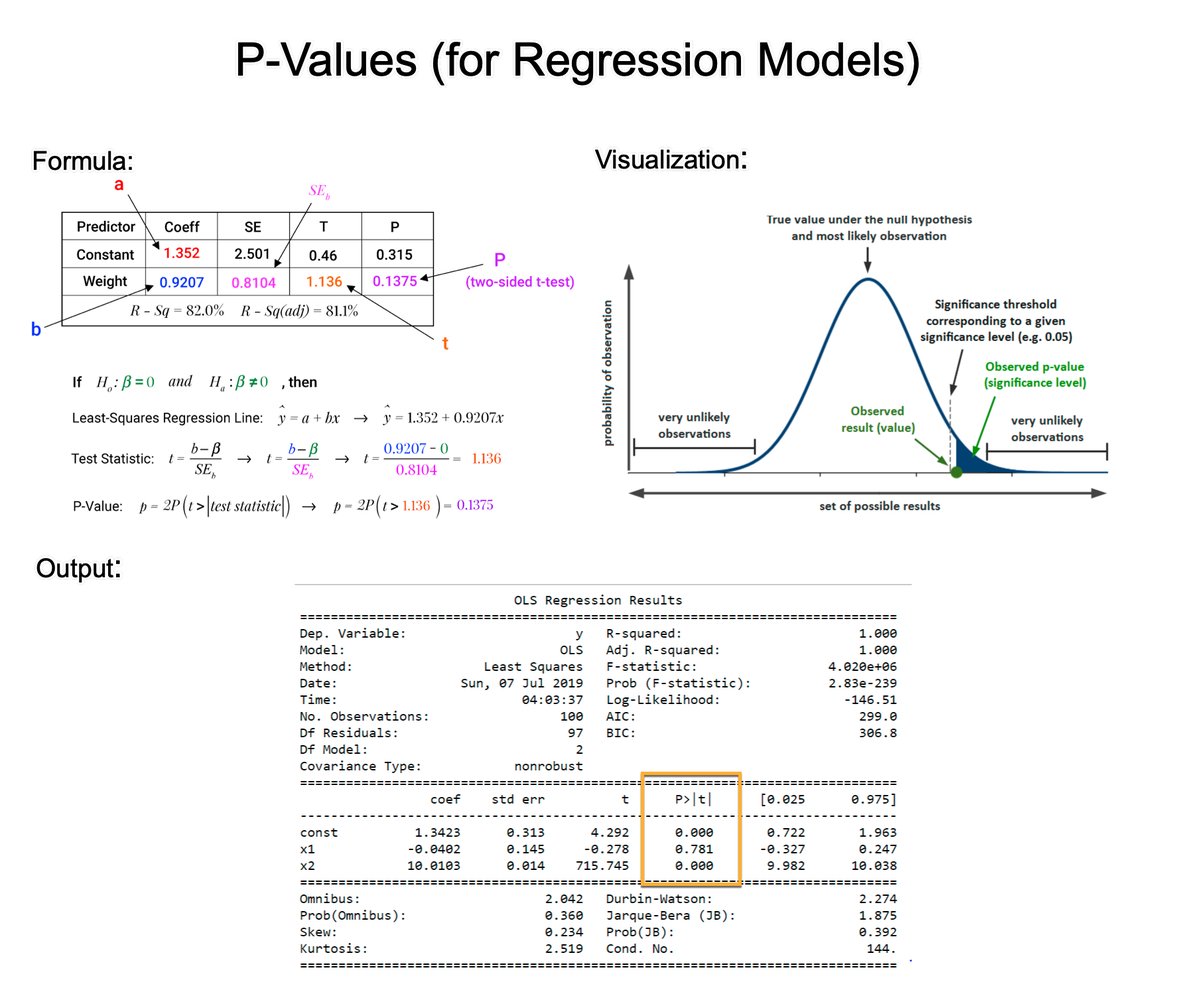
Understanding P-Values is essential for improving regression models. In 2 minutes, learn what took me 2 years to figure out.
1. The p-value: A p-value, in statistics, is a measure used to assess the strength of the evidence against a null hypothesis.
2. Null Hypothesis (H0): This is a general statement or default position that there is no relationship between two measured phenomena or no association among groups. For example, the regressor does not affect the outcome.
3. Alternative Hypothesis (H1): This is what you want to test for. It is often the opposite of the null hypothesis. For example, that the regressor does affect the outcome.
4. Calculating the p-value: The p-value for each coefficient is typically calculated using the t-test. There are several steps involved. Let's break them down.
5. Coefficient Estimate: In a regression model, you have estimates of coefficients (β) for each predictor. These coefficients represent the change in the dependent variable for a one-unit change in the predictor, holding all other predictors constant.
6. Standard Error of the Coefficient: The standard error (SE) measures the accuracy with which a sample represents a population. In regression, the SE of a coefficient estimate indicates how much variability there is in the estimate of the coefficient.
7. Test Statistic (T): The test statistic for each coefficient in a regression model is calculated by dividing the Coefficient Estimate / Standard Error of the Coefficient. This gives you a t-value.
8. Degrees of Freedom: The degrees of freedom (df) for this test are usually calculated as the number of observations minus the number of parameters being estimated (including the intercept).
9. P-Value Calculation: The p-value is then determined by comparing the calculated t-value to the t-distribution with the appropriate degrees of freedom. The area under the t-distribution curve, beyond the calculated t-value, gives the p-value.
10. Interpretation: A small p-value (usually ≤ 0.05) indicates that it is unlikely to observe such a data pattern if the null hypothesis were true, suggesting that the predictor is a significant contributor to the model.
There you have it- my top 10 concepts on p-values. The next problem you'll face is how to apply data science to business.
I'd like to help.
I’ve spent 100 hours consolidating my learnings into a free 5-day course, How to Solve Business Problems with Data Science. It comes with:
300+ lines of R and Python code
5 bonus trainings
2 systematic frameworks
1 complete roadmap to avoid mistakes and start solving business problems with data science, TODAY.
👉 Here it is for free: https://t.co/YXG4pL97ZN
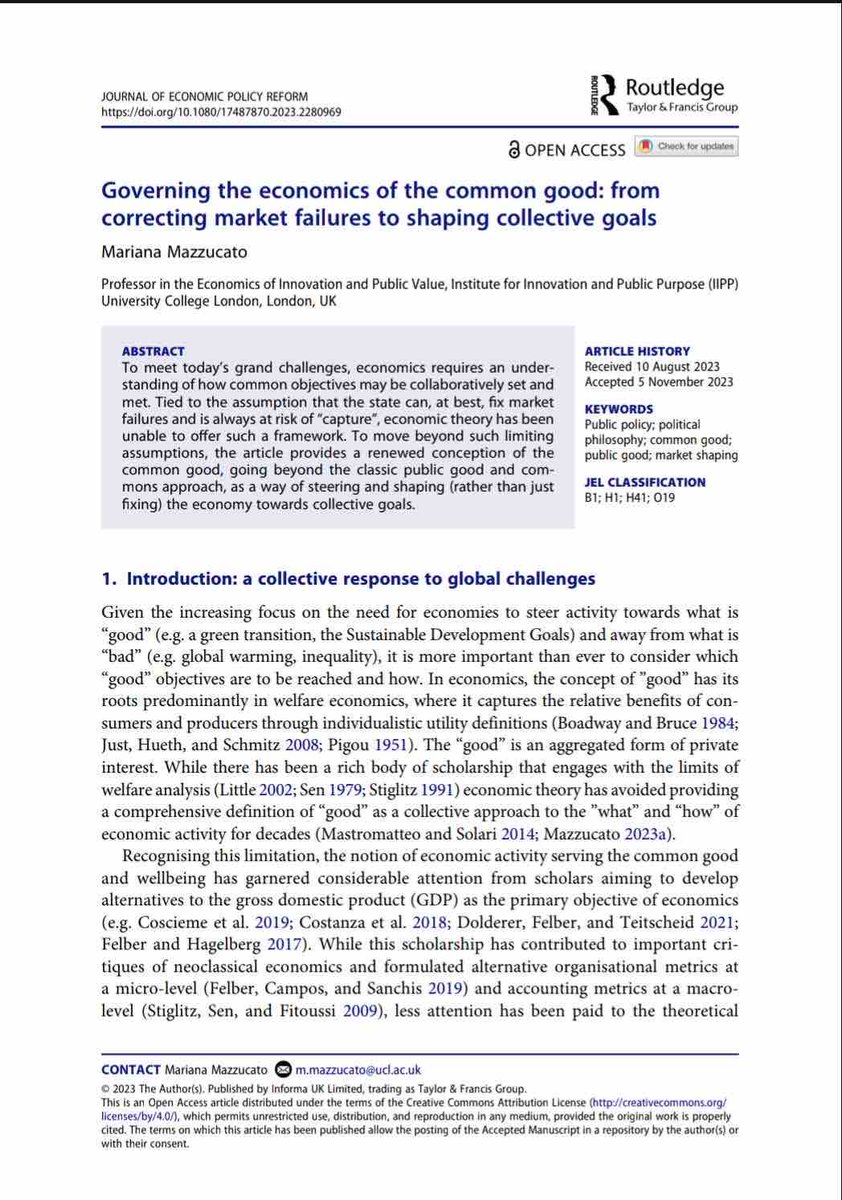
IIPP Director @MazzucatoM outlines a framework to help redesign our economics around the common good. Her paper provides key criteria to help govern and tackle our collective challenges.
Read it here ➡️ https://t.co/tQh09VunMk
African countries can’t resolve their debt crisis under a system rigged against them https://t.co/CsvHXODuM3
💻 Carlos Lopes, University of Cape Town @UCT_News#BusinessAndEconomy
The call for papers for the Jobs and Development conference 2024 is out. This year, it will be even bigger with the @ilo joining @UNUWIDER@WorldBank and the Network on Jobs and Development in co-hosting the conference. Please submit!
One's ability to make very definitive statement on any matter is proportional to the lack of knowledge of that matter. Thus, after visiting a country for 48h, one can generalize what that country is much more easily than after living there five years.