We just killed Apify.
Your agent can now read every social media platform.
No logins. No subscriptions.
X, Reddit, LinkedIn, TikTok, Facebook, Instagram, YouTube, Rednote, and even Amazon.
Apify: $199/month.
Monid: From $0.0015/request. Pay as you go.
Writing clean code helps you build scalable, maintainable software applications.
And in this handbook, @shahancd explains what clean code is and why it's important.
He also walks you through some helpful coding patterns & discusses comments, naming conventions, functions, project structure, and lots more.
https://t.co/zxU0Iu6jdR
Baidu just open-sourced an OCR model that reads entire 40-page documents in one shot.
It's called Unlimited-OCR. 3 billion parameters but only 500 million active during inference. Runs 100% locally on your machine.
Why this matters: traditional OCR tools chop documents page by page. Tables that span two pages break. Reading order gets lost. Cross-page context disappears.
Unlimited-OCR processes the whole document at once. 32K context window. Text, formulas, tables, reading order all preserved across pages.
Output comes out as clean structured Markdown.
→ 93% accuracy on the standard benchmark. +6 points over the baseline.
→ Error rate stays below 0.11 even past 40 pages.
→ Multilingual out of the box.
→ 2.12 million downloads on Hugging Face last month. 14,600 GitHub
stars.
For context: Amazon Textract, Google Cloud Vision, and Azure Document Intelligence all charge per page. This runs locally for free.
Andrew Ng just released a 1-hour course on building agentic knowledge Graphs from scratch:
• 00:00 - Introduction to agentic knowledge Graphs
• 03:07 - Construction of agentic Graphs
• 14:00 - Architecture of multi-agent systems
• 23:00 - Building agentic graphs with Google ADK
• 01:06:03 - Why Graphsare the future of agentic AI
Worth more than 10 articles on loop engineering.
Watch it today, then read how to become a graph engineer in the article below.
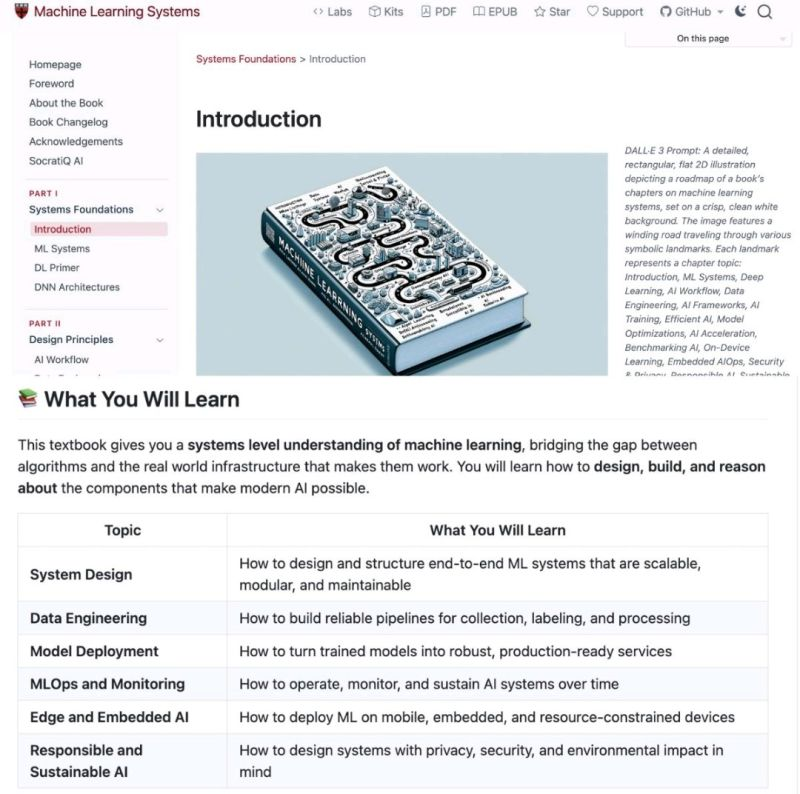
Harvard just open-sourced its entire ML Systems curriculum.
Free. Public. 6 pillars. Hundreds of pages.
And it won't get most data scientists any closer to a $150K AI role.
Here's why.
China open-sourced a peanut-sized OCR that parses entire 100-page PDFs in one shot..
It's called Unlimited-OCR. Only 3B params. Runs locally.
Every other OCR tool chops your doc into pages and loses the thread. this one reads the whole thing in a single pass.
→ One-shot "long-horizon" parsing (32K context window)
→ Multilingual, out of the box
→ 93% on the standard parsing benchmark (+6 over baseline)
→ <0.11 error rate past 40 pages
→ Runs 100% locally on your own hardware
→ Works with Transformers, vLLM, SGLang, Docker, Ollama, llama.cpp
Traditional cloud OCR (Textract, Google Vision, Azure Doc Intelligence) costs $1.50–$15 per 1,000 pages.
This runs on your machine. For free. Forever.
Baidu built it explicitly to push DeepSeek-OCR one step further. Already at 1.9M downloads on Hugging Face and most people have no idea it exists yet.
100% open source.
NVIDIA open-sourced a 600M model that transcribes 40 languages in real-time at 80ms latency and it costs $0.
that's faster than you can blink. across mandarin, arabic, hindi, portuguese, tagalog, whatever,from a SINGLE checkpoint.
→ 17x more concurrent streams than buffered ASR on the same H100.
→ punctuation + capitalization built-in. no post-processing.
→ runs on your own GPU. no API bill
100% Open Source.
This 1-hour Stanford lecture on Markov Decision Processes will teach you more about the math behind systematic trading than a 3-month internship at Jane Street or JPMorgan.
Bookmark & give it an hour today, no matter what.
She literally showed how she uses adversarial agents in Claude Code to win hackathons and ship features:
2:47 - How she won her hackathon
4:30 - The 5-layer Claude stack
7:17 - Which model to actually use
9:55 - Chat vs Desktop vs Chrome
14:43 - Cowork automations
26:18 - Skills that beat prompts
34:28 - The AI chief of staff build
59:24 - MCPs every PM needs
1:02:16 - Claude Design is here
1:08:53 - Adversarial agents, live
1:13:01 - The new AI builder role
1:15:57 - The 2026 AI PM interview
1:29:06 - Self-improving product loop
A guy named Jonah accidentally built the most useful website on the internet.
It's called Privacy Guides.
This is the website Google would rather you not find, Meta actively lobbies against, data brokers have tried to discredit for years, and the entire advertising industry treats as a direct threat to their business model.
It has been online since 2019. It takes no affiliate money. It runs no ads. Journalists cite it. Security researchers trust it.
Here's how it works.
Privacy Guides is a curated recommendation list. The site itself sells nothing.
It just tells you which private tool actually replaces every surveillance product in your life, tested by security researchers and updated every month, organized into 40+ categories with the exact reason each pick was chosen.
→ Browsers that block trackers and ads by default
→ Email providers that cannot read your messages
→ Search engines that do not build a profile on you
→ Password managers you can self-host
→ VPNs that accept cash and Monero and log nothing
→ Messengers with end-to-end encryption Signal-tier or better
→ Photo apps that do not scan your camera roll
→ Health apps that do not sell your data to insurance companies
→ A custom Android OS called GrapheneOS that strips Google out of your phone entirely
The site is run by a non-profit called MAGIC Grants. Every recommendation goes through a public forum review, a GitHub pull request, and criteria published on the site so anyone can audit why a tool was chosen. No company can pay to be listed. No affiliate link exists on the entire domain.
Google can't shut this down. Meta can't shut this down. Amazon can't shut this down.
The entire $600 billion surveillance advertising industry is built on the assumption that you would never spend one afternoon on this website.
https://t.co/BQJjD1jANC
🚨NotebookLM + Google Antigravity is one of the most powerful combo available right now—and almost no one is using it.
If you’re not taking advantage of this, you’re missing out on serious leverage.
Here’s how to set it up in 2 minutes + what it can do 👇
Someone turned Claude into an entire company.
42 skills, organised like a real org chart (links below):
Here is every department, and where to get each one.
Developers
Superpowers → https://t.co/pPPxKoPEwD
Context7 → https://t.co/3Kk9U8PG1T
Skill Creator → https://t.co/Lanao7tpOh
MCP Builder → https://t.co/Lanao7tpOh
Webapp Testing → https://t.co/Lanao7tpOh
Claude-Mem → https://t.co/yTb8qxqa7S
Designers
UI UX Pro Max → https://t.co/MQTtS9flwt
Taste → https://t.co/AEq4GZc60x
Frontend Design → https://t.co/AEq4GZc60x
Transitions → https://t.co/Z7JOt7lJb2
Web Artifacts → https://t.co/Lanao7tpOh
Brand Guidelines → https://t.co/Lanao7tpOh
Marketing
45 skills to run your marketing, from copywriting to SEO to lead magnets.
Access them all here → https://t.co/OWo258NM7L
Social Media
17 skills to run your social media, from post writing to Reels to thumbnails.
Access them all here → https://t.co/2qawCgAyQF
Finance
8 skills to run your finances, from statements to reconciliation to audits.
Access them all here → https://t.co/X6dVFcZBIJ
Small Business
31 skills to run your small business, from cash flow to payroll to invoicing.
Access them all here → https://t.co/7Prb2sXVpI
Legal
9 skills to handle your legal work, from contract review to NDAs to compliance.
Access them all here → https://t.co/GKaZzGYPOr
Every skill on the chart is real and installable from the links above.
Same departments. Same output. No payroll.
Bookmark this.
Deep learning terms can be a bit confusing when you're first learning them.
In this article, @Roland_Sankara explains CNNs, RNNs, and Transformers with beginner-friendly mental models.
You'll learn how neural networks work, why CNNs focus on spatial patterns, how Keras helps you build models, and lots more.
https://t.co/cVPz5bU9KK
Andrew Ng just released a 2-hour course
On building agentic skills from scratch with Anthropic:
00:00 - How to build agent skills with Claude
22:32 - Claude pre-built skills for AI agents
41:07 - Agentic skills vs tools, MCP, and subagents
01:06:06 - Skills for long-running agents
This 2-hour watch can replace 10 paid courses on building agents
Taught with Anthropic themselves
Bookmark and watch it tonight
Then read the article below
Google engineer explained how to fine-tune a tiny LLM from 46% to 90% accuracy on your phone in 21 minutes - better than $1500 on-device AI bootcamps.
pick Gemma 270M -> generate synthetic task data -> fine-tune with LoRA -> quantize to int4 -> deploy to Pixel and hit 2000 tokens per second.
That loop is how a 270M model beats a 70B one on your task, running fully offline in your pocket.
Gemma 270M + synthetic data + LoRA + int4 quantization + on-device runtime - that's the stack.
Watch and save it, then fine-tune your own tiny agent tonight.
ALGUIEN CREÓ UNA REPO DE GITHUB QUE TE PERMITE EJECUTAR CLAUDE CODE GRATIS
un repo que redirige claude code a 10 proveedores gratis (deepseek, kimi, etc)
5 minutos de configuración. listo.
20,000 developers ya lo están usando
entiende qué está pasando aquí:
→ claude code cuesta dinero
→ este repo lo hace gratis
→ no es un hack, es simplemente redirigir tráfico
→ funciona exactamente igual
→ nadie está pagando nada
esto es el tipo de cosa que cambia cómo codea la gente
si pagabas $200/mes en claude code y esto funciona, acabas de recuperar ese dinero para siempre
20k developers no es un numero pequeño
significa que funciona, que es estable, y que está creciendo
Te la dejo abajo 👇🏻
Un chico en China integró el método de Andrej Karpathy en Claude Code y convirtió un baúl de Obsidian muerto con 15.000 notas en el segundo cerebro más inteligente del planeta.
Su baúl era un cementerio: 956 archivos que nadie volvía a abrir, 80 pestañas guardadas, 0 clics en 6 meses.
Entonces una frase de Karpathy le hizo reaccionar: no sabes nada hasta que puedes construirlo desde cero.
Los tutoriales son un aprendizaje falso que tu cerebro borra en 3 días, junto con las 40 pestañas que guardaste y nunca abriste.
Así que le dio la vuelta a todo el planteamiento.
Obsidian es el IDE, Claude Code es el programador y sus 5.000 notas son el código fuente.
Dejó de hacerle a la IA preguntas que esta olvida a la mañana siguiente y, en su lugar, logró que mantuviera una wiki viva.
3 comandos ejecutan todo el sistema.
Ingestar: introduce un artículo, un podcast o un PDF de 40 páginas, y Claude lo divide en páginas atómicas enlazadas a todo lo que él ya sabe.
Consultar: pregunta cualquier cosa y responde basándose en sus propias notas, con sus propias palabras, citando sus propias páginas en lugar de adivinar a partir de datos de entrenamiento.
Cerrar el ciclo: cada respuesta se convierte en una nueva nota, y el baúl se afina cada vez que lo toca, multiplicando su valor en lugar de estancarse.
La semana 1 tenía 2000 notas, en su mayoría ruido.
El mes 2 alcanzó las 7.400 con conexiones activándose a toda máquina.
El mes 6 se convirtió en 15.000 notas capaces de debatirle.
Superó a cualquier curso de IA de 2.000 $ que hubiera comprado jamás, porque su sistema ya sabía lo que él sabía.
La estructura de carpetas y el prompt exacto de Claude Code están en la respuesta.
Sígueme si construyes con IA.
Sus notas dejaron de ser un simple almacenamiento.
Empezaron a pensar por sí mismas.
How to become AI engineer in next 6 months:
By the end, you want to be able to:
- build LLM apps end-to-end
- use APIs from OpenAI / Anthropic / open-source stacks
- design prompts and context properly
- add tool calling and structured outputs
- deploy real projects
So, let’s discuss your roadmap month by month
Month 1: Get solid enough in coding and fundamentals
What to learn:
- Python really well
- Git + GitHub
- CLI / terminal basics
- JSON, APIs, HTTP, async basics
- basic SQL
- basic data handling with pandas
- virtual environments, package management, error handling
- FastAPI or Flask
Month 2: Master LLM app development
What to learn:
- prompting fundamentals
- system vs user instructions
- structured outputs / JSON schemas
- function/tool calling
- streaming responses
- conversation state
- cost / latency / token basics
- failure handling
- prompt injection awareness
Month 3: Learn RAG properly
What to learn:
- embeddings
- chunking
- vector databases
- metadata filtering
- reranking
- retrieval quality issues
- hallucination reduction
- citations and grounding
Month 4: Agents, tools, workflows, evals
- agent loops
- tool selection
- state management
- retries
- when NOT to use agents
- multi-step workflows
- evaluation harnesses
- task success metrics
Month 5: Deployment, product thinking, and reliability
What to learn:
- FastAPI production patterns
- Docker
- background jobs
- queues
- auth + API key security
- logging
- observability
- prompt/version management
- eval dashboards
- cost monitoring
- rate limits
- caching
Month 6: Specialize and become hireable
these knowledge and skills you gained can be applied in three directions
you need to choose one of them and focus on practice
although everything mentioned above is also best learned purely through practice
Direction 1: AI product engineer
Best if you want startup jobs fast
Focus on:
- LLM apps
- RAG
- agents
- deployment
- product UX
Direction 2: Applied ML / LLM engineer
Focus on:
- fine-tuning
- when to fine-tune vs prompt
- evaluation
- inference optimization
- open-source models
- training pipelines
Direction 3: AI automation engineer
Focus on:
- workflow orchestration
- business process automation
- multi-tool systems
- CRM, docs, email, support, ops use cases
This roadmap will help you go through a practical path, and the key is to study each of these points and then test them in real work
By month six, you will already have several built products or examples of completed tasks
And it will be much easier to get a job as an AI engineer
Save it so you don't lose it and can return to study later