A new kind of AI model is spreading fast: decision models.
They don't write. They score a fixed set of answers in one pass and return a probability.
Google just released one. Here's the landscape, and where they fit in an agent ↓
Where they don't fit: one benchmark study found they're strong when the evidence is in the input, weaker when the answer needs outside knowledge, and small errors add up over long agent runs.
Use them for single decisions, not to run the agent.
So judge the centre on shared compute, usable local data and people who can ship. A model nobody can reach over 2G helps no one, which is why the 4G line matters as much as the GPUs.
Ghana's 2027 Budget: US$300m for a National AI Centre plus rural 2G-to-4G upgrades (2027-28).
Finance Minister: "We don't intend to challenge China or America." Focus: health, agriculture, energy, logistics, Ghanaian languages.
Right call. Here's why. #Ghana
https://t.co/gniZD8PM5K
It's already the pattern: about two-thirds of funded African AI companies apply AI inside an existing sector (health records, banking, agriculture, customer service) rather than building horizontal platforms.
https://t.co/85TEhIfsJQ
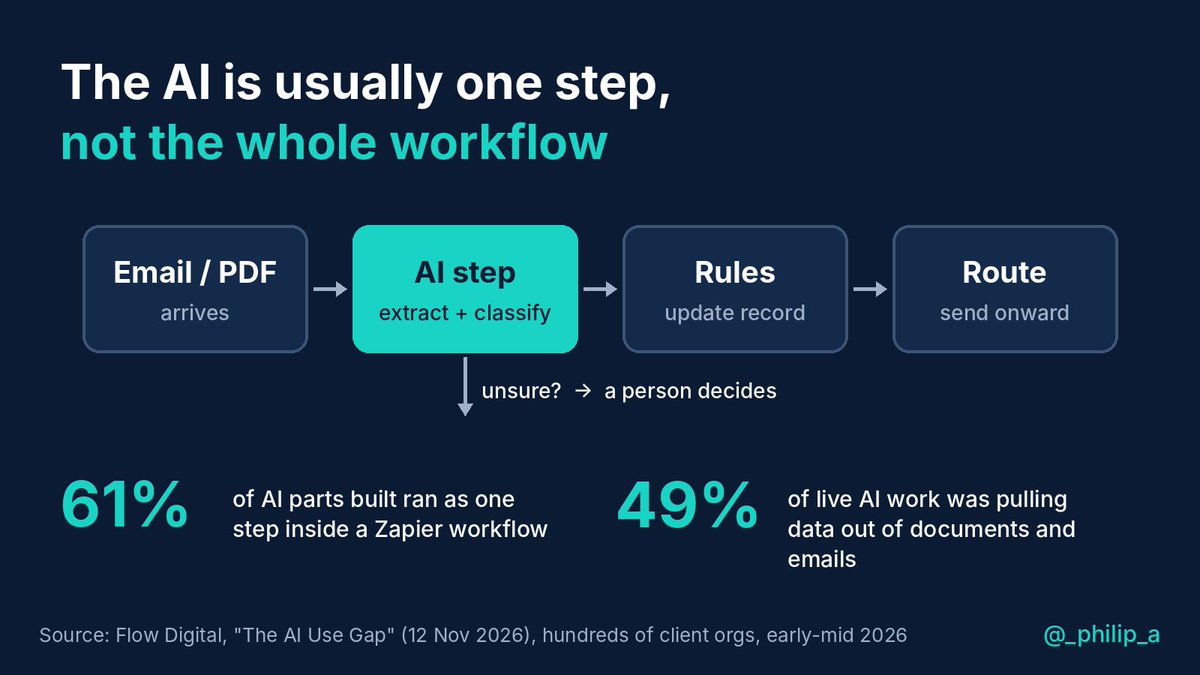
Most production AI isn't an agent. It's one step in a boring workflow.
Flow Digital reviewed hundreds of orgs. 61% of AI parts built ran as a step inside Zapier. 49% of the work: pulling data from documents and emails.
Start with the messy input.
https://t.co/Y3OF3UH2Nw
AT&T now runs nearly 500 agentic workflows in production, handling 1M+ transactions a month.
The bit worth copying: every workflow starts with a human in the loop. Autonomy only comes once accuracy hits the mid-to-high 90s.
Earn autonomy. #AIAgents
https://t.co/dUgooN0RkB
Most processes people want an AI agent for don't need one.
Before I build one, I ask four questions. Here they are, applied to a common request: "automate our supplier invoices" ↓
@kang_0421 Agreed. Normalising the key matters more than people expect. And flag for a person rather than block: a wrong block can delay a payment that’s due.
@chrismatthews The first one, by far. Most requests have fixed steps, which means a workflow. And agreed: if nobody can write the steps down, then it’s not ready to be automated.