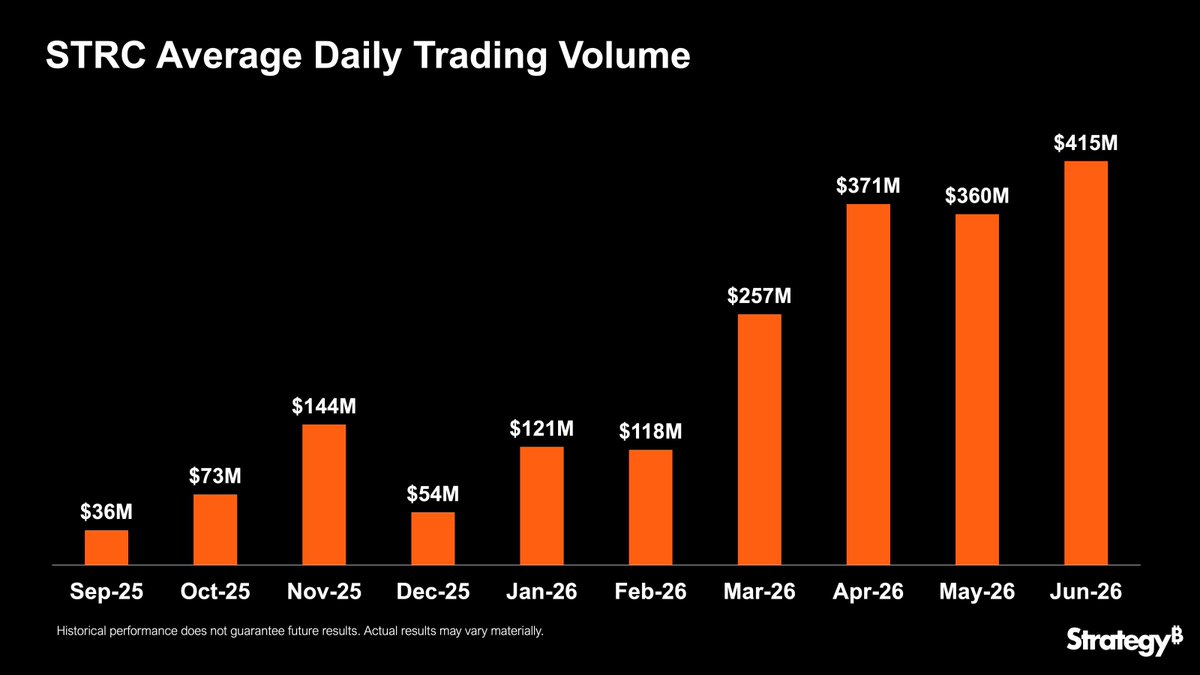
I joined @kgreifeld and @RomaineBostick on Bloomberg today to discuss Strategy’s evolution into a Digital Capital platform, our $3B cash reserve, $STRC, balance sheet resilience, and our long-term commitment to Bitcoin.
01:17 - Strategy’s evolution from Bitcoin Treasury Company to full Digital Capital platform
01:25 - Over 840,000 BTC, $10.5B of $STRC, and Strategy’s responsibilities
01:45 - Why Strategy built a $3B cash reserve after listening to preferred shareholders
02:30 - The path for $STRC: build USD reserves, return $STRC to par, issue more $STRC, and buy $BTC
04:22 - $MSTR’s goal: outperform Bitcoin over time while managing volatility through bull and bear markets
05:41 - Balance sheet resilience and why debt risk is low
06:50 - Strategy’s long-term Bitcoin commitment: “We’re not going anywhere”
07:04 - Bitcoin is bigger than Strategy: 4% ownership, $30–40B of daily volume, and bitcoin sales that did not move the market
08:46 - Software, AI, Bitcoin, and the maturity of a 25-year public company operating inside digital finance
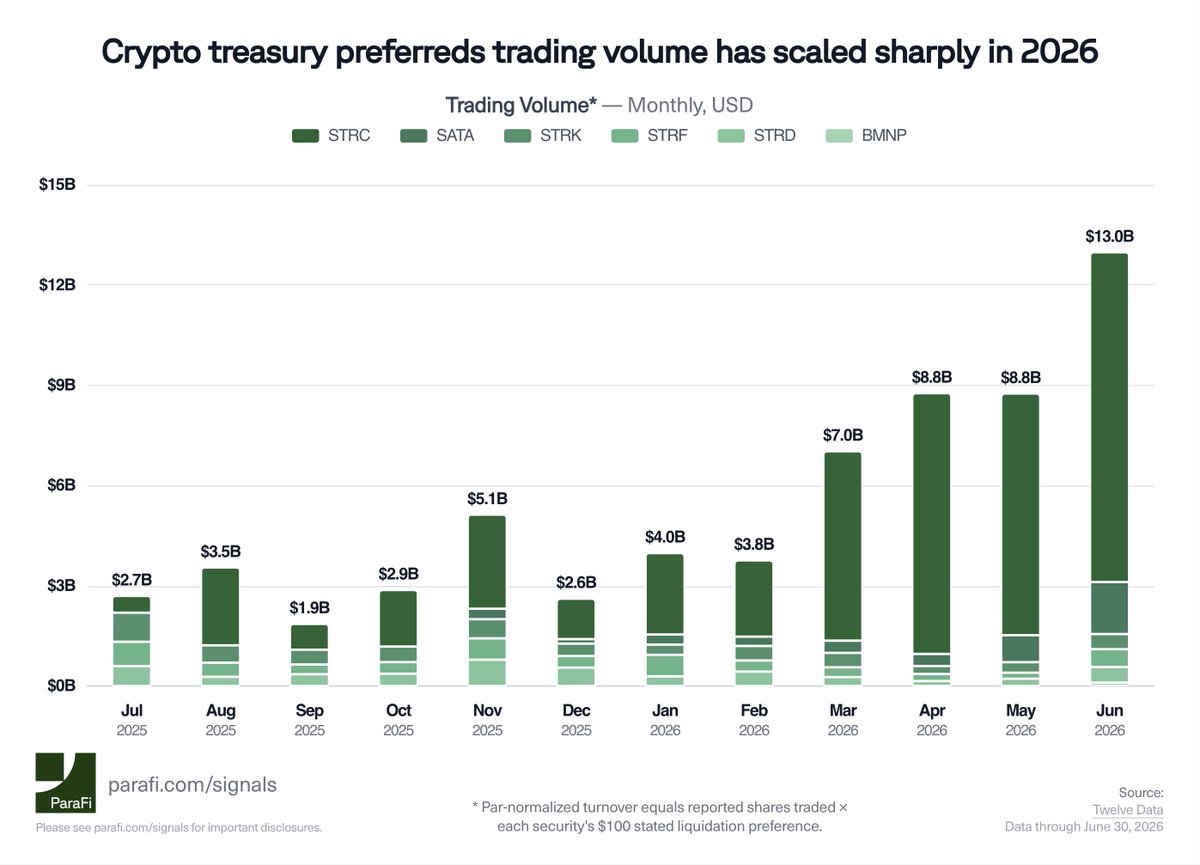
Trading activity in crypto treasury preferreds has accelerated sharply in 2026, with monthly par-normalized volume reaching approximately $13B in June. The step-change has been driven by STRC and a growing number of new preferred listings, transforming what was once a niche market for bespoke financing dominated by financial institutions (banks and insurers) into a broader, more liquid, and increasingly evergreen asset class.
Beyond higher trading volumes, the key signal is the maturation of the preferred equity market itself. As liquidity deepens, these instruments become increasingly more efficient not only on coupon and issuer quality, but also on secondary-market depth, relative value, and the durability of investor demand. This evolution is beginning to extend beyond crypto: in June, Alphabet launched its first convertible preferred offering as part of an $80B + equity raise to fund AI infrastructure, while Super Micro Computer announced a $3.75B convertible preferred issuance within a $7B capital raise for AI expansion, underscoring the growing role of preferred equity as a scalable financing instrument across sectors.
Introducing the Bitcoin Bank Adoption Index. Adoption of Bitcoin and the related digital asset ecosystem across major banks and financial institutions is accelerating, but still early at 32%.
Methodology and updates to follow. Institutions with questions, corrections, or additional public information: [email protected].
A discussion between @macroleverageTP, @PhongLe, and me on why Bitcoin Treasury Companies exist, what the first real stress test for Digital Credit taught us, and the opportunity ahead for Bitcoin-backed financial innovation.
TIMESTAMPS
0:04 - Why Bitcoin Treasury Companies Exist
7:22 - Financial Engineering Vs. Financial Innovation
14:24 - What Makes Bitcoin Treasury Companies Durable
18:42 - Does Bitcoin Need Treasury Companies?
22:20 - Addressing Bitcoin Treasury Company Criticism
26:46 - Growing Demand For Bitcoin-Backed Products
30:11 - What Has Surprised The CEOs Most
36:06 - The Evolution Of Digital Credit Products
45:10 - Lessons From The First Market Stress Test
53:10 - Bitcoin Market Depth And Liquidity
55:21 - Why Selling Bitcoin Is Not A Contradiction
1:03:37 - The Future Of Bitcoin Treasury Companies
$MSTR $ASST $STRC $SATA $BTC
For the 3 months April 6 to July 6, 2026, we increased our Bitcoin holdings 10% to 843,775 Bitcoin, increased our USD reserve 13% to $2.55B, and more than doubled YTD BTC Yield from 3.7% to 7.8%. $MSTR $BTC
https://t.co/3SqgyK5mwu
New Stock Listing
Trade: ANTA, CBRS, DISK, FOTO, KMEM, QNT and STRC
24/5 access. $0 commission, low platform fees and 7,000+ stocks to choose from
Exchange the World, one market at a time.
Read more 👉 https://t.co/SqdKFYwjf0
Bitcoin is Freedom
I spent the last few weeks in my motherland, Vietnam. The country has transformed since my family escaped in 1978. It is more prosperous, energetic, and ambitious than the Vietnam I left behind. A young population, rising investment, and global aspiration have created extraordinary momentum.
And yet one thing remains clear. For many in Vietnam, the ultimate dream is still America. And if they cannot make it to America, they want to wear American brands, eat American food, listen to American music, and exude American confidence.
My trip to Vietnam reminded me of this, and the World Cup has made it visible on a global stage. America remains not only a country people admire, but a place people still want to reach, represent, and belong to.
The United States remains the land of the free, the Wild Wild West, and the home of the American Dream. Walmart and Waffle House. Boston and Austin. Silicon Valley and Wall Street. A country where people can still rise from welfare to extraordinary success through hard work, ingenuity, risk taking, and some luck.
My family experienced that promise directly. We arrived in America as refugees, sponsored by a Catholic church in Syracuse, New York. We received public assistance, food stamps, and free school lunches. My father worked three jobs. We lived frugally and dealt with poverty and racism. America was not easy, but it was open. It gave us a system where effort, education, entrepreneurship, and perseverance could compound.
This is America. The world still aspires to be like us.
What has made America successful over the last 250 years is not accidental. It is a principled Constitution, geographic scale, abundant resources, and a culture of liberty, capitalism, entrepreneurship, and reinvention. Other nations try to replicate the recipe, but often waver. Interventionism, bureaucracy, corruption, and ego get in the way.
Which brings me to Bitcoin.
Bitcoin is the United States of money. It aspires to do for money what the American Constitution aspired to do for government: create a system governed by transparent rules rather than the discretion of individuals. Built on a principled white paper, digitally enforced scarcity, and proof of work, Bitcoin is digital capital governed by code, energy, and consensus.
But beyond that, Bitcoin is hope.
It provides hope for those who have worked hard for their money and want to protect it from monetary inflation. It provides hope for those born in countries without reliable rule of law or economic freedoms. It provides hope for anyone seeking protection, opportunity, and a form of property that does not depend on geography, politics, or permission.
I was born in the year of America’s bicentennial. Fifty years later, the future of American dominance is being questioned. I have no question. The United States of America is the greatest country in the world.
My life is proof of what America makes possible. I left Vietnam as a refugee, grew up poor in America, built a career through education and hard work, and now have a wonderful wife and three children. That is the American Dream to me. It is not just wealth. It is freedom, family, opportunity, and the ability to determine your own future.
That is also why Bitcoin resonated with me. I found Bitcoin because it reflected the same principles that shaped my life: clear rules, individual sovereignty, property rights, resilience, open competition, and long-term conviction.
America gave my family freedom through a country. Bitcoin offers individuals monetary freedom through a network. One opened the door for me. The other opens a door for anyone, anywhere, to protect the fruits of their labor.
That is why Bitcoin is freedom.
For more than 35 years, @Strategy’s software business has been built on rapid, iterative innovation: build, deploy, observe, listen, improve. We’ve applied the same approach to our Bitcoin Treasury Company. Thank you for helping us improve.
Global markets and sectors are experiencing unprecedented uncertainty. We accumulated 4% of the world’s apex digital asset for times like these. $BTC $MSTR
Bitcoin and AI are the two most transformative technologies of the 21st century. Markets rarely appreciate transformative technologies in a straight line.