There will be no AI jobpocalypse.
The story that AI will lead to massive unemployment is stoking unnecessary fear. AI — like any other technology — does affect jobs, but telling overblown stories of large-scale unemployment is irresponsible and damaging. Let’s put a stop to it.
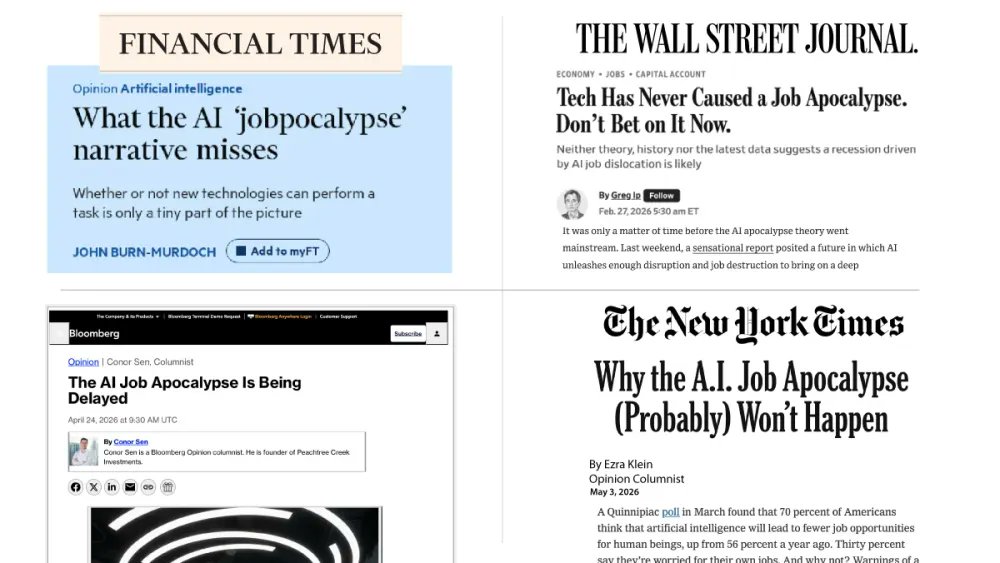
I’ve expressed skepticism about the jobpocalypse in previous posts. I’m glad to see that the popular press is now pushing back on this narrative. The image below features some recent headlines.
Software engineering is the sector most affected by AI tools, as coding agents race ahead. Yet hiring of software engineers remains strong! So while there are examples of AI taking away jobs, the trends strongly suggest the net job creation is vastly greater than the job destruction — just like earlier waves of technology. Further, despite all the exciting progress in AI, the U.S. unemployment rate remains a healthy 4.3%.
Why is the AI jobpocalypse narrative so popular? For one thing, frontier AI labs have a strong incentive to tell stories that make AI technology sound more powerful. At their most extreme, they promote science-fiction scenarios of AI “taking over” and causing human extinction. If a technology can replace many employees, surely that technology must be very valuable!
Also, a lot of SaaS software companies charge around $100-$1000 per user/year. But if an AI company can replace an employee who makes $100,000 — or make them 50% more productive — then charging even $10,000 starts to look reasonable. By anchoring not to typical SaaS prices but to salaries of employees, AI companies can charge a lot more.
Additionally, businesses have a strong incentive to talk about layoffs as if they were caused by AI. After all, talking about how they’re using AI to be far more productive with fewer staff makes them look smart. This is a better message than admitting they overhired during the pandemic when capital was abundant due to low interest rates and a massive government financial stimulus.
To be clear, I recognize that AI is causing a lot of people’s work to change. This is hard. This is stressful. (And to some, it can be fun.) I empathize with everyone affected. At the same time, this is very different from predicting a collapse of the job market.
Societies are capable of telling themselves stories for years that have little basis in reality and lead to poor society-wide decision making. For example, fears over nuclear plant safety led to under-investment in nuclear power. Fears of the “population bomb” in the 1960s led countries to implement harsh policies to reduce their populations. And worries about dietary fat led governments to promote unhealthy high-sugar diets for decades.
Now that mainstream media is openly skeptical about the jobpocalypse, I hope these stories will start to lose their teeth (much like fears of AI-driven human extinction have).
Contrary to the predictions of an AI jobpocalypse, I predict the opposite: There will be an AI jobapalooza! AI will lead to a lot more good AI engineering jobs, and I’m also optimistic about the future of the overall job market. What AI engineers do will be different from traditional software engineering, and many of these jobs will be in businesses other than traditional large employers of developers. In non-AI roles, too, the skills needed will change because of AI. That makes this a good time to encourage more people to become proficient in AI, and make sure they’re ready for the different but plentiful jobs of the future!
[Original text in The Batch newsletter.]
Stanford just released a 1.5-hour lecture on “LLM Architecture.”
This is the exact thing systems engineers at Anthropic and OpenAI require to understand at a deep level.
Give it some time.
This might be the highest-ROI learning you do this month.
@rasbt This is great work! I’ve been exploring a similar idea with a different architectural approach. Really impressive. Would love to connect and exchange thoughts if you’re open to it.
@Moltbot/@moltbook is the first visible cultural and economic contours of what we have been building at Project NANDA: Architecting the Internet of AI Agents. But what is REAL and what is NEXT. 1/n
Excited to share our new survey on Multilingual Prompt Engineering!
Multilingual Prompt Engineering is essential to unlock the full power of large language models across diverse languages. Yet with so many strategies emerging over the last few years, it can be hard to know which works best for each task.
In our survey, you’ll find:
* Categorization of 39 prompting techniques across 30 NLP tasks
* Coverage of ~250 languages on major benchmarks
* Performance comparisons of these techniques on state-of-the-art LLMs
* A clear taxonomy diagram plus deep dives into high- vs. low-resource settings
* Derive insights by language family and resource level
Altogether, we review 36 papers, most published in the last two years to give you a roadmap for applying prompt engineering in any multilingual setting.
Read the full survey here: https://t.co/xTGGYq64ah
hashtag#LLMs hashtag#PromptEngineering hashtag#MultilingualNLP hashtag#Survey hashtag#Taxonomy
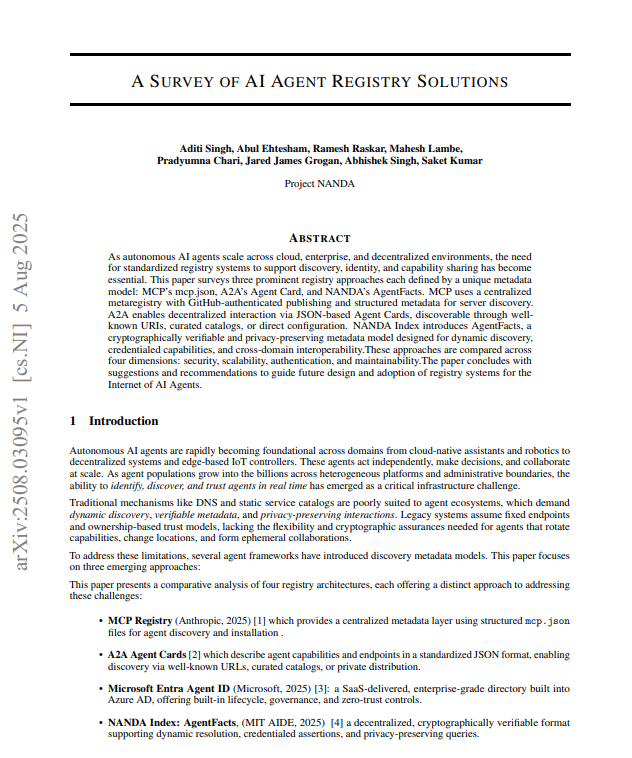
🚀 New survey from MIT Project NANDA charts the future of AI agent registries—comparing MCP, A2A, Entra ID & Nanda Quilt. NANDA’s AgentFacts model stands out with cryptographic trust, privacy, and federated governance for scalable, zero-trust AI ecosystems.#AIAgentRegistry, #TrustInfrastructure, #FederatedGovernance, #VerifiableIdentity, #PrivacyPreservingSystems, #ZeroTrustArchitecture, #DecentralizedDiscovery, #AgentInteroperability
https://t.co/EaWJwsamxy
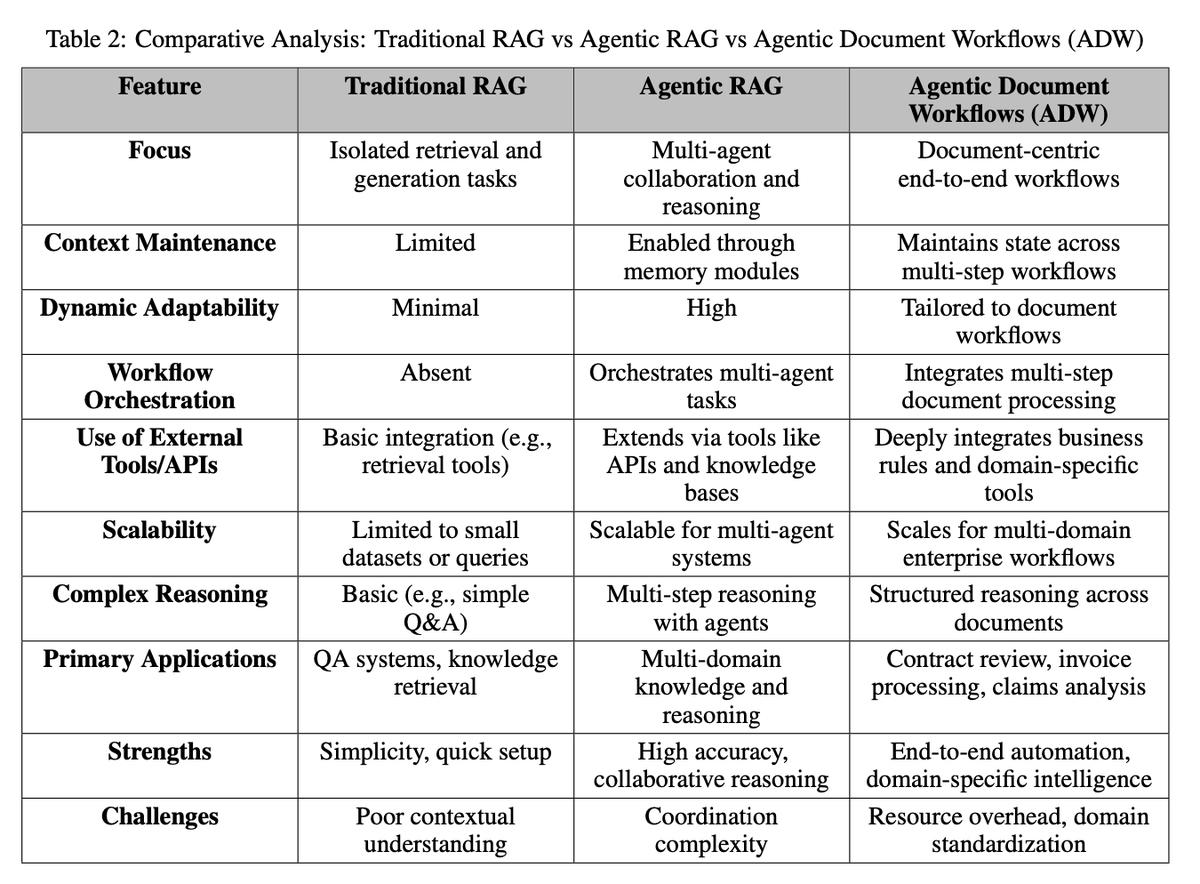
📚🤖 Agentic RAG Survey
A guide exploring agent-enhanced RAG systems. This repository demonstrates single and multi-agent RAG implementations using LangGraph, with practical examples for building intelligent applications.
Explore the evolution of RAG 🔍
https://t.co/vXisxX8vTF
This GitHub repo is a gold mine for EVERY data scientist!
DS Interactive Python repo has interactive dashboards to learn statistics, ML models, and other DS concepts.
Topics include PCA, bagging & boosting, clustering, neural networks, etc.
Fully open-source and free!
🚀 Researchers, students, and paper lovers — check out https://t.co/IqhYrjBZBt!
An incredible AI-powered tool for reading, annotating, and exploring academic papers faster & smarter.
👏 Great work by @sabaimran_go and her team.🌟
#AI#AcademicTwitter#ResearchTools#OpenPaperAI
Join us for MIT Nanda: Agentic Web Registry Deep Dive
Registration required: https://t.co/XBhvuK8jsP
More on the project: https://t.co/UeH6Rj3X5Y
#MIT#NANDA#MITNANDA#AGENTIC