My YC Paper Club talk on Prime Agent is out.
I talked about moving beyond naive prompting toward an agentic OS, and how eval-driven harness design can expose more of a model’s underlying capabilities through persistent computation, memory, and agent-to-agent communication.
Harnesses often get dismissed as just scaffolding, just prompt engineering, and not real research. But that couldn't be farther from the truth. The same model weights that score 30% on ARC-AGI score 95% with a better harness.
So we gathered a group of researchers and founders working at the frontier to do a deep dive into the state of harnesses.
We cover how we got to this point, the case for making your harness as expressive as possible, and what YC learned building an agent for every employee in the company.
00:00 - @FrancoisChauba1: Why harnesses matter
04:27 - Building an auto-researcher by accident
07:13 - A five minute history of harnesses
13:56 - Self-improving harnesses
18:35 - @sethkarten: Prime Agent, a self-improving RLM harness
21:50 - Context as an L1, L2, L3 cache
24:51 - From Turing machine to von Neumann computer
28:33 - Messaging between agents
30:04 - ARC-AGI results
33:09 - Emulator Bench and GPU kernels
37:30 - @JonSaadFalcon: OpenJarvis, personal AI on personal devices
38:26 - How far behind are local models
39:21 - The five primitives of a personal AI stack
42:47 - Letting cloud models optimize your local stack
43:53 - 800x cheaper than the cloud
45:58 - @josh__france and @jbellregan: QM, YC's agent harness for work
47:29 - A history of YC's internal agents
49:24 - OpenClaw and a fleet of 50 agents
51:04 - Pulling the brain out of the sandbox
54:43 - Letting the agent choose its own sandbox and model
57:16 - The grind tool: budgets on goals
58:50 - Agents don't understand social context
working on a blogpost about the abject terror that AI solving the Riemann hypothesis may instill in the sensitive young man who once dreamed of glory through advancing Mathematics or the sciences
and why he should rejoice instead!
AI agents can master individual games. But can they learn to play any game??
Introducing GG Agents, our new competition testing agents on a diverse set of games 🎮
https://t.co/5pSa1atfrj
Do agents generalize in games? Small open source models definitely do not!
Introducing a new competition: GG Agents
Generalist Gaming Agents evaluates an agent's ability to play real-time games, leveraging continual learning across private unseen games
Most AI agents only succeed in the single environment they were trained for.
Join the Generalist Gaming Agents competition, hosted by GARC (Generalist Agent Research Collective), with support from @PrincetonCS and @PrincetonPLI! Build one offline agent that plays 32 browser games across 10 genres, from platformers and shooters to puzzles and racing.
💰 Prize Pool: $50,000
⏰ Entry Deadline: February 22nd, 2027
Your work will help advance agent architectures that balance fast action with deeper planning and train agents that don't pause the game to think.
Get started here: https://t.co/jpXsSs7hTT
Most AI agents only succeed in the single environment they were trained for.
Join the Generalist Gaming Agents competition, hosted by GARC (Generalist Agent Research Collective), with support from @PrincetonCS and @PrincetonPLI! Build one offline agent that plays 32 browser games across 10 genres, from platformers and shooters to puzzles and racing.
💰 Prize Pool: $50,000
⏰ Entry Deadline: February 22nd, 2027
@maxbittker@kzdagoof fixed population yields a convergent exploitative policy, potentially overfitting as well. At least self-play with some policy diversity should be required to get a better sense of elo.
1/6 I've received 257 PhD inquiries from 26+ countries from June–Nov 11 this year—about twice my 2022–2025 June–December average of 127, with seven weeks still uncounted.
Absolutely important to note that all agent work is converging into one agent platform / harness.
I see many people independently converging on this. It is important to do literature reviews as you work to prevent repeating the mistakes of others
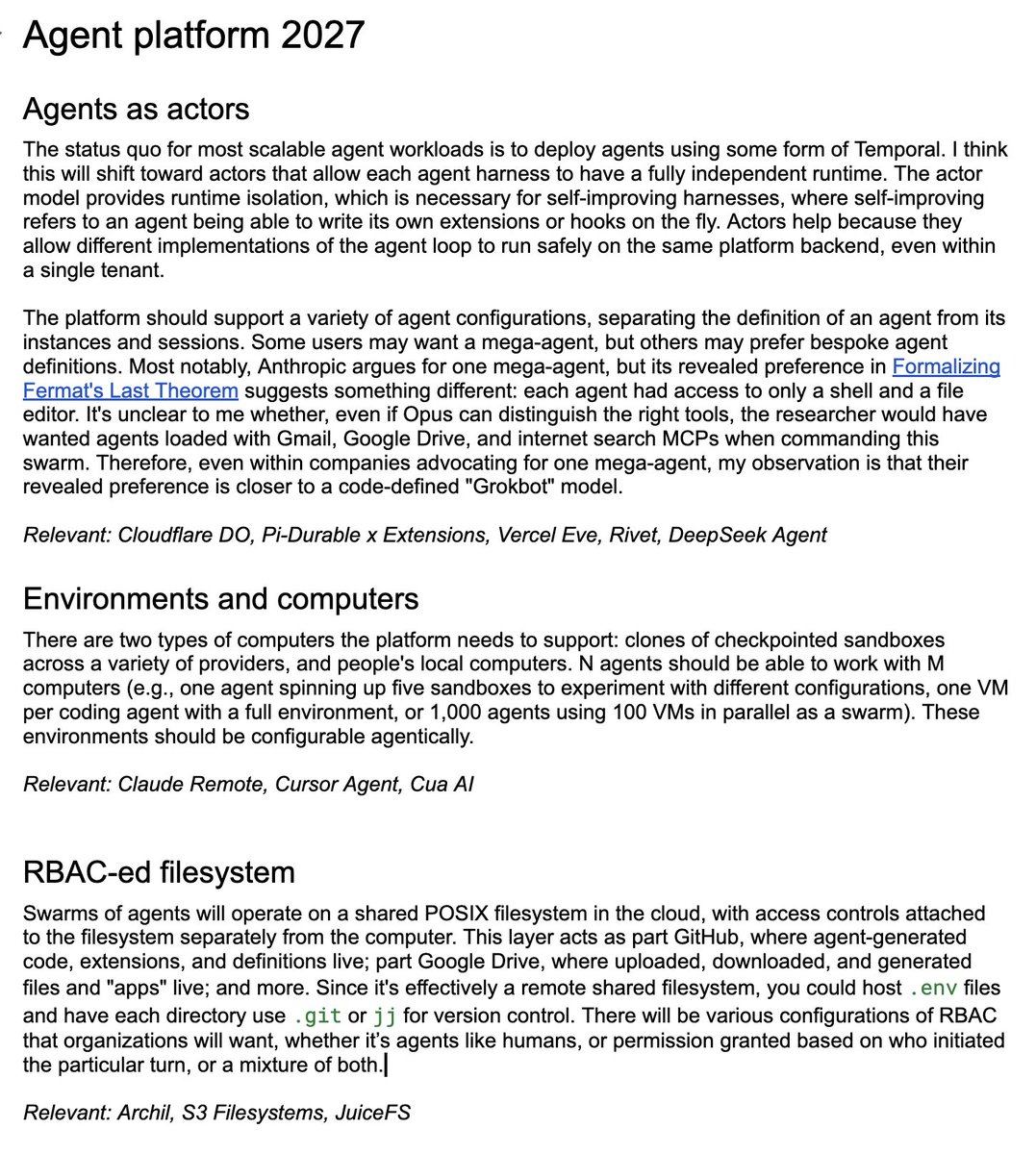
Agent platform of 2027.
This is the end game. This is the blueprint for the one and only application layer software that will exist. Every other software will effectively become databases for this layer, the everything agentic operating system for the million agent swarm to work on top of.
This is obviously the end game vision for the application layer of ChatGPT and Claude. I have reasons to believe that an independent company will own this product layer. But most ADE, "enterprise agent platform", or vertical saas companies, are focused on the wrong things far too narrowly, not technically competent, and do not have the product / technical vision to see this inevitable future.
The correct agent platform that wins will function like the base of a garden, from which customers will plant their unique "seeds" to grow their own plants and trees, managed and evolved by agents, humans, and signals from the sensors of the business. This presents a clearer picture than "factory of a factory" imo.