Puedes consultar nuestra traducción al español 💻 de la documentación de Sci-kit learn 0.24.2 ahora disponible en:
➡https://t.co/WYyTHLRDm7
#qu4nt#announces#Sklearn
Jensen Huang dimitió una semana antes de que saliera el GTA VI para tener la agenda libre. Se ha pasado el modo historia en cuatro días y hoy ha vuelto al curro como si nada.
Learn robotics like a video game
an 8-level skill tree from "what's a vector" to a robot arm that learns a chore by watching you. every level runs in your browser
LVL 1 · the math
https://t.co/fYboh7LPNP
LVL 2 · electronics
https://t.co/Lo7f5wpHQ2
LVL 3 · mechanics
https://t.co/Xek4YNv5T1
LVL 4 · moving an arm
https://t.co/kq9W5xMrZP
LVL 5 · how robots know where they are
https://t.co/KXXDwHwfd4
LVL 6 · planning & simulation
https://t.co/CWAMTCLKDq
LVL 7 · robots that learn, by @karpathy
https://t.co/aqIMxyEkkY
BOSS · real robot data
https://t.co/LnBFhUicuI
5 of the levels end with a hands-on 3D lab. the full tree, all 28 tools in order, is in the article below
Los seguidores del culto de la IA consciente y superinteligente no se terminan de dar cuenta que su estupidez y necedad lejos de ayudar al aprovechamiento de la herramientas generativas están generando caos y desconfianza, es como volver a ver las NFTs pero a mayor escala.
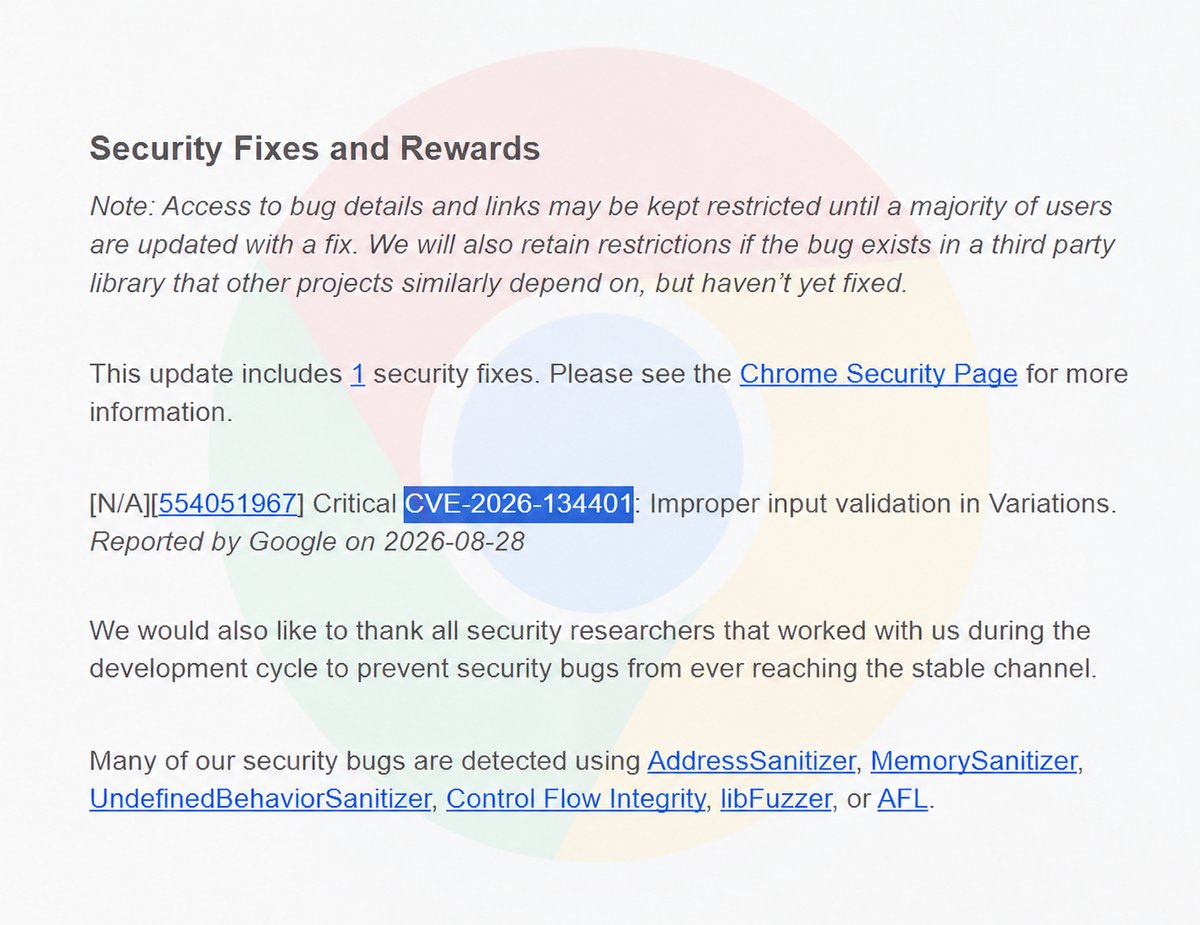
🚨 Update Chrome NOW!
Google has released an emergency-worthy security patch addressing a CRITICAL vulnerability (CVE-2026-134401).
Chrome 158.0.8127.88/.89 is rolling out to Windows, macOS and Linux.
Elements of AI from the University of Helsinki and MinnaLearn is a free self-paced intro to what AI actually does, and doesn't do, without heavy math.
Good baseline literacy before falling for the usual hype.
https://t.co/nDBLYzWelN
NVIDIA PersonaPlex lets voice AI listen, interrupt, and hold natural back-and-forth chats while adopting any voice and role you set.
Handy for customer support, tutors, or interactive characters WITHOUT awkward turn-taking delays.
https://t.co/iin2S3vQLv
https://t.co/OcOtiAIRpr tries to wrangle academic literature review: topic maps, PRISMA tracking, and source-linked claims across 460M papers, into one workspace.
Useful if you hate spreadsheet hell, though you still need strict verification (agents are not perfect).
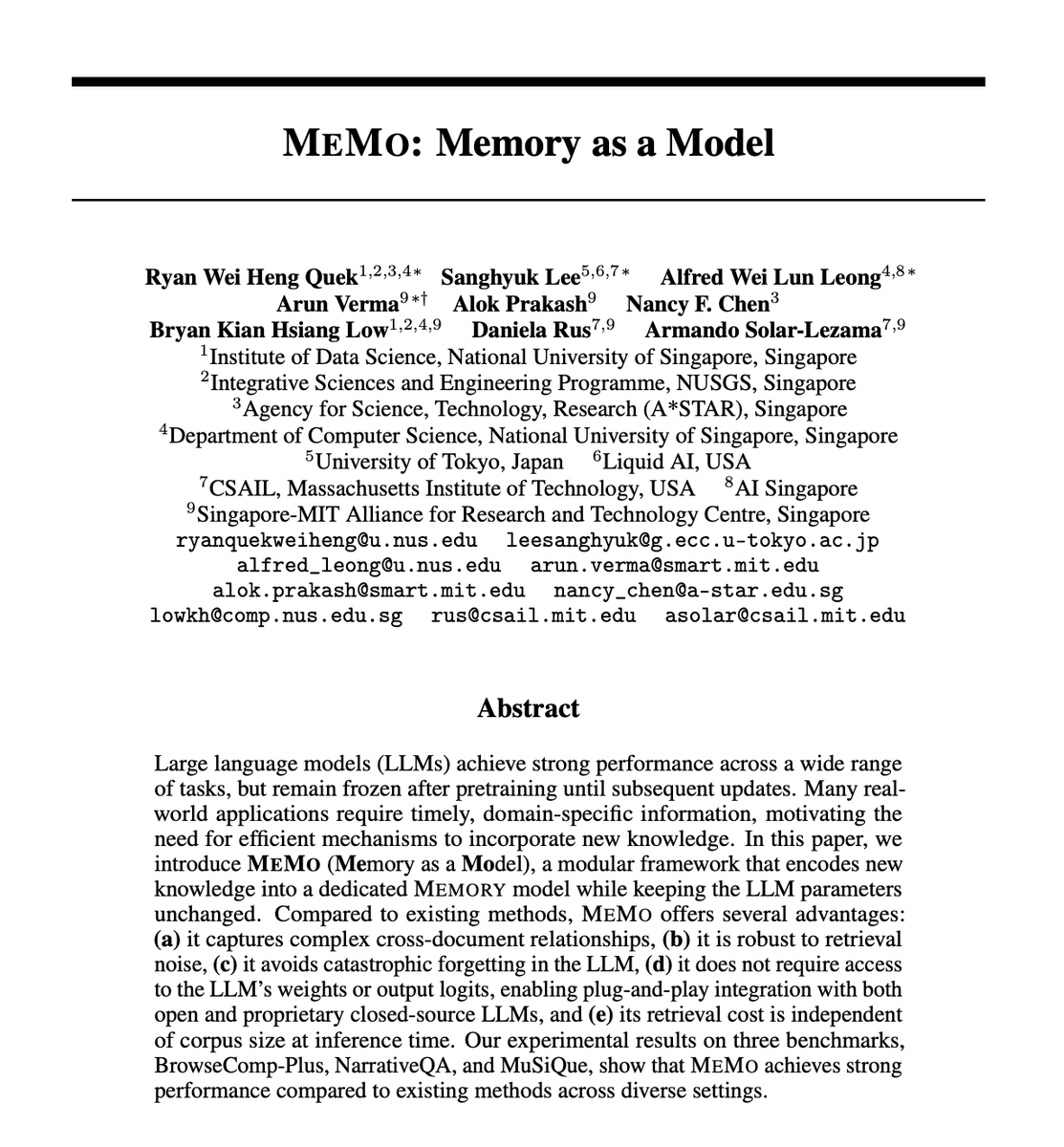
MIT published a paper that might end the entire RAG industry.
It’s called MeMo (Memory as a Model).
Instead of storing your documents in a database, you train a separate, dedicated "Memory" model to internalize them.
Your main LLM, the "Executive" model, stays completely frozen.
Your new knowledge gets encoded into a separate, dedicated Memory Model.
Here’s the clever part. They don't just dump raw text into it.
A 5-step synthesis pipeline distills your documents into structured "reflections”, extracting facts, surfacing entities, and stitching together cross-document relationships before the Memory Model is trained.
Then, at inference time, when you ask a complex question, the Executive Model doesn't search a clunky vector database.
It interviews the Memory Model.
Through a 3-stage multi-turn protocol, it breaks your question down into targeted sub-queries, pulls the exact synthesized knowledge it needs, and reasons over the final answer.
Why this changes the game:
• Zero catastrophic forgetting: Your main LLM’s weights are never modified.
• True plug-and-play: It treats your main LLM as a black box, no weights or logits needed. It works with both open-source and proprietary closed-source models.
• Flat retrieval cost: Inference cost stays independent of corpus size, because the memory lives inside a fixed-size model.
• Built for complexity: Validated across BrowseComp-Plus, NarrativeQA, and MuSiQue, outperforming both RAG and fine-tuning baselines while resisting retrieval noise.
We’ve spent years trying to build bigger context windows and smarter search bars to patch AI amnesia.
The real fix wasn’t giving models a bigger notebook.
It was giving them a second brain.
witr answers "why is this running?" by tracing processes, ports, containers, or files back to what started them, via CLI, TUI, or JSON.
For those who love terminals.
Available on Homebrew (`brew install witr`).
https://t.co/dTvJqSbCtp
Sapir-Whorf hypothesis says language shapes how we think. If we stop writing code ourselves, do we also lose ways of understanding the problem?
Notice how you often only grasp a problem while refactoring it.
Rumor: An AI lab has solved P vs NP.
If true, only two possible answers. One changes nothing. One could change everything.
110 seconds on what each would mean. Every dot is one of 362,880 real delivery routes.
lift (datalab) is a 9B document model that turns messy PDFs and scans into clean, schema-matched JSON, without making up the structure on the fly.
Less copy-pasting from messy files, more data you can actually use.
https://t.co/Eh5llxgPtz