"Tech twitter" is about to find out there's SO MUCH TO MAKE outside of their vibe-coded echo-chamber man!
Want some examples?
Here is a list of 100. I obviously used GPT to generate explanations, but now you have the answer to the question "What to build next"-
Firmware for microcontrollers : low-level code controlling hardware like sensors and actuators.
Real-time operating systems (RTOS) : OS designed for deterministic timing and embedded systems.
Linux kernel development : core OS code handling memory, processes, and hardware abstraction.
Device drivers : software that allows OS to communicate with hardware peripherals.
Bootloaders (e.g., U-Boot) : initialize hardware and load the operating system.
Robotics control software : algorithms to control robotic arms, drones, and autonomous systems.
SLAM systems : software for simultaneous localization and mapping in robotics.
Autonomous vehicle software : perception, planning, and control for self-driving systems.
Industrial automation software : PLC and SCADA systems for factory automation.
SCADA systems : supervisory control systems for industrial processes.
CNC machine controllers : software to control machining tools precisely.
Embedded Linux systems : customized Linux distributions for devices.
IoT device firmware : connectivity and control logic for IoT hardware.
IoT gateways : aggregate and preprocess data from multiple IoT devices.
Network protocol stacks : implementations of TCP/IP, BLE, Zigbee, etc.
Bluetooth stack development : communication protocols for short-range wireless.
Wi-Fi firmware : low-level software managing wireless connectivity.
DSP software : signal processing for audio, video, and communications.
Audio codecs : encode/decode audio streams efficiently.
Video codecs : compress and decompress video streams.
Computer vision systems : image processing and object detection pipelines.
FPGA programming : hardware-level logic design using HDL.
ASIC design tools : software for designing custom chips.
Hardware abstraction layers (HAL) : interfaces between hardware and software.
Power management firmware : optimize energy usage in embedded systems.
Automotive ECUs software : control engine, braking, infotainment, etc.
CAN bus software : communication in automotive systems.
Avionics software : flight control and navigation systems.
Satellite communication software : manage data exchange with satellites.
SDR (Software Defined Radio) : radio communication implemented in software.
Telecom switching systems : manage call routing and data traffic.
Baseband processing software : core cellular signal processing.
Operating system schedulers : manage task execution timing.
Memory management systems : allocate and track system memory.
Filesystems (e.g., ext4) : organize and store data on storage devices.
Database engines : manage structured data storage and retrieval.
Distributed systems frameworks : coordinate multiple machines.
Cluster resource managers : allocate compute resources across clusters.
Virtualization software : create virtual machines and isolate workloads.
Hypervisors : run and manage virtual machines directly on hardware.
Container runtimes : manage lightweight application containers.
GPU drivers : enable software to utilize graphics hardware.
Graphics rendering engines : low-level rendering pipelines.
Game engines (core runtime) : physics, rendering, and input systems.
Physics simulation engines : simulate real-world physics interactions.
Scientific computing software : numerical simulations and modeling.
High-performance computing (HPC) frameworks : parallel computation systems.
Compiler design : translate high-level code into machine code.
Linkers and loaders : combine and prepare binaries for execution.
Debuggers : tools for analyzing and fixing software issues.
Profilers : analyze performance bottlenecks in code.
Static analysis tools : detect bugs without running code.
Binary analysis tools : inspect compiled executables.
Reverse engineering tools : analyze unknown binaries.
Malware detection engines : identify malicious software behavior.
Antivirus software : protect systems from threats.
Intrusion detection systems : monitor and detect network attacks.
Encryption libraries : implement cryptographic algorithms.
Secure boot systems : ensure only trusted firmware runs.
Trusted execution environments : isolate secure code execution.
Blockchain nodes : maintain and validate distributed ledgers.
Consensus algorithms : ensure agreement in distributed systems.
Cryptographic wallets : manage digital assets securely.
Smart contract runtimes : execute blockchain-based contracts.
Data acquisition systems : collect sensor data in real time.
Telemetry systems : monitor remote system performance.
Logging frameworks : capture system events for analysis.
Time synchronization systems : ensure clocks are aligned (e.g., NTP).
GIS systems : process and analyze geographic data.
Navigation systems : compute routes and positioning.
Medical device software : control diagnostic and therapeutic devices.
Imaging systems : process MRI, CT, and ultrasound data.
Bioinformatics tools : analyze biological and genetic data.
Energy grid management software : control power distribution.
Smart meter firmware : measure and transmit energy usage.
HVAC control systems : manage heating and cooling efficiently.
Building automation systems : integrate sensors and controls in buildings.
Railway signaling software : ensure safe train operations.
Traffic control systems : manage urban traffic flow.
Drone flight controllers : stabilize and navigate UAVs.
Navigation firmware (GPS modules) : compute location data.
Sensor fusion systems : combine multiple sensor inputs.
Gesture recognition systems : interpret motion inputs.
Voice recognition engines : process and understand speech.
Natural language processing engines : analyze and generate text.
Recommendation engines : suggest items based on patterns.
Fraud detection systems : identify suspicious activities.
Financial trading systems : execute high-speed trades.
Risk modeling systems : simulate financial risk scenarios.
Backup and recovery systems : protect and restore data.
Data compression tools : reduce storage and transmission size.
File synchronization tools : keep data consistent across systems.
Version control systems : track code changes over time.
Build systems : automate compilation and packaging.
Continuous integration tools : automate testing and builds.
Embedded test frameworks : validate firmware functionality.
Hardware-in-the-loop simulation : test embedded systems with real hardware.
Digital twin systems : simulate real-world systems virtually.
Having loser mentality is an insult to God because you were handed a singular unrepeatable flame of consciousness as a specific individual with specific gifts and chose to let it gutter out in self-pity. Feeling small is more ingratitude than humility
The creator doesn’t make surplus people. The fact that the egg chooses the sperm means every cell in your body proliferated from a messianic selection. The loser mentality is on every level, (biologically, metaphysically, theologically, etc.) against the verdict of life
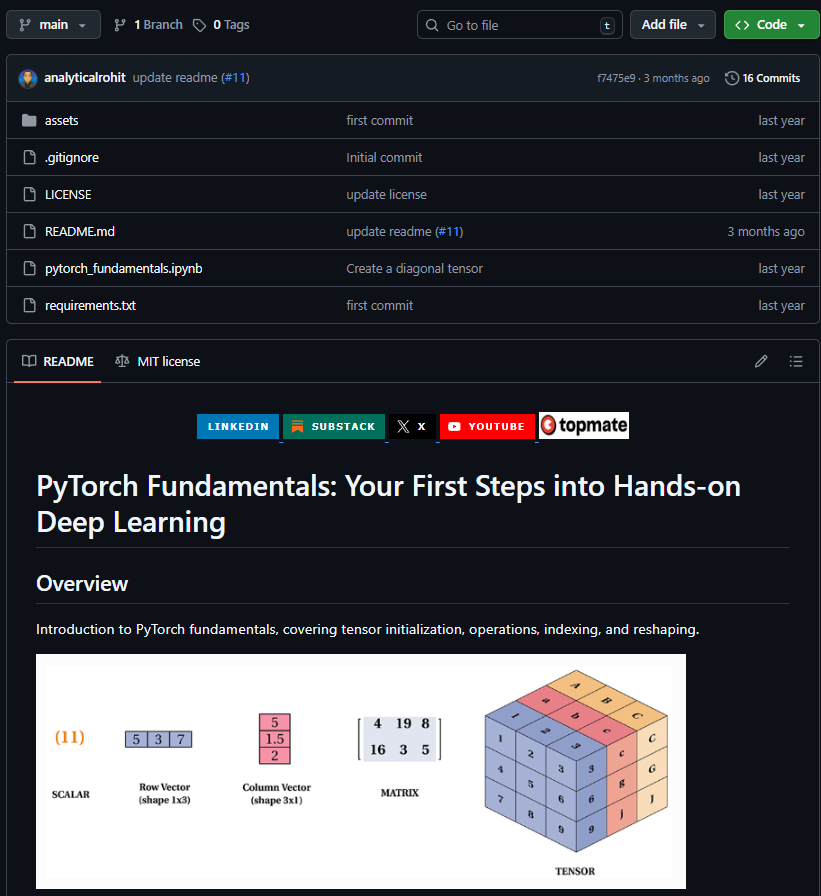
Master the PyTorch fundamentals step by step:
> with clear explanations
> hands-on code
GitHub repo (800+ stars): https://t.co/n9c7Vu4fVc
90% of deep learning projects start with PyTorch.
But most beginners get stuck because:
> they skip the basics
> jump straight into building models
لأي حد مهتم انه يذاكر Full stack Engineering
دة مجموعة كورسات مقدمة من جامعة Helsinki in Finland
انا شخصياً درسته وفعلا خلى مستوايا في مكانة تانية
https://t.co/xd91F7TCAB
شباب انا كنت عملت كود لحاجة شبيهة برضو ب claude وحاططها open source على github لو حد حابب يستخدمها ويظبطها زي ماهو عايز
بيجيبلك كل ال positions باستخدام ال APIs و
بيظبطلك ال cv لكل position ويعملك cover letter باستخدام qwen كمان
https://t.co/WrkCwrbZP4
I made a free course on CUDA programming for NVIDIA H100s. (1/N)
10 lessons covering the Hopper programming model at the PTX level — from architecture through kernel design to multi-GPU orchestration.
Includes slide decks, real kernel source walkthroughs, and 7 interactive visualizers.
https://t.co/JCw05vS9u0
LIST OF 40 WEBSITES TO FIND REMOTE JOBS
1. Linkedin. com
2. Indeed. com
3. Glassdoor. com
4. FlexJobs. com
5. weworkremotely. com
6. Remote. com
7. Upwork. com
8. Freelancer. com
9. Fiverr. com
10. Guru. com
11. Toptal. com
12. AngelList. com
13. Hubstafftalent. com
14. Simplyhired. com
15. Remotive. com
16. Virtualvocations. com
17. workingnomads. com
18. Hired. com
19. cloudpeeps. com
20. taskrabbit. com
21. talent. com
22. Remote OK - remoteok. io
23. DRemote - dremote. io
24. Jooble - jooble. org
25. stackoverflow. com/jobs
26. jobspresso. com
27. onlinejobs. ph
28. simplyhired. com
29. themuse. com
30. skipthedrive. com
31. zirtual. com
32. justremote. com
33. hireable. com
34. remoteworkhub. com
35. jobbatical. com
36. freelancewritinggigs. com
37. contentwritingjobs. com
38. problogger. com/jobs
39. behance. net
40. designhill. com
We’re thrilled to open-source TriAttention! 🚀
🦞 Deploy OpenClaw (32B LLM) on a single 24GB RTX 4090 locally
💻Full code open-source & vLLM-ready for one-click deployment
⚡️ 2.5× faster inference speed & 10.7× less KV cache memory usage
TriAttention is a novel KV cache compression method built on rigorous trigonometric analysis in the Pre‑RoPE space for efficient LLM long reasoning.
Github Repo: https://t.co/Gpu4E9oo3v
Paper Link: https://t.co/DIWxgvlsjN
Homepage: https://t.co/pDFK3mq53O