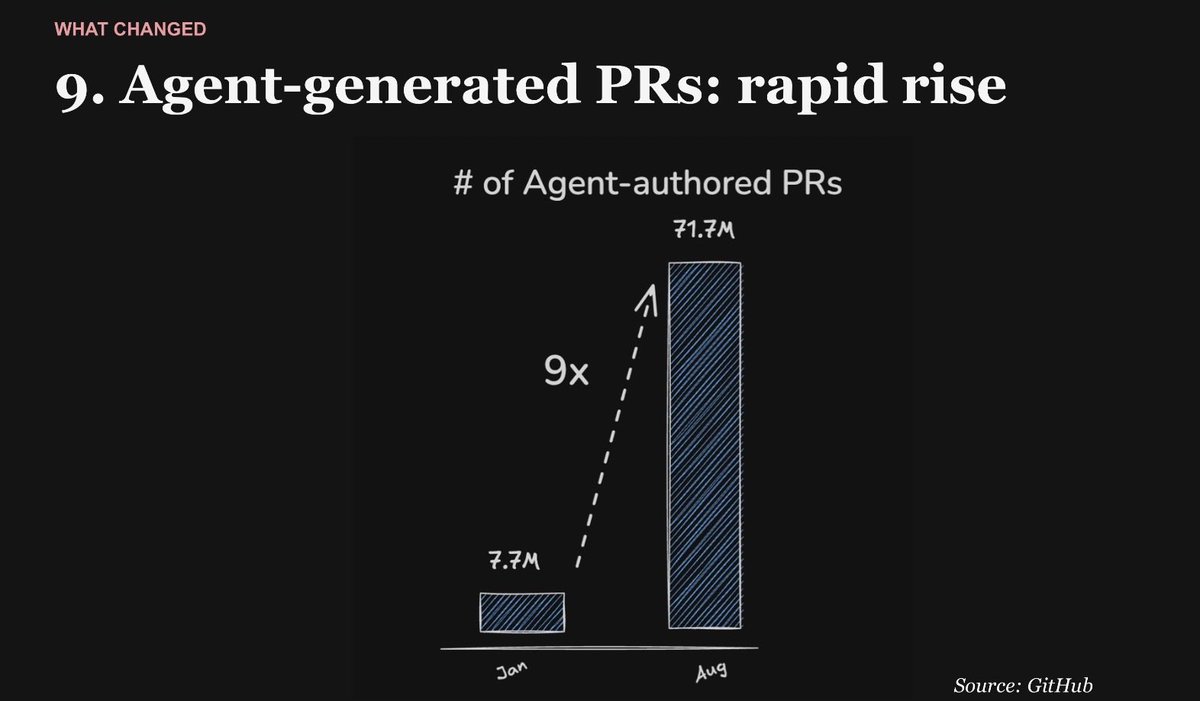
Fresh data from GitHub:
Agent-generated PRs have exploded in size. 9x the last 8 months (!!)
No signs of slowing down. This is why everyone is rethinking code reviews, deploys, possibly even o11y
thanks @kdaigle + team for the stat!
(Slide from my talk yesterday)
AI may finally allow us to test whether (or more precisely where) you make more money by being good. In startups you generally do, which is one reason I like this world.
Benedict Evans: The underlying story is that Nvidia has a torrent of cash, from the hyperscalers (who get if from ads and enterprise software, and from model labs) and from the model labs (who get it from investors), and it’s pumping that cash back into market, by enabling cheaper capital for the model labs (with all these guarantees), which is bad for the hyper-scalers, by strengthening the Nvidia GPU ecosystem, which is bad for Google’s TPU business and everyone else who wants to build their own AI chips, and by pushing into open models, which are bad for the model labs, but much less bad for the hyperscalers
Why I generally prefer not hiring from BIG startups and companies…
In large companies, processes and management decisions make things happen, and success has many fathers.
In small setups like ours, it takes people to get things done.. 🥲
If one can’t get your hands dirty.
If one can’t forget your past glory.
If one can’t get past your past comforts.
Then don’t consider joining startups, you are not made for that.
A casual visit to our senior propulsion scientist, Mr. Gnanagandhi’s home, became one of the most memorable moments after Vikram-1.
To my surprise, hundreds of children and families from his apartment community had gathered with endless questions about rockets, propulsion, and space.
It felt especially meaningful because Mr. Gnanagandhi has been a pillar of Skyroot’s journey and one of the key contributors to Vikram-1. Seeing the community celebrate him and the mission was truly heartwarming.
The true impact of a launch isn’t just reaching orbit—it’s inspiring young minds to dream bigger. 🚀
And this is exactly why “SaaS replaced by AI coded software” is not viable for any company that has a an ACTUAL business.
It’s a fun exercise to rebuild ticketing/o11y/feature flags etc… but do you really want to maintain it? Do you want updates, oncall etc to be YOUR problem??
Starbucks spends $400 million a year on software. Yesterday they announced they're moving off IBM and Microsoft to build their own custom systems in-house.
IBM dropped 3% and Salesforce dropped 4% on the news.
And honestly this is, unequivocally, the biggest signal I've seen since OpenAI and Anthropic launched their consulting arms back in Q1. The largest companies in the world are done paying for software that half fits how they work.
We saw this coming about a year ago. Moved everything we build off Airtable and low-code tools and went fully custom. Already paying off, and it's only going to compound from here.
This is the opportunity right now.
You get all of a company's data into one system. You build out a single operating system for the entire business. You cut out bad, redundant processes. Then you layer AI on top of it, under the correct processes.
That's the core of AI consulting. Helping companies actually operate better.
There are a lot of fly-by-night offerings circulating right now when it comes to Ai Services.
For example, 'second brains'.
Throwing scattered data into a second brain while the processes underneath stay broken does nothing. The companies who will absolutely destroy their competition over the next 5 years are rebuilding how they work from the ground up.
Starbucks is showing you what other companies will be doing over the next several years.
Your job is to position yourself to facilitate that process for as many companies as you can.
Harrison Chase, CEO of LangChain:
"Everything gets rebuilt."
the post lays out 4 loops that retire prompt engineering. Harrison Chase, who runs the company the playbook comes from, names the bigger pattern. when agents grade themselves (loop 2), fire on events instead of your keystrokes (loop 3), and edit their own setup from traces (loop 4), the old stack, you typing prompts into a chat box, is exactly the thing getting torn out.
his sharpest idea maps straight onto loop 3: ambient agents. agents triggered not by a human message but by an event, a webhook, a cron, a new ticket. you stop visiting an app and start waking up to work that already happened. the post calls it "a coworker who's always on." same thing.
so don't polish prompts for the old stack. build the loops for the new one: a grader, an event trigger, a self-improving pass. prompt engineering had a good run. the rebuild is the job now.
50% of recent YC startups don't have an AWS account.
Because it isn't the default anymore for every use case. Inference goes to the neo clouds. Hosting goes to Vercel or Render. Agent workloads come to us.
The cloud market is growing faster than the hyperscalers, and they're losing market share to companies most people haven't even heard of.
Someone predicted AWS would be less than 10% of the total cloud market share eventually. It is still growing in absolute terms. But they are being lapped by the overall market.
The engineers who can switch fluidly between these two complementary mindsets, multiple times a day, can ride the AI wave.
#SoftwareEngineering#AIAgents#Atobic
The bottlenecks in software development today are planning and verification with implementation largely handled by agents. This has large implications for how teams are organised, their composition and the nature of work executed by Software Product Engineers.
Planning and verification demand a creative, divergent mode of thinking and exercising judgments that can't yet be handed to an agent. Running agents for implementation in parallel requires an operations mindset focused on directing agents and maximising throughput.
That means watching production traces, catching intent drift before users feel it and shipping fixes fast. The difference in an agentic world is you deploy PR agents and code-review agents to close that feedback loop for you.
The bitter lesson in 26 words:
Don’t be distracted by human knowledge, as AI has been historically.
Instead focus on methods for creating knowledge that scale with computation, like search and learning.