I asked a.i to give a breakdown of what the reality of making a living as a trader looks like and I am impressed by the answer. Mostly because its everything I have preached and taught for years. If you want to be top 1%, you need to behave like the top 1%
"The brutal reality of trading is that 90% to 95% of retail traders lose money and eventually quit. You are entering a hyper-competitive arena against institutional algorithms, PhD mathematicians, and insider capital, all designed to take your money.
To survive—let alone make a living—it takes a psychological makeup that goes entirely against human nature. Here is a sobering, realistic look at the traits required:
1. Pathological Risk Management
Most people trade to make money; professional traders trade to protect capital. If you cannot treat capital preservation as your absolute highest priority, the market will wipe you out in weeks.
The Reality: You must be perfectly content with risking only 1% or less of your account per trade, even if it means small, boring gains initially.
2. Emotional Stoicism
The market is a meat grinder for human emotions. If your self-worth or mood fluctuates with your daily profit and loss (P&L), you will not last.
The Reality: You need the ability to take three consecutive losses, feel absolutely nothing, and execute the fourth trade with the exact same discipline. Money cannot be viewed as rent, groceries, or status—it is purely a tool, like nails to a carpenter.
3. Probabilistic Thinking
Human brains crave certainty. Trading offers none. You must accept that you can do everything perfectly right and still lose money on a trade.
The Reality: You have to think like a casino owner, not a gambler. A casino doesn't panic when a player hits blackjack; they know their edge will play out over 10,000 hands. You must be comfortable operating in a perpetual fog of uncertainty.
4. Radical Self-Accountability
When a trade goes wrong, amateur traders blame "market manipulation," algorithms, bad luck, or their broker. Masters look inward.
The Reality: You are the captain of your own sinking ship. Every loss is your fault—either because your analysis was wrong, your risk was too high, or you hesitated. If you have an ego that cannot handle being wrong daily, trading will destroy you.
5. High Frustration Tolerance (Monotony)
Hollywood portrays trading as a high-octane adrenaline rush of shouting and flashing screens. Real, profitable trading is mind-numbingly boring.
The Reality: It involves hours of sitting on your hands, doing nothing, waiting for a specific setup that might never come. If you trade out of boredom just to "feel something," you are donating your money to the market.
6. Mental Flexibility (The Anti-Stubbornness)
In the real world, sticking to your guns is often seen as a virtue. In trading, it’s a death sentence.
The Reality: You must be able to hold a fierce bullish conviction at 9:30 AM, watch the price action shift, and flip to a bearish stance by 9:35 AM without a shred of cognitive dissonance. You cannot marry an opinion.
The Bottom Line: > Making a living as a trader means accepting that you are a small fish in an ocean of sharks. Success requires turning yourself into a disciplined, data-driven machine that treats losing as a standard, unemotional cost of doing business.
You keep treating happiness like a prize you have to earn.
You tell yourself you’re “locked in”
You tell yourself this is what it takes.
You tell yourself you’ll finally breathe once you hit the goal.
But watch what happens.
You reach the number.
You barely feel it.
Then you move the goalposts again.
At some point, you’re not building a better life.
You’re building a life you’re never actually experiencing.
Ambition is powerful when it gives you direction.
But it ruins you when it becomes the only way you know how to feel safe.
That’s the part most winners miss.
You can be productive and still be disconnected.
You can win and still feel behind.
You can look disciplined from the outside while your body is living in survival mode.
Always measuring.
Always comparing.
Always asking what’s next.
And from that place, yes, you can perform.
But you can’t really live.
You start delaying your own life.
“I’ll enjoy this after the next goal.”
“I’ll slow down when the life is stable.”
“I’ll be present once I’m finally where I’m supposed to be.”
But the target keeps moving.
The standard keeps rising.
The next level always finds you.
So if your peace depends on being finished,
You’ll spend your whole life chasing a moment that never arrives.
Your nervous system determines your performance ceiling.
Not your intelligence.
Not your strategy.
If your nervous system cannot tolerate uncertainty, you will sabotage execution.
Train tolerance.
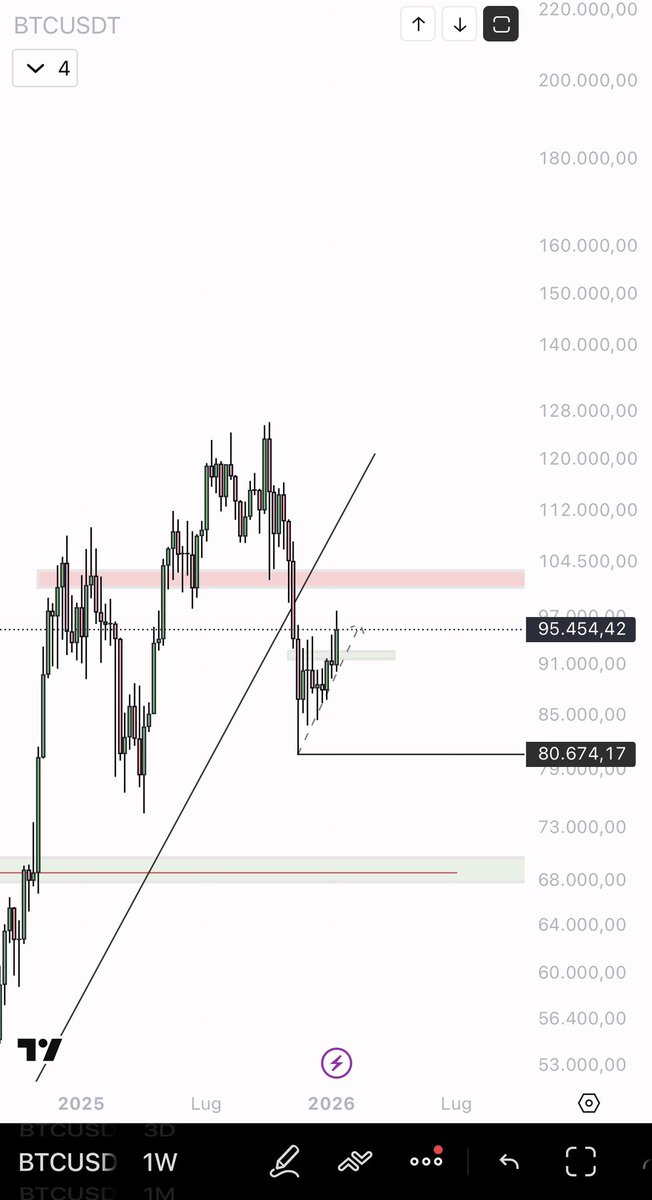
$BTC If we look at the macro picture, the reading is quite simple:
the red box remains the key resistance on the weekly chart. Until the price manages to break through it and, above all, consolidate above it, we cannot talk about a real bullish reversal. Everything else, for now, is just noise.
Below that zone, we are still trapped in this mega range that we know so well by now. A context that, in terms of direction, says nothing: neither real strength nor structural weakness. It is a market that should not be 'interpreted' but simply exploited.
That is why it makes sense to work it only on the lower timeframes — 15m, H1, H4 — where, with the right triggers, the price still gives you clear opportunities. Retests, false breaks, absorptions: you can move well there, but always from a tactical, not strategic, perspective.
At the macro level, therefore, I see nothing that would lead me to be particularly positive or negative. There is no signal that really makes a difference.
Simply put: as long as we remain below this level, the chart is useless for taking a medium- to long-term position. It is a chart for management, not conviction.
When we break that resistance on the weekly chart, then the situation will really change. Until then: calm, selection and no bias.
Technical analysis is the easy part
Most people who join my Discord can learn the technicals I use pretty quickly
After a few weeks a lot of them are just as good as me at technical analysis and reading price action
But your emotional control and psychology are the things that can make or break your trading
Technicals are the easy part, your mind is what most traders need to work on - and a lot of time that I spend with students is talking about this