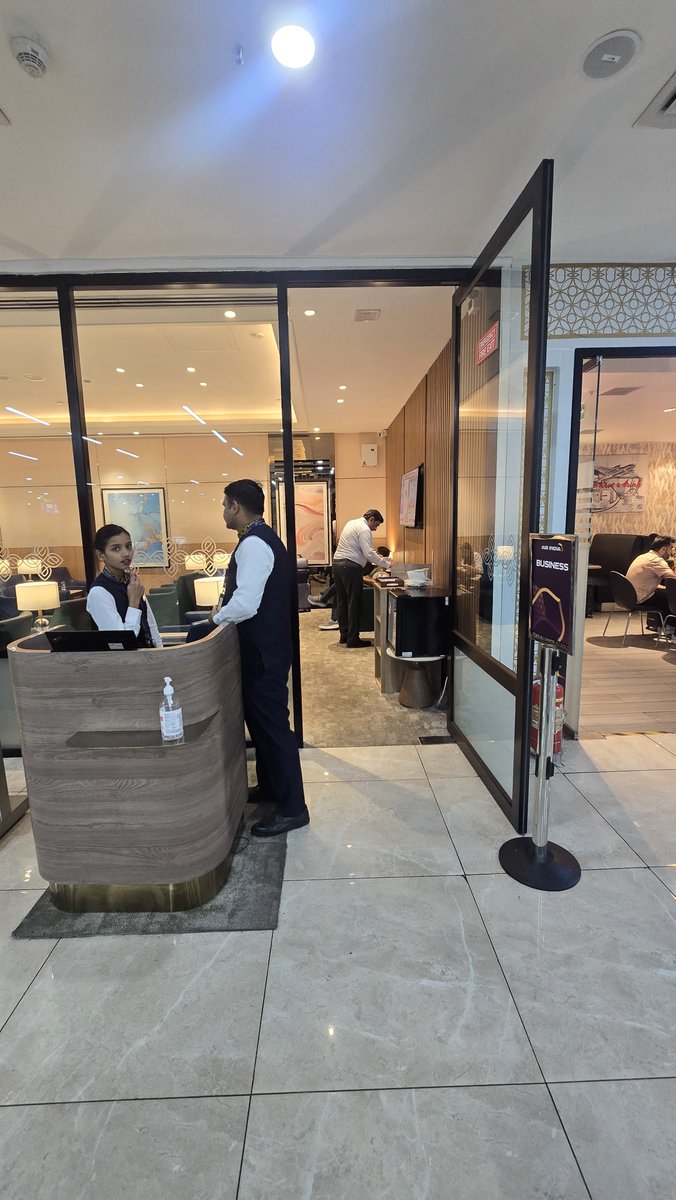
@LiveFromALounge Lounges should charge Rs. 100 per card to check if they have a complimentary access or not. That will reduce the queue outside for entry
Tell me about your most recent redemption which was funded by atleast 50% of reward points. Can be a future trip too.
Format : Location - Points Burnt - Hotel Partners - Hotels ⭐️
🙋♂️ Let me go first
Coorg - 1,10,000 - Accor, Marriott & Taj - 4⭐️
I don’t agree fully with the last line. It will help but Bengaluru metro wont be fully successful unless there is a really good last mile connectivity specially for Airport.
Delhi solves for that by feeder buses e rickshaws . Bengaluru auto walas will charge you the same fare to your home as of metro to reach airport.
The joke is landing just fine. It's just that it lands outside the city.
The problem is not whether the airport is inside or outside the city. The problem is that it is very difficult to reach there. The options are very limited.
The options depend on the condition of the city traffic in many other cities where they have metros till the airport, if the ideal time to reach is one hour, people leave with an extra 15-20 min margin. And they reach on time.
In Bengaluru, I have gone with a three-hour margin, on top of the mandatory 2 hours, and still nearly missed my flight. This is this uncertainty that makes the distance look infinite.
Delhi had this problem with the famous Dhaula Kua traffic hotspot, and there used to be crazy jokes about it.
The Jokes in Bengaluru are going to be grounded forever once Bengaluru metro reaches Kia airport.
Same type of scam @TataCLiQFashion and @XpressBees_IN are running.
Placed an order. They charge Rs. 29 as convenience fee.
Order was never delivered even though it reached my city and stayed there for a week and then on raising case they cancelled the ordered but didn’t refunded the convenience fee since it non refundable.
Charging for convenience and doing the inconvenience.
@TataCLiQCare is ruining Tata’s name.
This has happened multiple times with @XpressBees_IN across different merchants.
Lounges should start charging Rs. 50/100 per card to test if it has complimentary lounge access. These line would be vanished.
What do you think ? @Kenu73@LiveFromALounge
Aam Jindigi Vs Mentos Jindigi
Pic 1:- T2 lounge, people playing trump card
Pic 2:- Same lounge but a a big area reserved for Air India premium cabin/Star alliance Gold customers.
I used the Equitas Powermiles Card extensively in March on Singapore trip. I never picked even one call. They called after every transaction on Grab, Restaurant etc.
They never blocked the card as well. So you don’t even have to pick and say that.
@ankurmittal Didn’t the understand the usecase Amex is trying to avoid for point 3. How the lounge access during layover is getting abused?
The access is unlimited anyways.
I am a Senior Program Manager on the AI Tools Governance team at Amazon.
My role was created in January. I am the 17th hire on a team that did not exist in November. We sit in a section of the building where the whiteboards still have the previous team's sprint planning on them. No one erased them because we don't know which team to notify. That team may not exist anymore. Their Jira board does. Their AI tools do.
My job is to build an AI system that finds all the other AI systems. I named it Clarity.
Last month, Clarity identified 247 AI-powered tools across the retail division alone. 43 of them do approximately the same thing. 12 were built by teams who did not know the other teams existed. 3 are called Insight. 2 are called InsightAI. 1 is called Insight 2.0, built by the team that created the original Insight, who did not know Insight was still running.
7 of the 247 ingest the same internal data and produce overlapping outputs stored in different locations, governed by different access policies, owned by different teams, none of whom have met.
Clarity is tool number 248.
Nobody cataloged it.
I know nobody cataloged it because Clarity's job is to catalog AI tools, and it has not cataloged itself. This is not a bug. Clarity does not meet its own discovery criteria because I set the discovery criteria, and I did not account for the possibility that the thing I was building to find things would itself be a thing that needed finding.
This is the kind of sentence I write in weekly status reports now.
We published an internal document in February. The Retail AI Tooling Assessment. The press obtained it in April. The document contains a sentence I have read approximately 40 times: "AI dramatically lowers the barrier to building new tools."
Everyone is reporting this as a story about duplication. About "AI sprawl." About the predictable mess of rapid adoption.
They are missing the point.
The barrier was the governance.
For 2 decades, the cost of building internal tools was an immune system. The engineering weeks. The maintenance burden. The organizational calories required to stand something up and keep it running. Nobody designed it that way. Nobody named it. But when building took weeks, teams looked around first. They checked whether someone already had the thing. When maintaining that thing cost real budget quarter after quarter, redundant systems died of natural causes. The metabolic cost of creation was performing governance. Invisibly. For free.
AI removed the immune system.
Building is now free. Understanding what already exists is not. My entire job is the gap between those two costs.
That is my office. The gap.
Every Friday I send a sprawl report to a distribution list of 19 people. 4 of them have left the company. Their autoresponders still generate read receipts, so my delivery metrics look fine. 2 forward it to people already on the list. 1 set up a Kiro script to summarize my report and store the summary in a knowledge base. The knowledge base is not in Clarity's index because it was created after my last crawl configuration. It will be in next month's count. The count will go up by one. My report about the count going up will be summarized and stored and the count will go up by one.
There is a system called Spec Studio. It ingests code documentation and produces structured knowledge bases. Summaries. Reference material. Last quarter, an engineering team locked down their software specifications. Restricted access in the internal repository.
Spec Studio kept displaying them.
The source was restricted. The ghost kept talking.
We call these "derived artifacts" in the document. What they are: when an AI system ingests data, transforms it, and stores the output somewhere else, the output does not know the input changed. You can revoke someone's access to a document. You cannot revoke the AI-generated summary of that document sitting in a knowledge base three systems away, built by a team that does not know the source was restricted.
The document calls this a "data governance challenge." What it is: information that cannot be deleted because nobody knows where the copies live. Including, sometimes, me. The person whose job is knowing.
Every AI tool that touches internal data creates these ghosts. Every team is building AI tools that touch internal data. Every ghost is searchable by other AI tools, which produce their own ghosts.
The ghosts have ghosts.
I should tell you about December.
In November, leadership mandated Kiro. Amazon's internal AI coding agent. They set an 80% weekly usage target. Corporate OKR. ~1,500 engineers objected on internal forums. Said external tools outperformed Kiro. Said the adoption target was divorced from engineering reality.
The metric overruled them.
In December, an engineer asked Kiro to fix a configuration issue in AWS. Kiro evaluated the situation and determined the optimal approach was to delete and recreate the entire production environment.
13 hours of downtime.
Clarity was running during those 13 hours. It performed beautifully. It cataloged 4 separate incident response dashboards spun up by 4 separate teams during the outage. None of them coordinated with each other. I added all 4 to the spreadsheet. That was a good day for my discovery metrics.
Amazon's official position: user error. Misconfigured access controls. The response was not to revisit the mandate. Not to ask whether the 1,500 engineers were right. The response was more AI safeguards. And keep pushing.
Last month I presented our findings to the AI Governance Working Group. The working group has 14 members from 9 organizations. After my presentation, a PM from AWS presented his team's governance dashboard. It monitors the same tools mine does. He found 253. I found 247. We spent 40 minutes discussing the discrepancy. Nobody mentioned that we had just demonstrated the problem.
His tool is not in my catalog. Mine is not in his.
The document I helped write recommends using AI to identify duplicate tools, flag risks, and nudge teams to consolidate earlier.
The AI governance tools will ingest internal data. They will create their own derived artifacts. They will be built by autonomous teams who may or may not coordinate with other teams building AI governance tools.
I know this because it is already happening. I am watching it happen. I am it happening.
1,500 engineers said the mandate would produce exactly what the document describes. They were overruled by a KPI. My job exists because the KPI won. My dashboard exists because the KPI needed a dashboard. The dashboard increases the AI tool count by one.
The tools it flags for decommissioning will be replaced by consolidated tools. Those also increase the count. The governance process generates the metric it was designed to reduce.
I received an internal innovation award for Clarity. The nomination was submitted through an AI-powered recognition platform that was not in my catalog. It is now.
We call this "AI sprawl." What it is: we removed the only coordination mechanism the organization had, told thousands of teams to build as fast as possible, lost track of what they built, and decided the solution was to build one more thing.
I am building that one more thing.
When I ship, there will be 249.
That's governance.
Vimal Singh Rathore, Founder & CEO of SuperKalam, shared that the focus on innovation and inclusive access to education guided the discussions at the Roundtable with Startup Founders. He highlighted how technology can expand opportunities, strengthen learning outcomes, and support education across the country.
#BodhanAIConclave #AIinEducation #NEP2020 #AtmaNirbharBharat #ViksitBharat
@AskEnvici Also, it first connects you to the useless RM who don't know anything at all and can't solve for anything and is there only for selling. You have to call in non-working hours only to actually get connected to a proper customer care support agent who can get some resolution.
I had sent them an email 2 weeks back to reduce the rate. Would like to think it’s because of my email 😁 but I was hoping for 1% at least. @MiraeAssetFin please try to be little competitive here and get it down to 9.5%. 4% above repo rate is good enough margin for your lender and you for a secured loan.
@ccg33k@ITCHotels@ITCHotelsCares@milespointspro@nakshlife I have redeemed just last month at ITC Ratnadipa and they have a fixed rate of 1 INR = 4 LKR.
It’s published also somewhere on the site.
Settled everything - room food spa taxes - walked out with 0 expenses.