Claude now has its own built-in browser in Cowork.
When your task involves a website, a browser opens in Cowork's side panel, and Claude navigates, fills forms, and finishes the job.
Behavioral cloning mystery
https://t.co/VqxzvcfGSx
I wrote a new blog post about "mysteries" in behavioral cloning that appear with real-world robot data (e.g., overfitting is "good"). I also tried to demystify them and shared my thoughts!
Excited to share our paper, “Learning Multi-Agent Coordination via Sheaf-ADMM” to be presented at #ICML2026
Blog: https://t.co/F5CVepgivO
Most AI models process information as one giant, monolithic block. But in nature, intelligence often comes from a group of individuals working together, where each individual only has a limited view of the world.
We built a framework called Sheaf-ADMM to study how this kind of collective problem-solving works. We divide a complex task into smaller overlapping pieces, and assign one agent to each piece.
To solve the global puzzle, the agents negotiate in three simple steps:
1. Local Guesses: Every agent looks at its limited view and proposes a solution.
2. Finding Common Ground: Agents communicate with their direct neighbors to smooth out conflicts. They do not need to agree on everything, but they must agree on the boundaries where their tasks overlap.
3. Remembering Disagreements: If neighbors cannot agree, they keep a memory of that conflict. This memory forces them to try harder to compromise in the next round.
We tested this on problems where no single agent has enough information to succeed alone:
• Multi-Agent Sudoku: Each agent sees only a single row, column, or 3x3 box. The framework achieved a 93% solve rate, while a parameter-matched message-passing baseline scored 11%.
• Image Classification: When we tested canvas-size domain shifts, a standard CNN dropped to 11% accuracy on MNIST, while our method retained 86%.
• Maze Pathfinding: Sheaf-ADMM matches a message-passing baseline��s accuracy while agents communicate over a 5-dimensional channel, 8x smaller than that required of the baseline (42).
Traditional message-passing networks hide their reasoning inside opaque hidden states. Our framework makes coordination completely transparent. You can watch exactly how local agents debate, compromise, and eventually reach a global consensus.
Sheaf-ADMM draws inspiration from two fields with long histories in distributed consensus: ADMM from distributed optimization, and sheaves from applied topology. We think these perspectives may offer insights for the distributed, multi-agent AI systems increasingly being built today.
Read our full paper: https://t.co/RoOHfekjQE
Code: https://t.co/KDKZRcbuQH
"From AGI to ASI"
This paper from Google DeepMind defines how AGI is one human-level general system, and ASI is a system or collective that beats large expert human organizations across almost everything.
They argue that the jump may come from scaling, new paradigms, recursive self-improvement, or huge multi-agent AI collectives.
With the key idea that digital minds can copy, speed up, share memory, and run in parallel, so superintelligence may look less like one breakthrough and more like accelerating AI civilization.
📚❮AI 에이전트 개발과 운영 올인원 가이드❯
단편적인 기능 매뉴얼 대신, 전체 시스템 흐름 안에서 LangGraph 기반 에이전트를 설계하는 법을 다룹니다. 개발에서 끝나지 않고, 프로덕션 운영·평가·개선까지 아우르는 구성이 특징
🎁 도서 증정 이벤트
∙ 리포스트 + 팔로우
∙ 3명 | ~2026년 6월 21일
�� 주요 내용
🔸LangGraph 워크플로, 멀티 에이전트, Human-in-the-Loop 등 13개 실습 프로젝트
🔸추론형 에이전트, MCP 등 최신 에이전트 구현 방법
🔸Langfuse 기반 LLMOps — 트레이싱·평가·지속적 개선
🔸Amazon Bedrock을 활용한 AWS 클라우드 환경 구축
🔸번역서 기준 예제 코드 Claude 4.6으로 업데이트 반영
👉 https://t.co/7Iu4KspcoO
내가 본 그의 가장 큰 잘못된 점: 상담받으러 온 사람 자체가 어떤 매력을 가졌는지 1도 고려 안하고 무시하고 자신만의 정답을 강요함
카톡 내용에서도 무시하는 발언이 다분함
난 자소서는 자신만의 매력을 보여줄 수 있는 스토리텔링이 중요하다 생각하고 그건 남의 말을 그대로 수용해서 될 게 아님
정답을 강요하면 그 사람은 정답이 있다는 틀에 갇혀서 자신의 강점을 자연스레 잃어버리게 됨
정답을 알려주는 게 아니라 함께 의논하고 본인이 직접 선택하는 방식으로 작성해나가는 게 맞다고 봄
난 그 사람이 남 무시하고 자기 말이 정답이라는 식으로 단정짓는 그 화법이 가장 싫었음
와 나 그분 트윗구경갔는데
취약계층 사회에 공헌 어쩌고 뭐시기했으면서
지 지인이랑은 상담자분
>계속 정병 발사하고 국취제 안 된다고 징징<
>그래서 상담 좀 해주다가 너무 노답이라<
고 이야기하고있었네
본인 비하하는 트윗은 못참으시면서
본인만 믿고 실드쳐주고 이용까지한사람한테 할말인가
Those are orthogonal concepts.
- World models trained on highly diverse data become foundation models: their encoders can be used for a wide variety of downstream tasks.
- "World" refers to two things: (1) predicting the evolution of a complex system or environment, (2) predicting the evolution of a system under control and its effect on the environment (action-conditioned world model) which is a necessary component of planning.
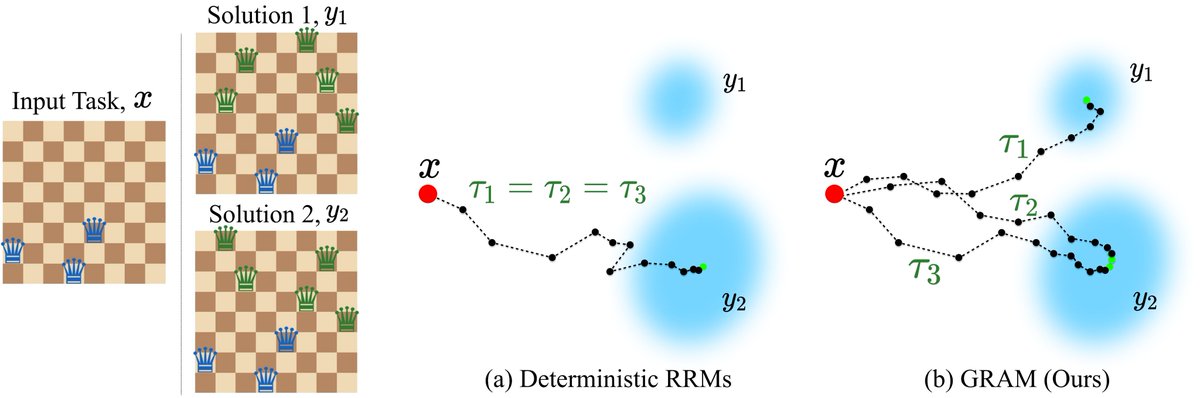
Generative Recursive Reasoning: a new probabilistic framework for AI reasoning. This enables AI to explore possible solutions, not just think longer.
> Beats Sudoku & ARC-AGI baselines
> Samples many latent paths in parallel
> Scales via depth + width
https://t.co/U1Iuc64yZZ