Statement from Reliance Industries
In light of recent remarks about Reliance and the Indian market, we wish to place the facts on record.
Like every Indian enterprise, Reliance has grown in an India that welcomes investment and innovation, homegrown or international, that improve the lives of the people.
That openness rests on the rule of law. As the Government of India has stated, it applies the same process to every applicant, Indian or foreign. Jio's own satellite services await clearances.
At Reliance, we have never feared competition. We see it as the truest test of who serves the customer best. Jio itself entered India's crowded telecom market in 2016 as the newest player, with not a single customer. In just ten years, Jio has earned the trust of over 530 million customers and given Indians some of the best digital infrastructure and most affordable data in the world.
We welcome competition in satellite communications, including Starlink. Every player, Jio included, must serve the people of India and abide by the laws and policies of the land.
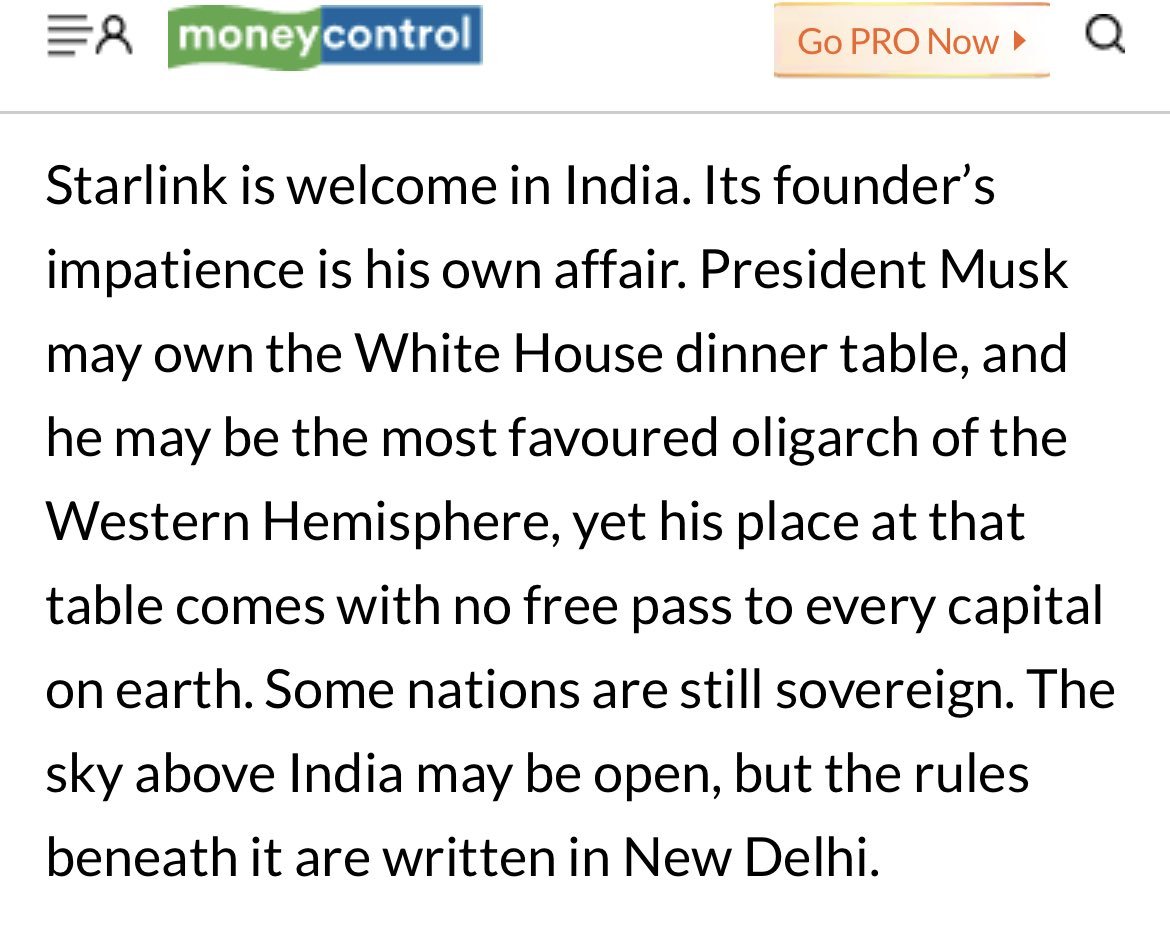
Watching Elon Musk this week has been a fascinating character study in the saviour complex of Western tech billionaires.
They arrive in your country selling you the future. Welcome them, and you’re a country that wants progress. Make them wait, and suddenly your people are victims who need rescuing from their own institutions by the chosen one.
It’s a pattern. When Thai rescuers didn’t use the mini-submarine Musk sent for the trapped boys, and diver Vernon Unsworth called the idea impractical, Musk attacked him as the “pedo guy.”
When Brazil’s Supreme Court ordered X to comply with its rulings, Musk called the judge a “dictator.”
The script rarely changes. Only the country does.
The colonial mindset isn’t always about wanting to rule a country. Sometimes it’s the assumption that you arrive as its saviour, and if the country doesn’t immediately recognise you as one, something must be wrong with the country.
Mr. Musk, yes, no billionaire should dictate a nation’s policy - Indian or American.
India must welcome competition in satellite internet, from Indian and global providers, whoever offers the most practical and affordable last-mile solution for those in remote regions. In countries with lower per-capita incomes, satellite internet must be affordable too. High subscription fees and equipment costs risk putting it beyond the reach of ordinary households. Connectivity must bridge the digital divide, not create a new one.
India knows our networks and spectrum are strategic infrastructure, not merely commercial assets. India’s national security safeguards are non-negotiable.
Every country makes choices based on its own interests. Those in the West cannot preach free markets while practicing protectionism at home. USA imposed 100% tariffs on Chinese EVs to protect its domestic industry, just as India takes measures to protect its own domestic manufacturers. Both India and the US have restricted Huawei over security concerns. One cannot demand a level playing field from others only when it suits its own agenda.
Indians will internally debate, question and address our strengths and shortcomings as a democratic country.
Take BharatNet, India’s programme to bring broadband to village-level local bodies. We will question why, as the CAG’s 2026 audit report found, the programme is struggling to meet its original objectives. Why were only 33.2% of service-ready Gram Panchayats operational, despite ₹39,888 crore being spent? At the same time, we know to appreciate our telecom sector and regulations, which has made internet data among the world’s most affordable, bringing millions online.
India is a democracy, not a colony. We welcome the world, but we, the Indian people, will decide our own future - not Western vested interests, their double standards or any billionaire - Indian or American.
Iran's FM Araghchi quotes Putin during his Moscow visit: 'The whole world is admiring Iranian resistance'.
✲ What was said: During Iran's FM Abbas Araghchi's diplomatic blitz of a 3-nation tour of multi-track diplomacy, his visit to Moscow on 27 Apr 2026, 👇🏻