@amerix I think it makes a lot of sense.
Someone said this:
“once your kids no longer depend on you for food and survival you are left with the relationship that you cultivated or lack thereof.”
Two Anthropic engineers spent 24 minutes exposing every Claude Code feature you didn't know existed.
Most people will scroll past this. Don't be most people.
Odious Debt case comes up tomorrow, 28 April 2026 at 11:00 a.m. before a three judge bench at Milimani High Court, Courtroom 31.
This case goes to the core of accountability in public borrowing.
Join virtually: https://t.co/HpbZDPn70G
#DeniBandia#OdiousDebt
System Design Series - Day 8/30
API Gateway Patterns – The Front Door of Your Microservices
API Gateway is the single entry point for all your clients.
Without it:
- Mobile/web clients call 10+ different services directly
- Authentication is duplicated everywhere
- Rate limiting, CORS, logging → repeated in every service
- Services are fully exposed to the internet
With it:
- One clean URL for clients
- Centralized auth, rate limiting, routing, aggregation
- Backend services stay hidden and secure
Here’s everything you need to know about API Gateway patterns.
What is an API Gateway?
Think of it as the hotel front desk
Without a front desk:
- Guests wander around looking for rooms
- No security check
- Housekeeping and room service have no coordination
With a front desk:
- Single check-in point
- Routes guests to correct room
- Handles security, coordination, and requests
API Gateway does exactly that for your microservices.
The Problem It Solves
Before API Gateway:
Mobile app needs user profile + orders:
→ Calls User Service directly
→ Calls Order Service directly
→ Calls Payment Service directly
Problems:
- Client knows internal service URLs
- Multiple network calls (slow on mobile)
- Auth tokens sent to every service
- No centralized rate limiting or logging
- Services exposed to the internet
After API Gateway:
Mobile app calls one URL:
https://api.example. com/profile
Gateway handles everything internally:
- Authenticates once
- Routes and aggregates calls
- Returns combined response
Benefits:
- 1 network call from client
- Services completely hidden (security win)
- Centralized cross-cutting concerns
- Much better client experience
Core Responsibilities:
1. Routing
Maps external URLs to internal services
GET /api/users → User Service
GET /api/orders → Order Service
2. Authentication & Authorization
Validates JWT/OAuth once at the gateway.
Services trust the gateway.
3. Rate Limiting
Prevents abuse (e.g., 100 requests/min per user).
4. Request Aggregation
Combines multiple backend calls into one response for the client.
5. Protocol Translation
Client uses REST → Service uses gRPC (handled at gateway).
Advanced Patterns
- Circuit Breaker → Prevents cascading failures when a service is down
- Request/Response Transformation → Convert old → new API formats
- Caching → Cache frequent responses at the gateway level
- Logging & Monitoring → Centralized observability
When to Use API Gateway
Use it when:
- You have multiple microservices
- External clients (mobile, web, third-party)
- You need centralized auth, rate limiting, or aggregation
Don’t use it when:
- Simple monolith (overkill)
- Only internal service-to-service communication
- Ultra-low latency is critical (extra hop)
Popular Solutions
- Kong (open-source, powerful plugins)
- AWS API Gateway (managed, serverless)
- NGINX + Lua (DIY, lightweight)
- Traefik, Envoy, KrakenD
Summary
API Gateway is not just a proxy.
It is the security layer, traffic manager, and aggregator for your entire backend.
It simplifies client code, hides internal complexity, and centralizes cross-cutting concerns.
Trade-offs:
- Extra network hop (adds latency)
- Becomes a critical component (make it highly available)
Used correctly, it’s one of the most valuable pieces in any microservices architecture.
Tomorrow (Day 9): Inter-Service Communication Patterns
Questions about API Gateway?
Drop them below 👇
#SystemDesign #APIGateway #Microservices #Backend
@LarryMadowo If you read this law 5. Morocco can go and get the trophy if they can!!! Senegal won!! Sadio Mane did everything and should not be in vain.
The first thing many of us do when we arrive somewhere is connect to Wi-Fi — airports, cafés, offices, lounges. But here’s the reality: Wi-Fi can be faked.
With just a phone, cybercriminals can clone a network, force your device to disconnect from the real one, and redirect you to a fake login page that captures your personal details.
Public Wi-Fi isn’t always what it seems. ✔️ Verify network names ✔️ Avoid duplicate hotspots ✔️ Be cautious with “free” Wi-Fi
Awareness is your first layer of security. #CyberSecurity #DigitalSafety #PublicWiFi #TechAwareness #InfoSec
@BcKulei@CaptKigen You're making a lot of assumptions! What makes you think he wants to stay in Australia for good?! Maybe that's his retirement home?! Most diasporans plan to come back home at some point. Mambo ni mengi.
Out of the Ksh 13T debt, only Ksh 6.9T can be traced from the treasury records.
Ksh 6.1T is invisible, undocumented and untraceable.
Where is that money and what was the money used for?
By July 2023, taxpayers had paid Ksh 8.8T.
That means Kenyans have no debts and have even paid in excess.
The debt register must be opened. Public debts must be audited.
We cannot be overtaxed to service the lavish lifestyles of crooks in government.
#AuditPublicDebts #OpenDebtRegister #RutoMustGoNow #DrainTheSwamp
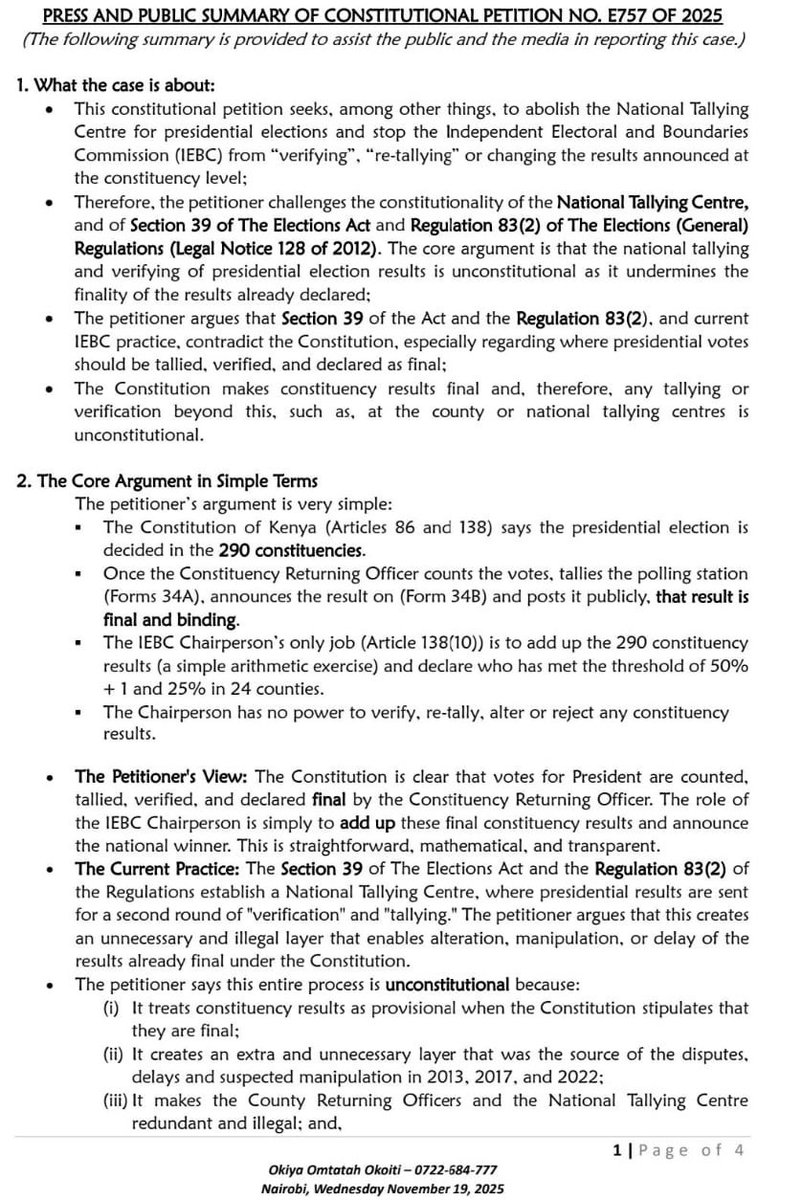
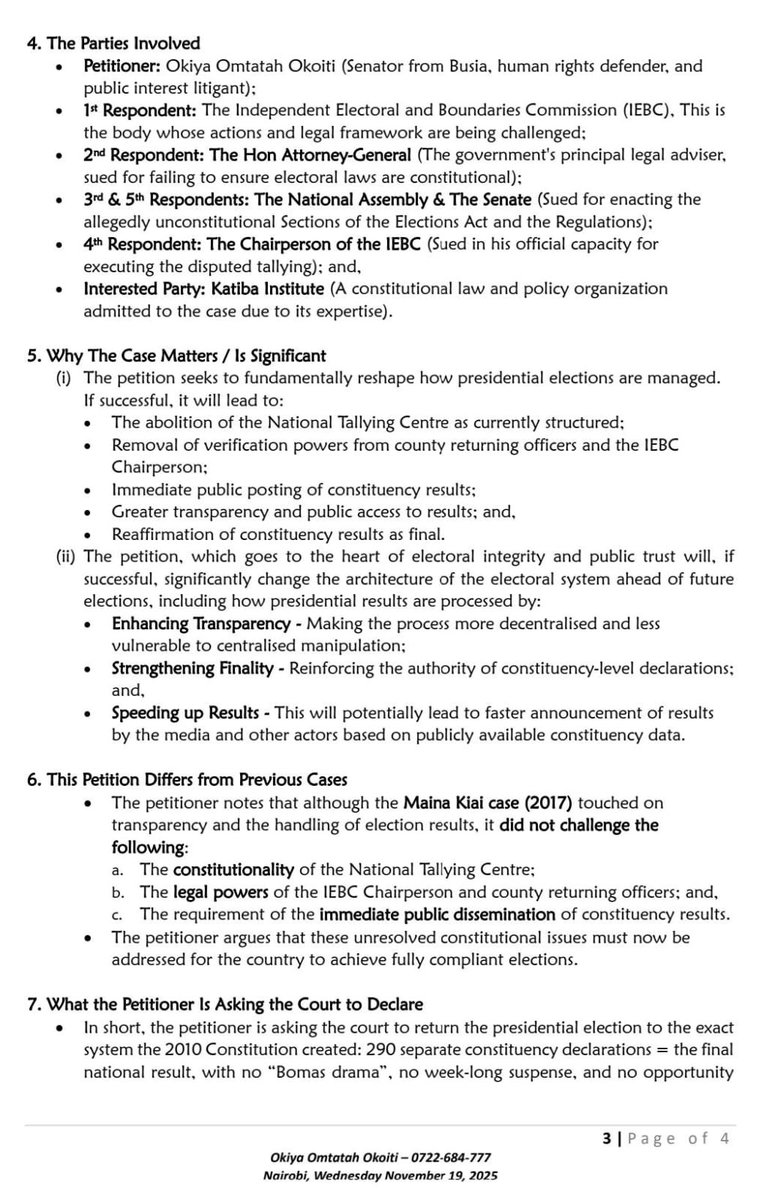
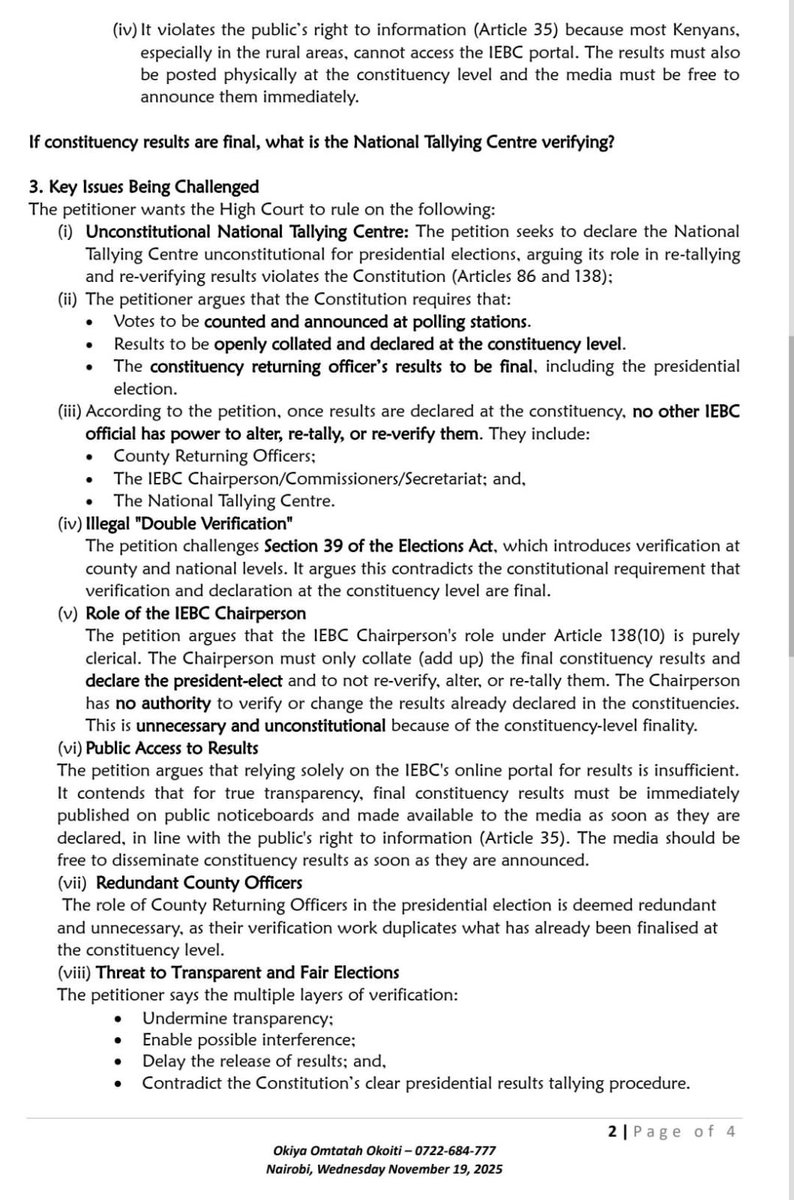
I have filed a Constitutional Petition No. E757 of 2025 in the High Court to defend the integrity of Kenya’s presidential election process and to uphold the Constitution of Kenya, 2010.
This petition challenges the unconstitutional establishment and operation of the National Tallying Centre during presidential elections, as well as Sections 39, 39(1C), 39(1G) of the Elections Act and Regulation 83(2) of the Elections (General) Regulations.
The Constitution is clear:
✔️ Presidential results are tallied, verified, and declared at the 290 constituencies, and those results are final and binding.
✔️ The role of the @IEBCKenya Chairperson under Article 138(10) is strictly clerical; to add up constituency results and declare the winner.
❌ The Chairperson cannot verify, re-tally, alter, or overturn any constituency result.
❌ No law or regulation may introduce a second layer of verification at county or national level.
Yet, current laws and @IEBCKenya practice unlawfully create a parallel system of verification at the National Tallying Centre, which:
• Treats final constituency results as provisional;
• Enables interference, manipulation, and delays;
• Undermines transparency and fuels mistrust;
• Violates the people’s sovereign will as expressed at the constituency level.
This petition seeks, among other declarations:
🔹 Abolition of the National Tallying Centre as currently constituted;
🔹 Quashing of unconstitutional provisions in the Elections Act and Regulations;
🔹 Immediate public posting of final constituency results at each constituency;
🔹 Removal of illegal verification powers from County Returning Officers and the IEBC Chairperson;
🔹 Restoration of strict compliance with Articles 86 and 138 of the Constitution.
If successful, this petition will fundamentally transform the management of presidential elections from 2027 onwards, ensuring a transparent, decentralised, and constitutionally faithful process with no “Bomas drama” and no ambiguity.
Our democracy must be anchored not on improvised systems, but on the letter and spirit of our Constitution. This petition is part of my continued commitment to defend the rule of law, protect the sovereign will of the people, and secure free, fair, and credible elections.