The reason anyone gets insanely rich is almost always because of the stock market. It certainly how @elonmusk did.
And the reason they get rich from the stock market, is because 150m Americans decided they wanted to own shares of stocks directly, or through their retirement plans, or through other approaches as a way of building their net worth and trying to create a better life for themselves.
One Hundred Fifty Million Americans. About 60% of adults.
Effectively believing that @elonmusk and many billionaires could make them wealthier and help them achieve a better life.
If you want @elonmusk , and most billionaires to no longer be that rich, convince those 150m to sell their stocks, funds, ETFs whatever.
Of course you would wipe out the net-worth of most of those people, and everyone else’s savings, as the markets crashed and brought down the economy and created the worst depression we have ever seen.
Alternatively
There are ways to improve healthcare access and eventually make it available to all.
To start -
If you want @elonmusk and all billionaires to improve healthcare for everyone , ask them to stop doing business with the enormous healthcare conglomerates and to work directly with transparently priced care providers.
It’s the behemoth HC conglomerates that make HC so bad for so many. (Check my timeline for more detail)
Removing them would push the cost of healthcare down for everyone. Their corporate decisions impact our healthcare cost and availability.
Of course if they do that, not only would our HC costs go down , and the quality of care for their employees and the entire country go up
But
They would see their corporate cash flow increase dramatically and we would have more millionaires, billionaires and maybe even another trillionaire when that cash flow moved from the big health care conglomerates to their bottom line, so would the net worth of the 150 million American adults that own public stocks
Capitalism is better than socialism because 150m Americans can influence exactly what happens in this country.
Whitney Cummings went full honesty mode on Joe Rogan: “I was as liberal as it gets, blue hair, rescue pitbulls, the whole thing. But the hypocrisy finally broke me.”
She saw “diversity” become diversity of everything except thought. “My body, my choice”… until it wasn’t. Climate alarmism while living on the coast. The contradictions piled up, and as a comic wired to spot bullshit, she couldn’t ignore them anymore.
When any side stops tolerating questions and starts enforcing agreement, it stops being about truth and starts becoming a tribe. That shift affects culture, comedy, and all of us.
I respect anyone brave enough to walk away from the script when it no longer makes sense. Whitney’s story feels like a lot of people’s quiet journey these days.
What’s one hypocrisy or contradiction that made you start questioning your old beliefs?
As a lifelong, taxpaying New Yorker, I am extremely worried about the ramifications of the estate tax proposal on New Yorkers if it gets signed into law. I want to be clear up front; this isn't about politics for me. I'm not fighting for the billionaire class, and I'm certainly not one of them. What I am is someone who understands basic math, economics, and business, who has watched what happens when states push tax policy past the breaking point.
Here's what's on the table right now: a proposal to reduce New York’s estate tax exemption from $7.1 million down to $750,000, an 89% cut while increasing the top rate from 16% all the way to 50%. This is embedded within a batch of revenue ideas sent up to Albany to try and plug a $5.4 billion hole in the city budget.
I want to discuss who this estate tax actually hits, because it’s certainly not the ultra-rich. The ultra-rich weren’t exempt as only the first $7.1 million avoided estate taxes. A $750,000 threshold in the New York metro area is not reasonable. The median home price in New York City hit roughly $809,000. In Nassau County you're looking at $820,000. Suffolk County sits around $675,000. Westchester is $754,000. If you bought a house in the city, Nassau, or Westchester and you spent 30 years paying off that mortgage like a responsible adult, congratulations, you're now above the estate tax threshold. What’s even better is that you hit the threshold before even factoring in your 401k, life insurance, savings, a family business, or other investments.
This isn't a tax on the wealthy it’s a tax on a retired couple in Bayside who paid off their split-level. It's a tax on the family that runs a deli in Astoria and owns the building. When you force those families to come up with 50% of the value above $750,000 after someone dies, what do you think happens? They sell. They liquidate. The house goes, the business goes, and the generational wealth that took a lifetime to build disappears in a single tax event. Family businesses which are the backbone of employment in neighborhoods all over this city get gutted.
According to the State Department of Taxation and Finance's own numbers New York's tax structure is incredibly top heavy as millionaires paid 44.6% of all personal income tax collected in 2024. The top 200,000 filers covered 51.9%. The bottom half of all earners paid 0.2%. Think about how fragile that makes us. You don't need a mass exodus. You need a few thousand people to change their mailing address to Palm Beach or Austin and the budget math falls apart.
Here's the part that really gets me though. The biggest victims of "tax the rich" policies aren't the rich. The rich utilize their resources and leave once they have had enough because their resources make them mobile. The people who get crushed are the ones who stay such as teachers, firefighters, nurses, and the small business owner. They can’t simply pick up and go. The harsh reality is that when the wealthy leave and the tax base shrinks, the city still needs the same amount of money to run the subways, pay the cops and keep the lights on. So where does it come from? It comes from everyone left behind as they are forced to pay higher taxes, and higher fees.
What may bother me more is the double taxation piece. The money in someone's estate didn't just appear from thin air. They earned it and paid income tax. They invested it and paid capital gains. They bought property with it and paid property taxes every single year. They bought things and paid sales tax. Every dollar in that estate has already been taxed multiple times over the course of a lifetime. Now when they die the state wants to take half of everything above $750,000? At what point does it stop being a tax and start being confiscation? That's a genuine question I have because if you work your whole life, play by every rule, pay every tax along the way, and the government still takes half when you die what exactly was the point of saving any of it?
A $750,000 threshold doesn't catch billionaires it catches the middle class. It catches people who were never wealthy, they were just disciplined. They bought a house, they didn't sell it, they put money away for retirement, and they wanted to leave something for their kids. Punishing that with a 50% tax rate sends a very specific message: the state believes your assets belong to it first and your family second. I don't care where you fall politically that should bother you.
I'll say this very simply. When you tax people to the point where they feel targeted, they leave. When they leave the burden falls on everyone who can't. When that burden gets heavy enough, more people figure out a way to go. That's not theory, that's exactly what IRS data and Census numbers have been showing us for half a decade straight.
New York is standing at a fork in the road right now. One direction is more punitive taxation with an increasing dependence on a shrinking pool of high earners who increasingly have one foot out the door. The other direction is putting forward competitive tax policy, fiscal discipline, and creating an environment where building wealth and creating jobs isn't treated like something the government needs to punish. I know which path leads somewhere good. I just hope the people making the decisions figure it out before there's nobody left to tax.
@amitisinvesting@BillAckman@chamath@patrickbetdavid@PBDsPodcast
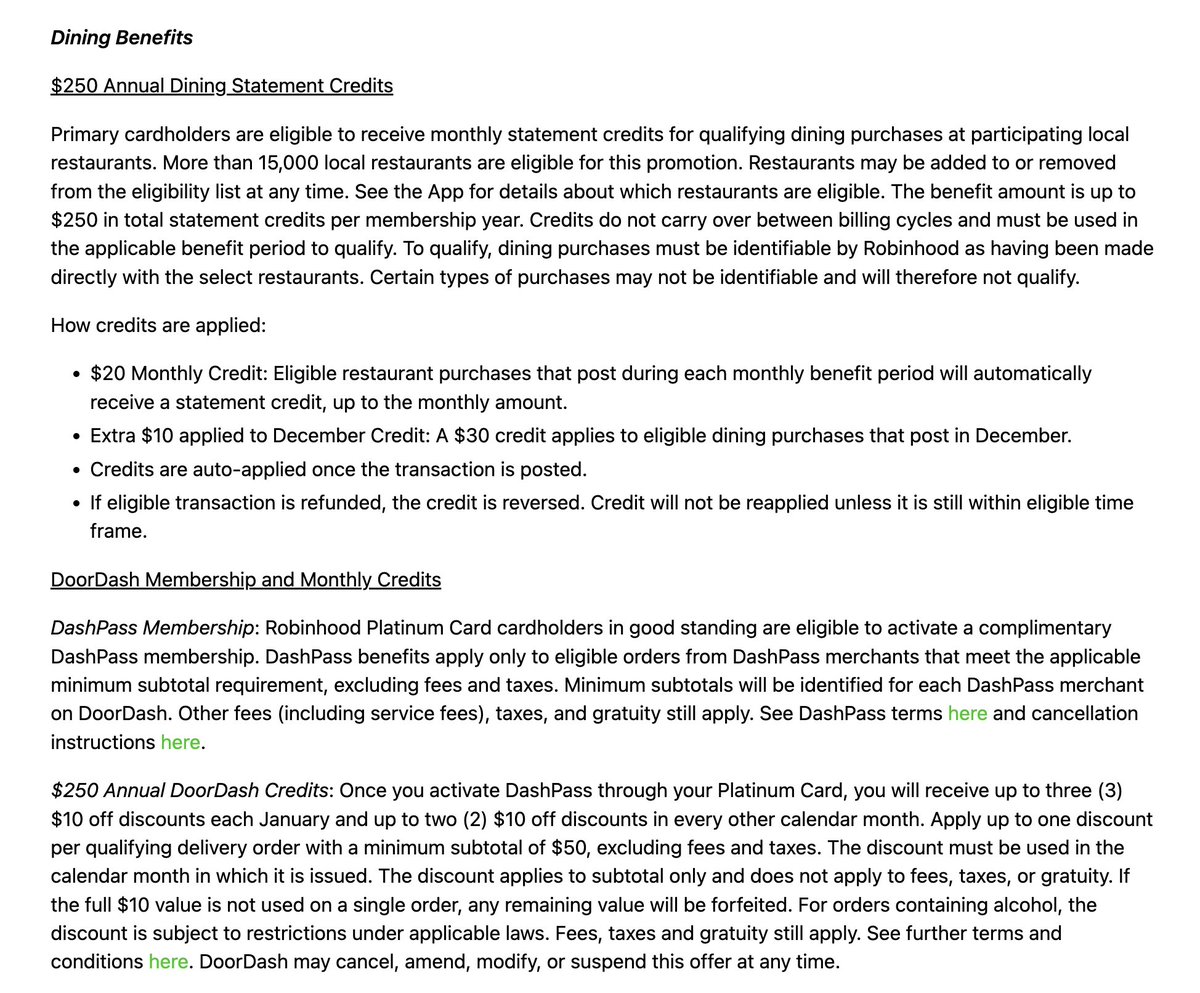
Yikes. Robinhood says their new Platinum Card has "$3,000+ in benefits."
I was so excited until i read the actual fine print. Here's what they're not telling you:
- The $250 DoorDash credit:
It's $10 off per order with a $50 minimum. You need to place 25 separate $50+ orders in a year to use it all. Miss a month, it's gone.
- The Function Health membership
You get a $365 credit. If you're in NY, the membership costs ~$615. You're covering the difference. And if you live in Hawaii or Rhode Island, you're excluded entirely.
- The Oura perk
Only applies if you buy a brand new Oura Ring within 6 months. Already own one? You get nothing. And the credit is $70, just the membership, not the ring.
- The dining credit
Capped at $20/month at restaurants Robinhood chooses. They can change the list whenever they want.
- The hotel credit
Only $100 of each $250 semi-annual credit can go toward standard hotels. The rest must be "Luxury" And Robinhood's portal is more expensive than direct.
- As a New Yorker the $250 autonomous rides credit is useless
For $695/year it's still deal for some, just make sure to read the fine print
Back before ESPN went to garbage, we had SportsCenter in its purest form.
No fluff, no filler, no viral debates. Just. Highlights.
Its why Millenials are the peak of ball knowledge. We’d get up early to rip this the hour before school and be READY.